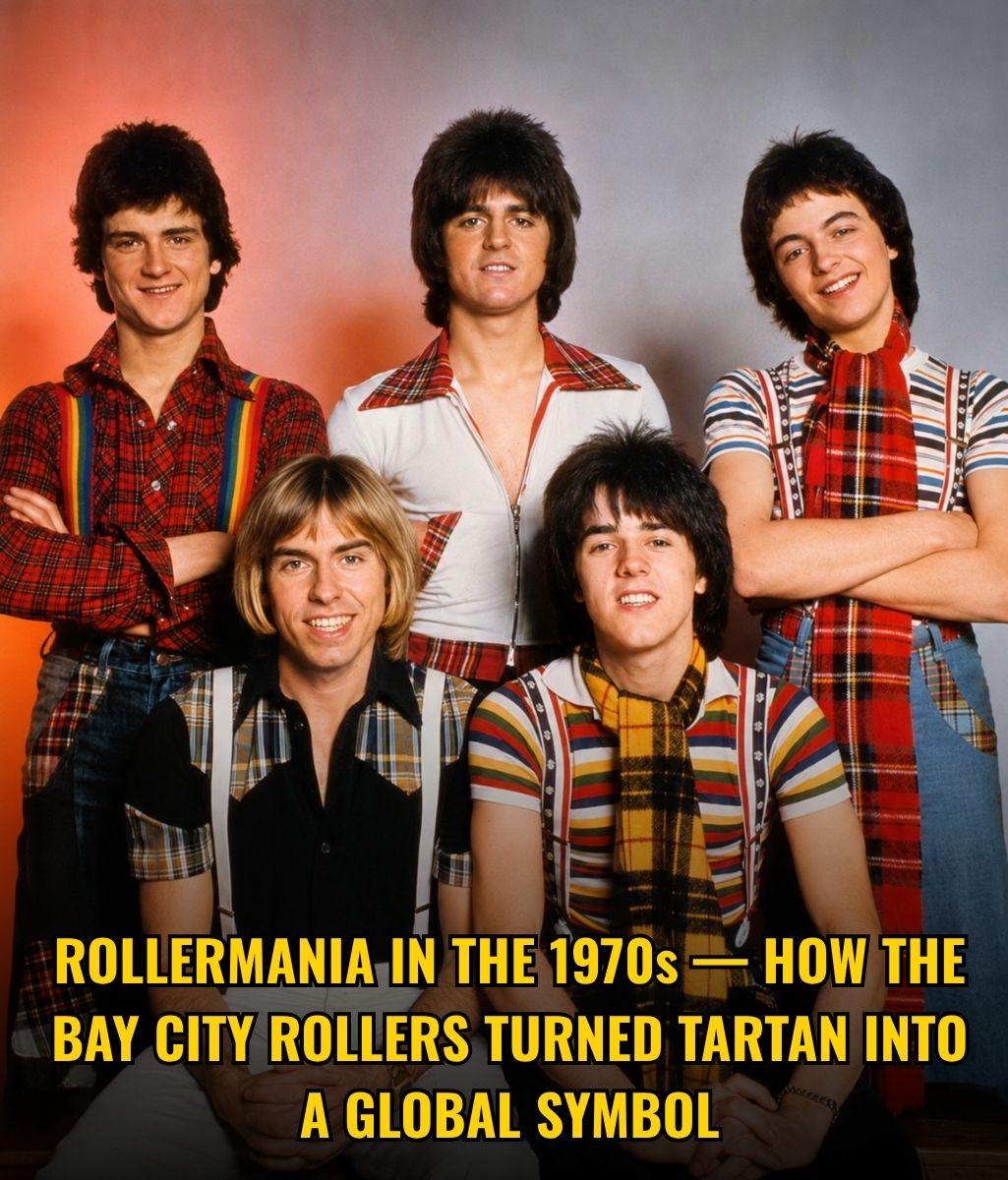
Long before social media could turn an outfit into a worldwide trend overnight, five young men from Scotland managed to make an old pattern suddenly feel like the most exciting thing a teenager could wear.
During the height of Bay City Rollers mania in the mid-1970s, tartan was no longer simply associated with Scottish tradition. It appeared on trousers, scarves, jackets, socks and homemade fan outfits from Britain to Japan and North America, becoming one of the most instantly recognizable visual symbols in pop music.
The phenomenon became known as Rollermania, and for a brief but extraordinary period, it seemed as though the Bay City Rollers really were turning the whole world tartan.
The transformation happened alongside the group’s rapid rise to fame.
After “Remember (Sha-La-La-La)” became a major British hit in 1974, the Rollers followed it with songs including “Shang-A-Lang,” “Summerlove Sensation” and “All of Me Loves All of You.” Their popularity accelerated so quickly that newspapers began comparing the hysteria surrounding them to Beatlemania. By 1975, “Bye Bye Baby” had spent six weeks at No. 1 in Britain, followed by another chart-topper, “Give a Little Love.”
The songs were only part of the attraction.
The Rollers had developed a look that young fans could copy easily. Their stage clothes combined cropped trousers, tartan cuffs, scarves, waistcoats, striped socks and youthful hairstyles that made them look less distant than many glamorous rock stars of the period.
According to later accounts, guitarist Eric Faulkner helped develop the idea of replacing existing checked patterns in their clothes with tartan. Once the group adopted the look more fully, fans began creating their own versions at home.
That accessibility was crucial.
A teenager did not need an expensive designer wardrobe to look like part of Rollermania. A strip of tartan sewn onto a pair of jeans, a scarf tied around the neck or a homemade badge could immediately identify someone as a Roller fan.
Soon the audience itself became part of the spectacle.
Concert photographs from the period show rows of young fans wearing tartan scarves and clothing while holding banners and screaming toward the stage. Newspapers sometimes referred to them as the “Tartan Army,” long before that phrase became so strongly associated with Scottish football supporters.
For Stuart “Woody” Wood, the scale of the craze became clearest when the group traveled overseas.
He later recalled performing at Tokyo’s famous Budokan, where thousands of Japanese fans appeared dressed in tartan. Looking from the stage, Woody remembered seeing what seemed like waves of the pattern stretching through the arena, joking that the sight almost made the band “tartansick.”
That image showed how far Rollermania had travelled.
Tartan had deep connections to Scottish history and identity, but the Bay City Rollers had transformed it into something new: a youthful international pop symbol. Academic studies of Scottish identity have even pointed to the group as one of the major examples of tartan being reimagined and carried onto a global cultural stage during the 1970s.
The timing also helped.
Britain in the mid-1970s was experiencing economic uncertainty, strikes and power cuts. Against that grey backdrop, the Bay City Rollers offered something deliberately uncomplicated. Their songs were catchy, optimistic and easy to sing, while their clothes were bright enough to make an audience instantly recognizable.
Woody later reflected that the band arrived at a moment when people needed that kind of escape. Their music was not designed to carry heavy political messages. It was about love, excitement and having a good time, which made the Rollers an appealing contrast to the anxiety surrounding everyday life.
By 1975, Rollermania had spread well beyond Britain.
“Saturday Night” helped break the group in the United States and eventually reached No. 1 on the Billboard Hot 100, while the band also developed enormous followings in Canada, Australia and Japan.
Where the Rollers went, tartan followed.
Fans decorated bedrooms with tartan, wore Roller-inspired trousers and scarves, collected magazines and posters, and treated clothing as a way of declaring membership in a worldwide community.
For many women who experienced the craze as teenagers, those patterns still trigger immediate memories decades later. The Guardian once observed that even years afterward, fans of a certain generation could become nostalgic simply at the mention of the Rollers’ tartan trousers.
That may ultimately be one of the most unusual parts of the Bay City Rollers legacy.
Many pop groups leave behind recognizable songs.
Far fewer leave behind a visual pattern.
The Bay City Rollers turned tartan into more than stage clothing. For millions of fans, it became a symbol of youth, friendship, first concerts and the excitement of belonging to something enormous. Rollermania eventually faded, but even half a century later, a flash of red tartan can still transport an entire generation back to the moment when five young Scots seemed determined to turn the whole world tartan.