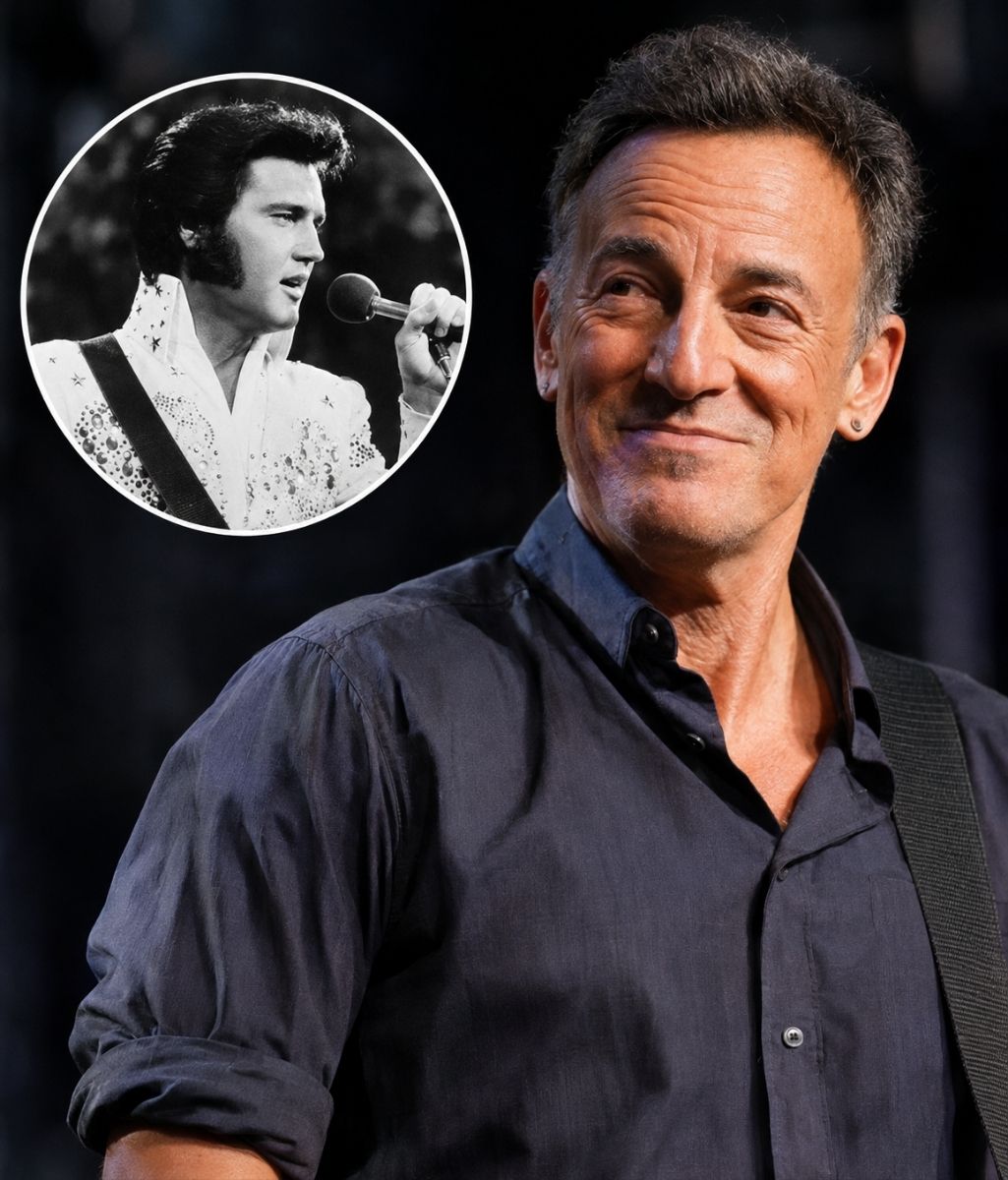
Long before Bruce Springsteen became one of the most celebrated performers in American rock music, he was simply a young boy sitting in front of a television in Freehold, New Jersey.
Then Elvis Presley appeared on the screen.
Springsteen has returned to that memory many times over the years because, in his telling, it was not merely the evening he discovered a new singer. It was the moment he first understood that music might offer a completely different way to live.
The year was 1956, and Elvis was appearing on The Ed Sullivan Show during the period when his performances were becoming a national sensation. Millions of families watched as a young singer from Memphis brought an energy, style and physical freedom into American living rooms that felt completely unlike the entertainment that had come before him.
For the young Springsteen, the effect was immediate.
Years later, he described Elvis as almost larger than life, a figure who seemed capable of breaking through the limitations of ordinary existence. He remembered being fascinated not only by the music, but by the idea that someone could create an entirely new version of himself through imagination, confidence and performance.
Springsteen later said that after watching Elvis, he went to a mirror and began moving around as though he were performing himself.
Then he grabbed a broom.
Holding it like a guitar, he began pretending to play along.
That was when he turned to his mother, Adele Springsteen, and made the request that would become part of his own musical mythology.
He wanted a guitar.
In a later conversation with Barack Obama, Springsteen remembered telling his mother that he wanted the kind of guitar he had just seen Elvis holding. His mother responded by getting him one, although that first instrument was rented rather than purchased.
The young Bruce quickly discovered something important.
A real guitar was much harder to play than a broom.
He later joked that he had the instrument for only a short period before realizing that making music required actual work and practice. At that age, he was not ready to make the commitment, and the guitar temporarily disappeared from his life.
The idea, however, did not disappear.
Elvis had already planted something that remained with him.
Springsteen later described that television appearance as his personal musical “Big Bang,” because Elvis showed him that a person did not necessarily have to remain defined by where they came from, how they looked or what other people expected them to become.
That lesson mattered deeply to a boy growing up in a working-class household in New Jersey.
Springsteen’s family life was complicated, and he has often spoken about feeling isolated and uncertain during childhood. Elvis represented something entirely different. He seemed fearless, unconventional and capable of transforming himself in front of the entire country.
For Bruce, that transformation suggested freedom.
Music would eventually return to his life with much greater force several years later.
When the Beatles arrived in America in the early 1960s, Springsteen was older and ready to take the guitar seriously. He began practicing obsessively, joined local bands and slowly developed the sound and stage presence that would eventually make him famous.
Yet Elvis remained the beginning.
Springsteen’s admiration became so strong that years later, after he himself had become a rising star, he traveled to Graceland and famously climbed over the wall hoping to meet his hero. A security guard informed him that Elvis was away, and Springsteen never got the meeting he wanted.
The encounter never happened, but perhaps it did not need to.
Elvis had already changed Bruce Springsteen’s life years earlier without ever knowing it.
One television performance had given a child in New Jersey an image of what music could make possible.
A broom became an imaginary guitar.
An imaginary guitar became a real one.
And eventually, that guitar became the center of Bruce Springsteen’s life.
Long before millions of fans called him “The Boss,” Bruce Springsteen was simply a boy looking at Elvis Presley on a television screen and asking his mother for a guitar. Sometimes an entire career begins with nothing more complicated than seeing someone else do the impossible and thinking, for the first time, that perhaps you could do it too.