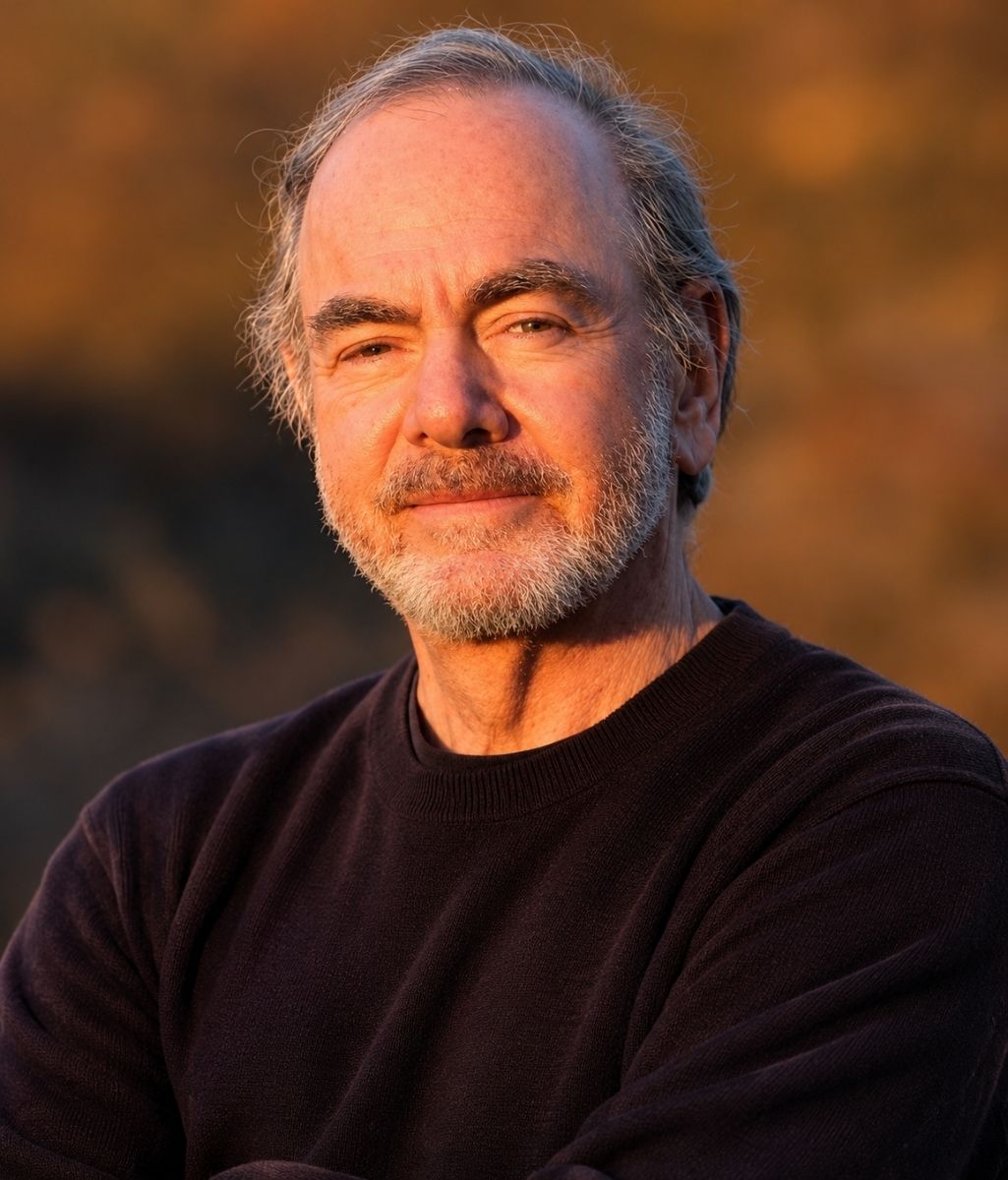
For more than five decades, Neil Diamond appeared to be completely at home beneath the brightest lights in the world.
He stood before packed arenas with thousands of people singing every word of “Sweet Caroline,” “Cracklin’ Rosie,” “Song Sung Blue,” “America” and “Love on the Rocks.” From the audience, Neil seemed confident, commanding and almost untouchable, the kind of performer who could control an entire room with a single familiar melody.
Behind that image, however, Neil lived with a very different view of himself.
When his life was eventually turned into the Broadway musical A Beautiful Noise, he admitted that watching his own story unfold onstage was surprisingly difficult. Neil said he felt flattered, but also embarrassed and frightened because the production forced parts of his private life into public view.
The thing that frightened him most was the possibility of being truly seen.
Neil explained that everyone carries some kind of façade, and beneath the image of the superstar, he did not think of himself as larger than life. He described himself much more simply as an ordinary man who happened to have spent decades in an extraordinary career.
That confession revealed something longtime fans may not have expected.
The confident performer who could walk onto a stage and command an arena was not always equally comfortable when the applause stopped.
Neil had spent much of his career writing songs filled with loneliness, uncertainty and the search for connection. “Solitary Man” became one of the clearest examples, but the same emotional tension appeared throughout his catalogue.
The stage gave him a place where those feelings could be transformed into music.
Real life was more complicated.
That contrast became even more pronounced after Neil was diagnosed with Parkinson’s disease.
In 2018, he announced that the diagnosis would force him to retire from touring. For someone whose identity had been built around live performance, the change was enormous.
Neil later admitted that he did not truly accept the diagnosis when doctors first told him what was happening.
For the first year or two, he lived partly in denial.
He still believed there was work to do, music to make and a life that should continue much as it always had. Accepting that certain things were changing permanently proved much harder than simply hearing the medical explanation.
Over time, however, something began to shift.
Neil eventually described a feeling of calm entering what he called the “hurricane” of his life. Instead of fighting constantly against what he could not change, he began learning how to live with it.
He said he became easier on himself and easier on the people around him.
That may sound like a small change, but for someone who had spent decades pushing himself through recording sessions, tours and enormous public expectations, it represented something profound.
Neil was beginning to accept himself without needing the stage to prove who he was.
Music remained essential.
Even after leaving full-scale touring behind, Neil continued to sing.
He said singing still made him feel whole because his mind and body seemed to work together when he performed. At the opening of A Beautiful Noise on Broadway, he surprised the audience by joining them in “Sweet Caroline,” creating one of those rare moments when the superstar and the private man seemed to exist together.
The audience did not need an elaborate concert.
They simply wanted Neil.
That realization appears to have brought him something he struggled to feel earlier in life.
He later acknowledged that, despite having enjoyed an extraordinary career, he had not always been able to look back at his achievements comfortably or believe that he truly deserved everything that had happened to him.
Only in later years did that perspective begin to soften.
Neil started looking back with greater gratitude instead of constantly measuring himself against the next performance, the next record or the next expectation.
That may be the real truth about Neil Diamond’s life behind the spotlight.
The public saw a man surrounded by applause.
Neil often saw someone still searching for peace.
The public saw confidence.
Neil carried doubts.
The public saw one of the most successful singer-songwriters of his generation.
Neil increasingly understood himself as something much simpler.
A man who loved singing.
A man who made mistakes.
A man who faced fear, illness and uncertainty like anyone else.
And eventually, a man who learned that he did not have to be the Neil Diamond from the posters every moment of his life.
Behind the spotlight, Neil Diamond’s greatest struggle may never have been fame itself. It was learning to accept the man who remained when the crowd went home, the music stopped and there was nobody left to impress but himself.