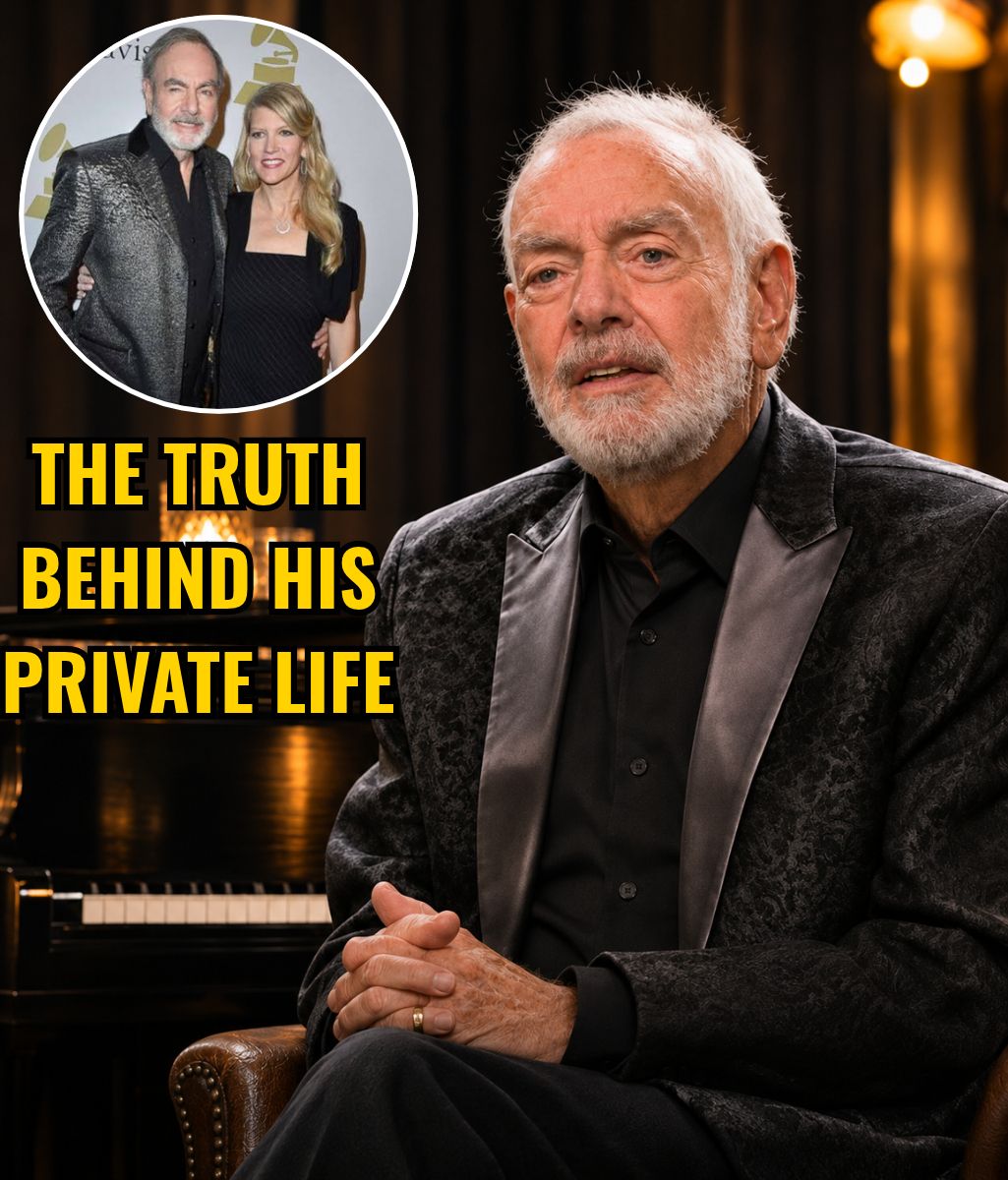
For decades, Neil Diamond appeared to have everything a performer could possibly want.
He had sold millions of records, filled arenas around the world and written songs that became part of people’s lives. “Sweet Caroline,” “Cracklin’ Rosie,” “Song Sung Blue,” “Love on the Rocks” and “I Am… I Said” turned him into one of the most recognizable singer-songwriters of his generation, while his concerts created the image of a man completely at ease inside the life he had chosen.
Behind that success, however, Neil eventually admitted that fame had demanded a price.
The same determination that helped him build an extraordinary career often made ordinary relationships much more difficult. Diamond later acknowledged that music frequently came first, while family life had to compete with long tours, recording sessions and the constant demands of being one of the biggest entertainers in the world. In one interview, he said plainly that his private life had suffered because of his devotion to work.
The regret became especially personal when he talked about his children.
Neil is the father of four, and years later he admitted feeling guilty that he had not been around more often while they were growing up. Touring could keep him away for months, and although he said he devoted himself completely to his children whenever he returned home, he understood that those missing years could never be reclaimed. He eventually discussed that guilt openly with them, saying therapy had helped him understand himself and become easier to live with.
His romantic life carried similar scars.
Diamond married his first wife, Jaye Posner, in 1963, and after that marriage ended, he married Marcia Murphey in 1969. Their marriage lasted more than two decades before ending in divorce in the mid-1990s.
Years later, Neil did not speak bitterly about either woman.
Instead, he turned much of the blame inward.
He described both of his former wives as remarkable women and admitted that he had been given every opportunity to make those marriages work. The fact that neither became the lifelong relationship he had hoped for left him wondering whether perhaps he simply was not capable of creating that kind of lasting bond.
That confession revealed a very different Neil Diamond from the confident man audiences saw beneath the stage lights.
For years, songs about loneliness and longing had been treated as part of his artistic personality. “Solitary Man” sounded like a dramatic title, but Neil’s private reflections suggested that the idea was closer to his real life than many fans realized.
He wanted companionship.
He simply found it difficult to protect that companionship from the demands of the career he had spent his life building.
Neil also understood that fame could not replace ordinary intimacy. He once explained that he disliked being single and wanted to know that there was someone beside him who loved him and whom he could love in return. After two divorces, that desire became even stronger rather than disappearing.
Then, later in life, something changed.
Neil met Katie McNeil in 2007 when she was working professionally with his management team. Their relationship developed slowly because Katie initially hesitated to become romantically involved with someone who was also a client. Eventually, however, friendship became something deeper, and the couple married in 2012.
For Neil, the marriage seemed to arrive at a time when he had become much more aware of the mistakes and emotional patterns of his younger years.
He openly described Katie as the woman of his dreams and said he did not want to reach the end of his life alone. Years later, Katie explained that the foundation of their relationship was friendship, mutual support and the willingness to stand beside one another through both good periods and difficult ones.
That support became particularly important as Neil’s life changed again.
In 2018, he announced that Parkinson’s disease had forced him to retire from touring. He later admitted that for the first year or two, he struggled to accept the diagnosis. When a Broadway musical based on his life, A Beautiful Noise, began taking shape, Neil said revisiting his own story became unexpectedly therapeutic.
Watching his life recreated onstage meant confronting both triumph and regret.
Neil wrote that there were painful moments he wished he could somehow rewrite, but eventually he came to understand that acceptance mattered more than changing the past. He thanked both former wives, his children, his grandchildren, Katie and his longtime therapist for shaping the person he ultimately became.
That may be the most revealing part of Neil Diamond’s private story.
The regret was real, but so was the gratitude.
He could acknowledge that fame had taken him away from people he loved without pretending that the music meant nothing. He could wish he had been a more present father while still recognizing how deeply he loved his children. He could look back on two failed marriages without denying that those relationships had mattered enormously.
For years, audiences heard Neil Diamond sing about loneliness, desire and the search for connection without knowing how closely those themes sometimes reflected the man himself.
The superstar could fill an arena with tens of thousands of people, yet the private man behind the songs spent much of his life trying to understand something far simpler: how to remain close to the people he loved while chasing the dream that had made him famous.
In the end, Neil Diamond’s story is not simply about heartbreak.
It is about realizing, perhaps later than he would have wanted, that success can give a person almost everything while still taking away time that can never be returned — and that learning to live with those regrets may be one of the hardest songs anyone ever has to finish.