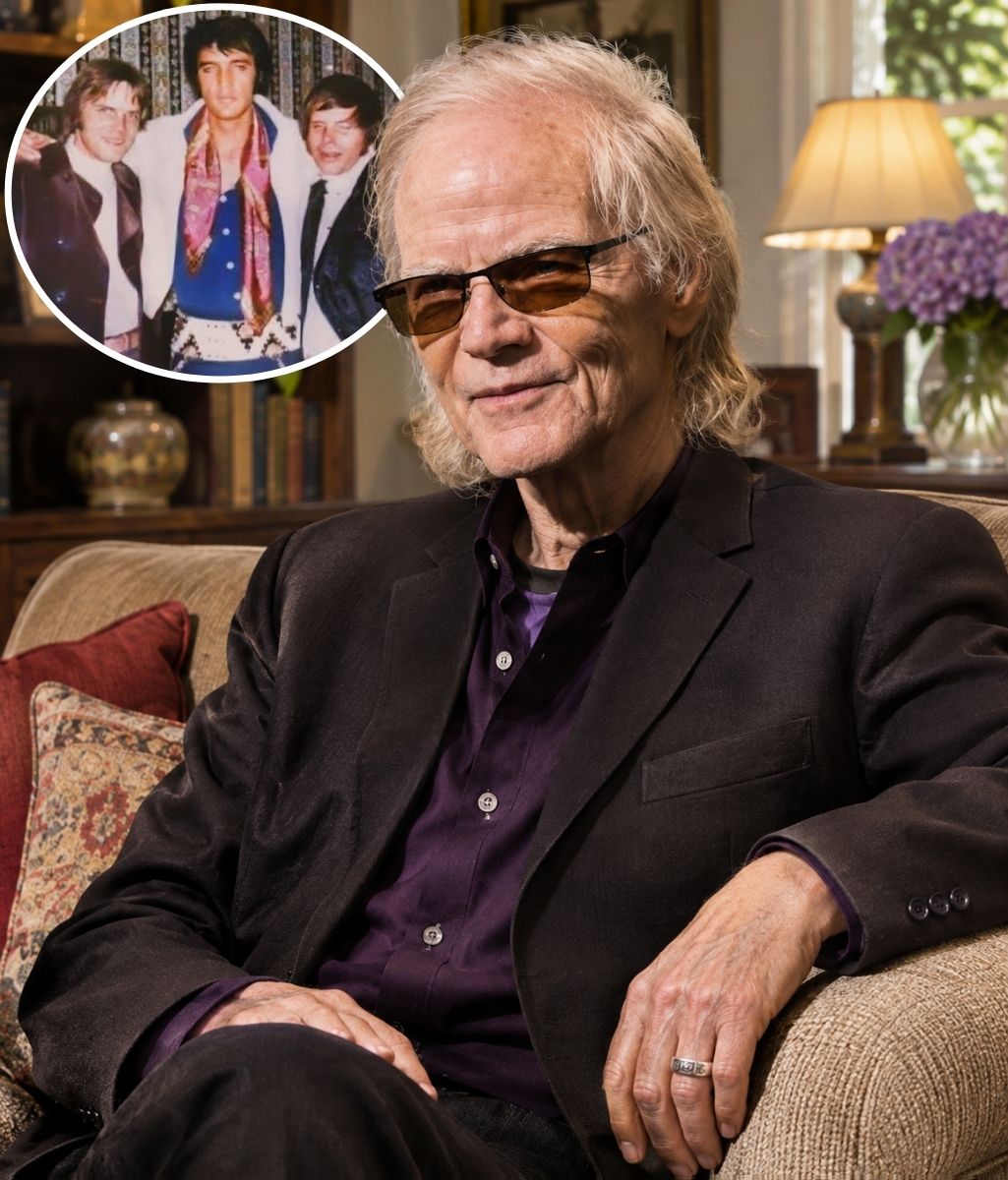
By the summer of 1969, Brian Hyland already knew what it felt like to stand at the top of the American charts.
Nearly a decade earlier, while still a teenager, he had scored a No. 1 hit with “Itsy Bitsy Teenie Weenie Yellow Polka Dot Bikini.” Hyland later recalled that his record reached the top during the same period that Elvis Presley’s “It’s Now or Never” was dominating the charts, placing the young singer briefly in direct competition with the biggest star in popular music. More than sixty years later, Hyland still remembered that extraordinary moment in his career.
Yet chart competition was one thing. Meeting Elvis Presley in person was something entirely different.
That opportunity came in August 1969, during Elvis’s historic return to live performance at the International Hotel in Las Vegas. After years dominated by Hollywood films, Elvis had returned to the concert stage with a new band, a new confidence and a show that reminded audiences why he had become the most influential rock-and-roll performer of his generation.
Among the people in the audience one night were Brian Hyland and his friend and producer Del Shannon, the singer-songwriter best known for the haunting 1961 hit “Runaway.”
What happened next became one of those small moments in Elvis history that says more about him than any carefully prepared publicity photograph ever could.
During the show, Elvis suddenly began singing “Runaway.”
The song did not belong to Elvis, and there was no commercial reason for him to perform it. It belonged to Del Shannon, who was sitting somewhere in the audience while thousands of people watched the biggest star in Las Vegas command the stage.
Elvis then told the crowd that Del Shannon was there.
The problem was that the spotlight operators could not find him.
According to Shannon’s later recollection, Brian Hyland, normally a fairly shy man, suddenly stood up and dramatically pointed toward his friend so the room could see exactly where Del was sitting. The moment was funny, spontaneous and completely removed from the carefully controlled image people often associate with major stars.
For Shannon, however, the real surprise came after the show.
Brian and Del were invited backstage.
There, away from the enormous stage, the lights and the screaming audience, they spent roughly two hours with Elvis Presley. Shannon later remembered being struck immediately by Elvis’s physical presence, saying he had never seen a better-looking man in his life.
That description may sound almost amusing today, but it reveals something important about Elvis during this particular period.
The Elvis who returned to Las Vegas in 1969 was not yet the exhausted figure that some later photographs would come to represent. He was thirty-four years old, newly energized by the success of his 1968 television comeback special and determined to prove that he was still capable of commanding a live audience without movie scripts, studio tricks or the security of the Hollywood system.
People who saw those shows often described an almost overwhelming stage presence.
Brian Hyland had already spent years surrounded by famous performers. He had toured with major teen idols, appeared on national television and experienced international fame himself. By 1969, he was not an easily impressed teenager encountering his first celebrity.
Yet Elvis still stood apart.
There was another detail that made that evening particularly revealing.
By choosing to sing “Runaway” while Del Shannon was sitting in the audience, Elvis demonstrated something that musicians who knew him frequently remembered: beneath the enormous fame was a man who remained deeply aware of other singers and songs.
Elvis was not simply performing his own catalogue.
He listened.
He remembered.
And when a song moved him, he could bring it into his own show simply because he loved it.
That musical curiosity helps explain why Elvis’s performances could move so easily between rock and roll, gospel, country, rhythm and blues, sentimental ballads and contemporary pop. He had grown up absorbing different kinds of American music, and fame never completely removed that instinct.
The connection between Brian Hyland and Elvis also contains an unusual twist.
Hyland’s first major hit had once competed with Elvis on the charts, yet there was no sense of rivalry when their paths finally crossed. They were simply musicians sharing the same extraordinary era, an era in which records could turn unknown teenagers into national figures almost overnight.
Hyland himself remained remarkably adaptable.
After the novelty-pop success of his early career, he moved toward more mature material with “Sealed with a Kiss,” and later achieved another major success with his version of “Gypsy Woman.” His career ultimately stretched far beyond the teenage-idol period that first made him famous, and he continued performing decades later.
That longevity may be one reason memories of musicians like Elvis still carry such weight when they come from artists of Hyland’s generation.
They were not remembering a distant legend they had only seen on television.
They had been there.
They had heard the audience erupt when Elvis walked onto a stage. They had watched him joke with musicians he admired. They had sat backstage after the applause had faded and seen the person behind the famous name.
In the years after Elvis died in 1977, countless stories emerged about his generosity, his humor, his insecurities and the enormous pressures surrounding his life. Some stories grew into myths, while others were exaggerated through decades of repetition.
The Las Vegas encounter involving Brian Hyland and Del Shannon does not need exaggeration.
Its power lies in how ordinary it was.
Elvis heard a song he liked, realized its creator was sitting in the audience, performed it as a tribute, and later spent time talking with two fellow musicians backstage.
There was no grand announcement and no carefully staged publicity moment.
For a few hours, three men who had each heard their voices coming from radios across America were simply musicians talking about music.
Brian Hyland’s connection to Elvis Presley therefore reveals something far more interesting than a sensational secret. Behind the title of “The King” was an artist who still noticed other artists, still celebrated the songs he admired and could make even successful performers feel that they were witnessing someone unlike anyone they had ever met.
For fans who remember Elvis only through the enormous mythology that surrounded him, that may be the most surprising truth of all.