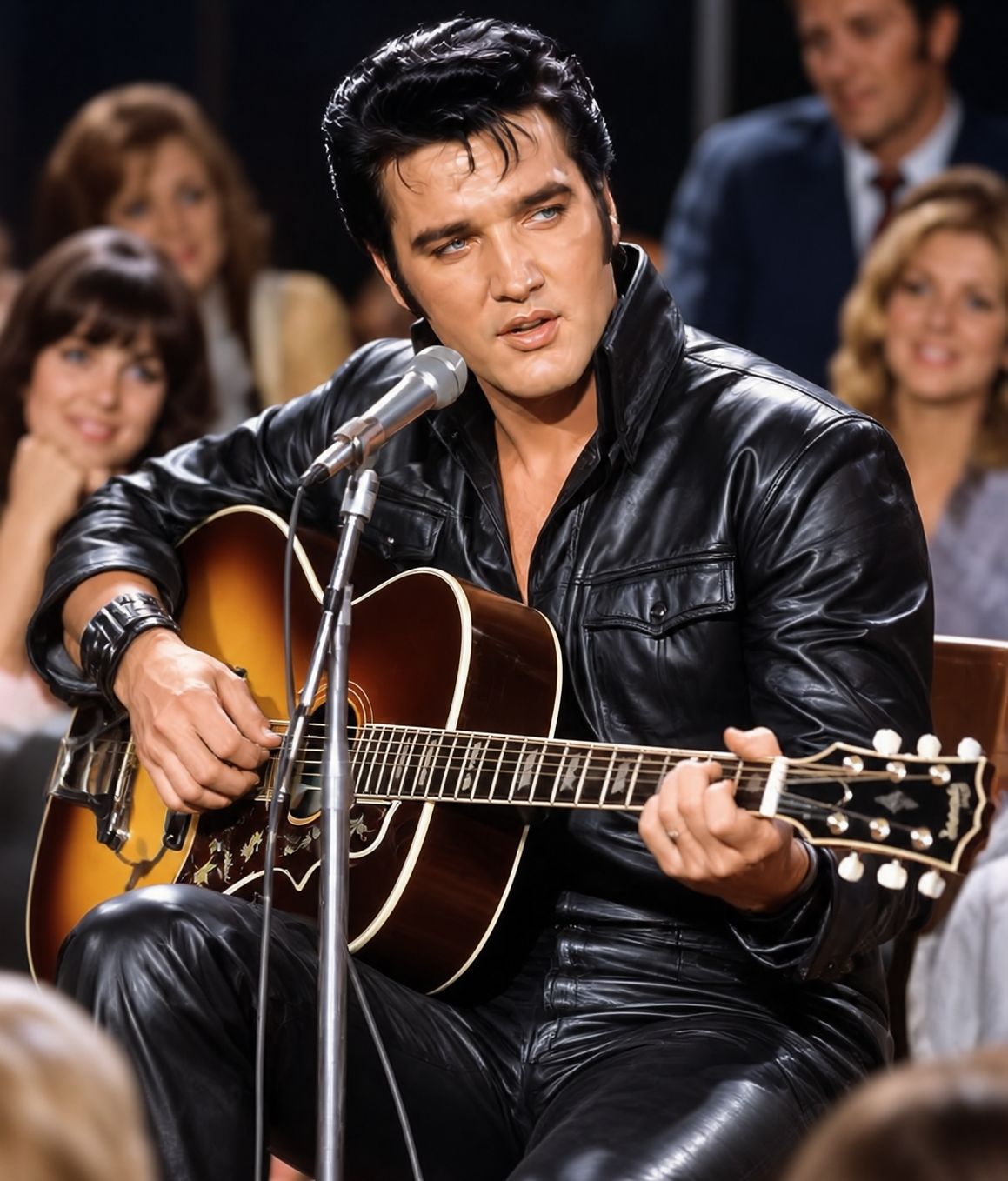
By the early 1970s, Elvis Presley was no longer the carefree young man who had shocked America with his hips, his hair, and the explosive sound of early rock ’n’ roll. He was still one of the most famous entertainers in the world, but his life had changed dramatically. His marriage to Priscilla Presley was falling apart, the constant pressure of touring had begun to take a toll, and the man standing beneath the stage lights carried far more emotional weight than the 21-year-old who had first become a national sensation.
One of the songs that seemed to capture that change most clearly was “You Gave Me a Mountain.” Written by country singer Marty Robbins, the song tells the story of a man who has endured hardship after hardship until life finally gives him one burden that feels almost impossible to carry. Elvis did not write the lyrics, but when he sang them, many fans felt as though he were revealing something deeply personal through someone else’s words.
That feeling became especially powerful during the Aloha from Hawaii concert in January 1973, one of the most famous televised performances of Elvis’s career. Standing before an enormous international audience, he delivered the song with a depth and gravity that sounded very different from the youthful confidence of his early years. The performance was powerful on its own, but the timing made it almost impossible for audiences to separate the song from what was happening in Elvis’s personal life.
Elvis and Priscilla had separated in 1972, and their divorce would become final later in 1973. They shared a daughter, Lisa Marie, whom Elvis loved deeply, and the breakup marked one of the most difficult emotional chapters of his adult life. Because the lyrics of “You Gave Me a Mountain” describe a man whose marriage is collapsing and whose family is slipping away, the parallels were difficult for many listeners to ignore, even though Elvis was not literally telling his own story through the song.
His voice gave the lyrics an emotional weight that made them sound less like fiction and more like memory. He had always possessed the ability to take material written by someone else and make it feel entirely personal, but during the 1970s that gift became especially powerful as his repertoire increasingly included dramatic songs about loneliness, endurance, regret, and loss.
Over the years, stories have circulated claiming that Elvis once found a particular song too painful to sing and swore never to perform it again. There is no reliable historical evidence confirming that he made such a promise about “You Gave Me a Mountain” or any other specific song, and the fact that this song remained part of his concert repertoire makes the claim even less convincing. The truth does not need that legend to be moving, because Elvis continued singing the song precisely because it allowed him to turn someone else’s words into something that sounded as though it had been drawn directly from his own life.
By the middle of the 1970s, songs such as “My Way,” “Separate Ways,” and “You Gave Me a Mountain” resonated differently when performed by Elvis. His personal life had become more complicated, his health and touring schedule were increasingly demanding, and the emotional character of his performances had matured along with him. Audiences were no longer responding only to the size or beauty of his voice; they were also hearing the experience, exhaustion, vulnerability, and regret that seemed to sit behind it.
That is why “You Gave Me a Mountain” remains one of Elvis Presley’s most emotionally revealing performances. He never needed to tell the audience that the song was about him, because by the time he reached the final lines, many listeners already felt as though they had heard something far more personal than another concert number. They had heard the King carrying the weight of his own life through someone else’s words.