Elvis Presley grew up in a South divided by laws, customs, and attitudes that told Black and white Americans where they could live, eat, shop, sit, and socialize. Long before he became the King of Rock ’n’ Roll, he was a poor boy from Tupelo and Memphis living inside that world. Yet many of the people who remembered him from those early years described something striking: Elvis often moved across racial boundaries with a naturalness that was unusual for the time.
That part of his story is important because popular culture has sometimes reduced Elvis’s relationship with Black music to a simple argument about influence. There is no question that blues, rhythm and blues, gospel, and Black performers had a profound impact on his sound. Elvis himself openly acknowledged that fact. He once spoke admiringly of blues musician Arthur “Big Boy” Crudup, whose “That’s All Right” became Elvis’s first Sun Records single, and later made clear that rock and roll had existed long before he became famous.
But the relationship went beyond music.
Growing up in Tupelo, Elvis lived close to Black families and developed friendships that crossed the rigid social lines of the segregated South. One account preserved by historian Roy Turner describes Elvis’s childhood friendship with Sam Bell, a Black boy from East Tupelo. Bell later remembered Elvis spending time with his family, while his grandparents noticed something that seemed small but carried enormous meaning in that era: Elvis addressed them respectfully as “yes, ma’am” and “no, ma’am.” In the Mississippi of Elvis’s childhood, that kind of courtesy from a white child toward Black adults was not something everyone took for granted.
As Elvis grew older and moved to Memphis, Black music became even more central to his life. He listened to rhythm and blues on the radio, visited Beale Street, bought clothes there, and absorbed sounds that would later become part of his own musical identity. When Memphis disc jockey Dewey Phillips first played “That’s All Right” in 1954, some listeners reportedly assumed the singer was Black because Elvis’s sound did not fit the racial categories listeners had been trained to expect.
That confusion said something important about what Elvis represented.
His music crossed boundaries before much of American society was ready to do the same.
By the time Elvis became nationally famous in 1956, he was performing music rooted heavily in Black traditions before huge audiences of white teenagers. That alone made him controversial. Rock and roll was not considered dangerous merely because it was loud or youthful. It was also dangerous because it blurred cultural lines in a society built around keeping those lines separate.
Elvis did not invent that music, and he never seriously claimed that he did.
In fact, one of the more revealing statements attributed to him from the period was his recognition that Black musicians had been performing rock and roll long before he arrived. He specifically praised artists such as Fats Domino, acknowledging that they possessed musical qualities he admired and could never simply reproduce.
His behavior in Memphis also challenged expectations in quieter ways.
The African-American newspaper Memphis World reported that Elvis had attended the local amusement park on a night designated for Black patrons, describing him as having effectively crossed one of Memphis’s segregation boundaries. In an era when public spaces were carefully divided by race, even a celebrity appearing comfortably in that environment carried meaning.
That does not mean Elvis should be rewritten as a civil-rights leader.
He was not Martin Luther King Jr., he did not organize marches, and he did not build his public career around political activism. Turning him into a heroic figure who single-handedly defeated segregation would distort both Elvis’s life and the much larger struggle carried by Black Americans who faced enormous personal danger fighting discriminatory laws.
But there is another truth that should not be lost.
Elvis did not behave as though the racial boundaries around him were sacred.
He admired Black musicians openly. He formed friendships across racial lines. He listened to music that many white Southerners considered inappropriate. He performed songs that connected white teenagers with Black musical traditions. And when racist rumors later circulated claiming Elvis had insulted Black people, researchers struggled to find credible evidence that he had ever made the infamous statements attributed to him. The Jim Crow Museum has described the most notorious of those quotations as a rumor whose accuracy could not be established.
That record makes later diner legends understandable.
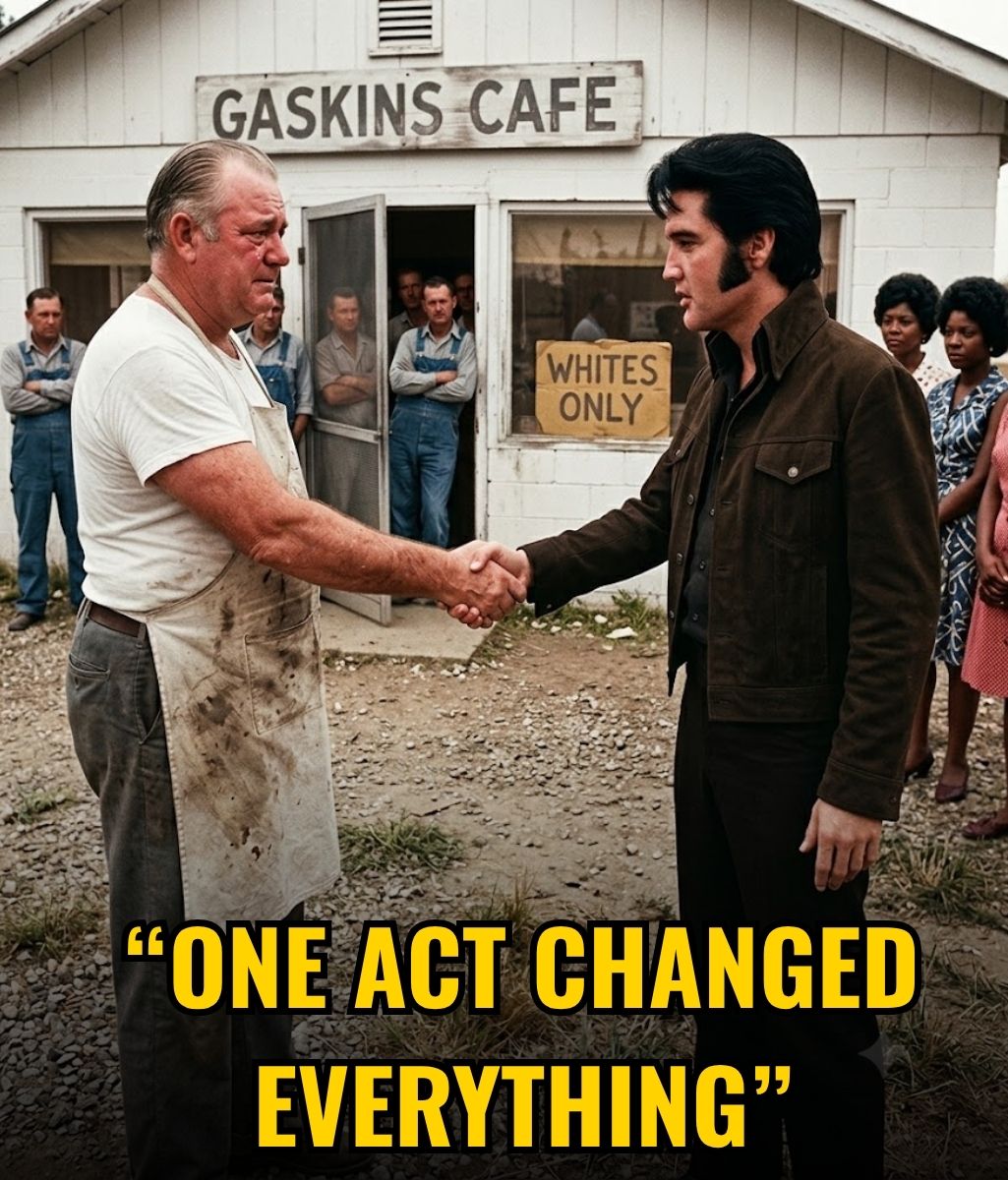
Stories circulate online about Elvis entering segregated restaurants, standing up for Black musicians, confronting owners, or forcing businesses to change discriminatory policies. Some versions are dramatic enough to sound like scenes from a film. The problem is that many of those specific stories lack reliable contemporary documentation, and repeating them as fact can actually weaken the genuine history that is already compelling enough.
Elvis did not need an invented confrontation to demonstrate where many of his instincts lay.
The real evidence is quieter.
It is a young Elvis sitting in Black neighborhoods and listening.
It is the white boy buying records on Beale Street.
It is the emerging star publicly crediting Black musicians for the music that inspired him.
It is a childhood friend remembering that Elvis treated his Black grandparents with unusual respect in a time and place where such respect was far from guaranteed.
Those details may not be as sensational as a dramatic showdown inside a “WHITES ONLY” diner, but they reveal something more believable about the man behind the legend.
Elvis Presley grew up inside a divided America, yet the music and people who shaped him repeatedly pulled him across the very lines that society tried to keep rigid.
He did not end segregation, and he should never be given credit that belongs to those who fought that battle directly. But in a culture determined to tell him who belonged on which side of the line, Elvis often seemed more interested in the music, the person, and the connection than in the line itself.