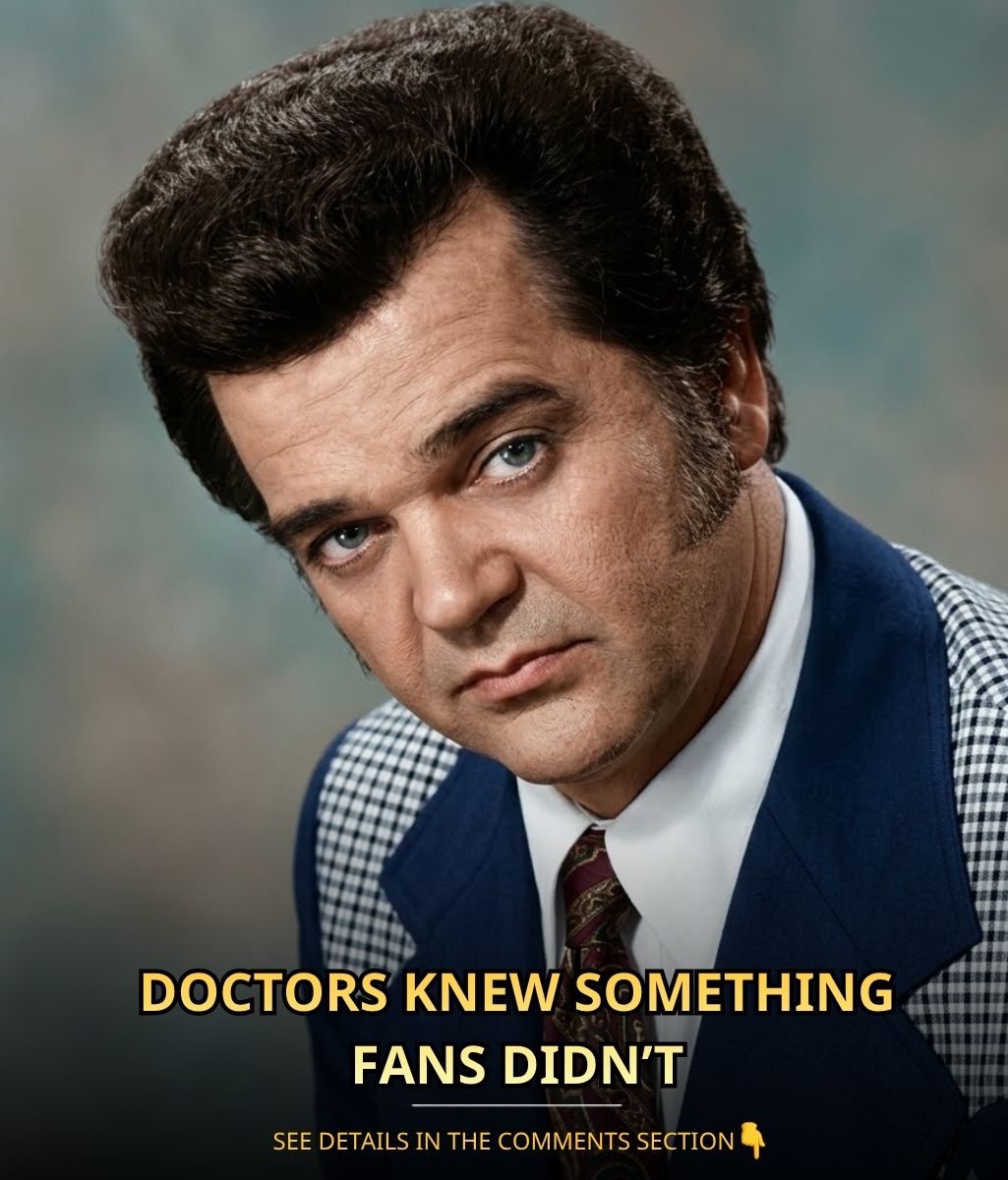
THE SILENT MEDICAL CRISIS THAT TOOK CONWAY TWITTY — What Happened After His Final Performance Left Country Music Almost No Time to Say Goodbye
On the evening of June 4, 1993, Conway Twitty was still doing what he had spent much of his life doing: performing for country music fans. He appeared at the Jim Stafford Theatre in Branson, Missouri, giving what no one in the audience could have known would become his final performance. There was no grand farewell planned and no public announcement that one of country music’s most recognizable voices was approaching the end. Within hours, however, everything changed.
After the show, Twitty became seriously ill and later collapsed on his tour bus. He was rushed to Cox South Hospital in Springfield, Missouri, where doctors faced an emergency involving an abdominal aortic aneurysm. Surgery was attempted, but Twitty died in the early hours of June 5, 1993. He was only 59 years old.
For many fans, the medical detail behind his death remains one of the most unsettling parts of the story because an abdominal aortic aneurysm can develop with few or even no obvious symptoms until it becomes dangerously enlarged or ruptures. The aorta is the body’s main artery, and when a weakened section in its abdominal portion expands and ruptures, it can cause catastrophic internal bleeding. Mayo Clinic describes rupture as a life-threatening emergency.
That does not mean doctors had hidden Conway Twitty’s condition, and there is no reliable evidence that they did. The more haunting truth is that this type of medical crisis itself can remain largely hidden. Cleveland Clinic notes that many people with an abdominal aortic aneurysm have no symptoms until the aneurysm is close to rupturing, at which point severe abdominal or back pain and other sudden symptoms may appear.
Seen in that light, Twitty’s final hours become even more difficult to comprehend. Only a short time earlier, he had been in front of an audience, still carrying the enormous career that had produced classics such as “Hello Darlin’,” “It’s Only Make Believe,” “You’ve Never Been This Far Before,” and decades of unforgettable recordings. Then an internal medical emergency turned an ordinary night on the road into a race against time.
There is something especially poignant about the absence of a formal goodbye. Conway had spent years walking onto stages with a reputation for saying relatively little and allowing the songs to carry the evening. On June 4, the audience in Branson watched another Conway Twitty performance without knowing that they were witnessing the final chapter of a career that had stretched from rock and roll into country music history.
By the following morning, that era was over.
News of his death shocked Nashville and country audiences across America. Twitty had remained an active performer, which made the suddenness especially difficult for fans to accept. He was not remembered as someone who had quietly disappeared from public life years earlier. He had been working, traveling, and performing almost until the very end.
That reality also explains why the medical cause continues to fascinate longtime fans. There was no long public farewell attached to his death. Instead, there was a final show, a sudden collapse, emergency surgery, and then devastating news.
The story has sometimes been sensationalized as though there were a secret doctors knew and refused to reveal. The documented facts point toward something more sobering: the medical condition itself can be silent, and when it becomes an emergency, circumstances can deteriorate with frightening speed.
For the people who loved Conway Twitty’s music, that distinction matters. His death does not need an invented mystery to be heartbreaking.
He stepped onto a stage on June 4, 1993, unaware that it would become his final performance. Hours later, doctors were fighting to save him. By the morning of June 5, one of country music’s most enduring voices was gone.
And perhaps that is the detail that still stays with fans more than three decades later: Conway Twitty never had the chance to know that his final song that night was truly a goodbye.