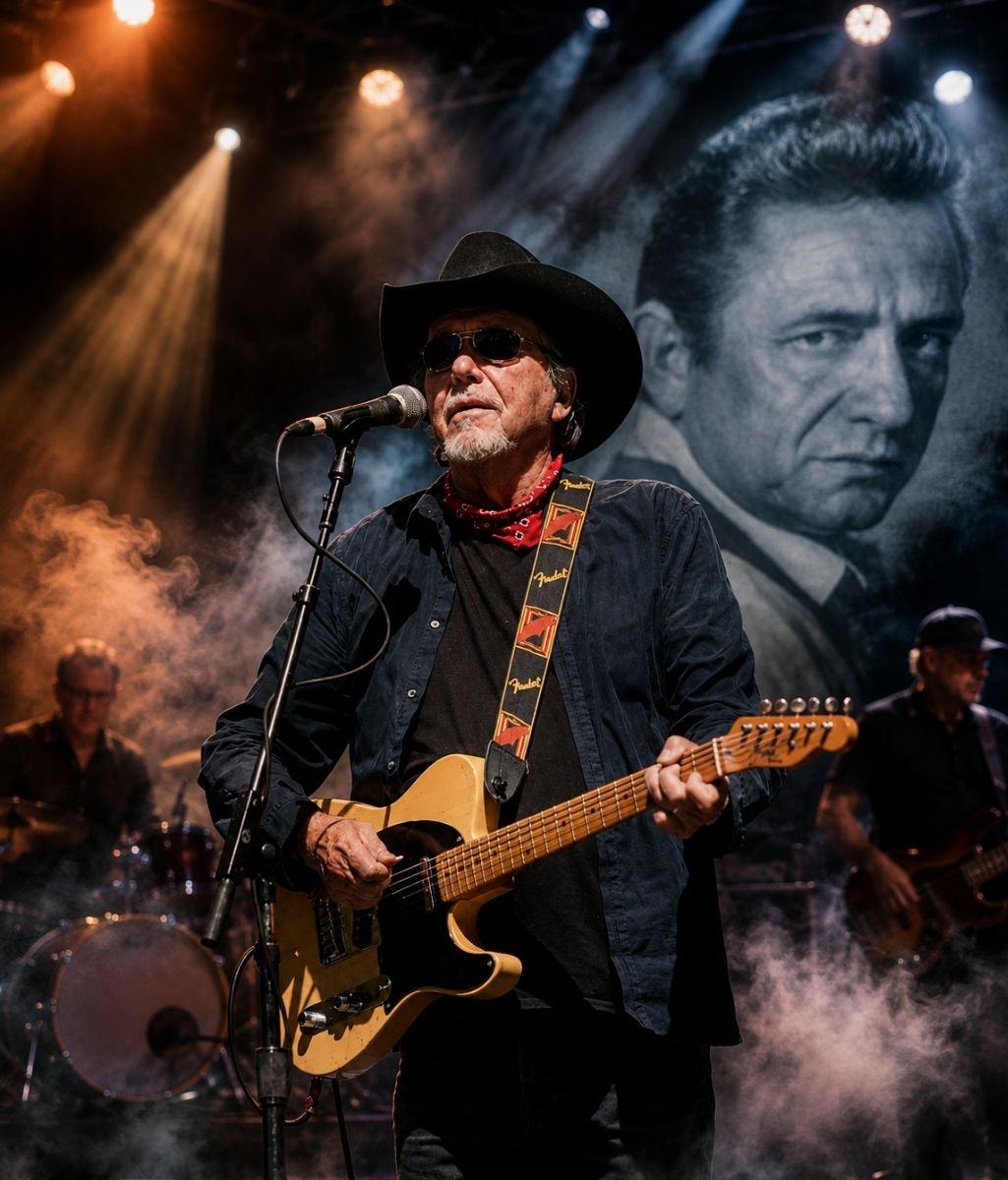
For longtime country music fans, few voices are as instantly recognizable as Johnny Cash’s. The deep delivery, the deliberate phrasing, and the unmistakable rhythm behind songs like “Folsom Prison Blues” became part of American music history. So when Bobby Bare decided to perform the song in his own way, the moment naturally carried a sense of affection and nostalgia. What began as a playful tribute, however, gradually became something more meaningful.
Bare had known Cash personally and later interviewed him on Bobby Bare and Friends, where the two musicians could talk comfortably about songs and the early years of their careers. Their connection belonged to an era of Nashville when major artists frequently crossed paths, exchanged stories, and understood the peculiar pressures that came with spending a lifetime in music.
That familiarity gave Bare something unusual when he performed “Folsom Prison Blues.”
Rather than simply covering the song note for note, Bare was known to have fun imitating Cash’s famous vocal style. Surviving recordings of the performance show him leaning into the unmistakable Johnny Cash manner of delivering the song, turning the opening portion into an affectionate impression that audiences could immediately recognize.
At first, the mood is light.
The audience understands the joke. Bare is not trying to become Johnny Cash; he is acknowledging just how distinctive Cash had become. Only a handful of words delivered in that familiar low register were enough to bring an entire musical personality to mind.
But beneath the humor was genuine admiration.
“Folsom Prison Blues” itself was never simply another country standard. Cash originally recorded the song during his Sun Records years, and its reputation grew enormously after he performed it at Folsom State Prison on January 13, 1968. The live version reached No. 1 on the country chart and later earned Cash the Grammy for Best Country Vocal Performance, Male. It became one of the recordings most closely associated with his image as the Man in Black.
For an artist like Bobby Bare, that history mattered.
Bare belonged to the same broad generation of country storytellers. Both singers understood that a powerful record did not require elaborate vocal display. The singer had to make listeners believe the story. Cash could do that with prison songs, spiritual material, songs about hardship, and deeply personal reflections. Bare brought a similar storytelling instinct to records such as “Detroit City,” “500 Miles Away from Home,” and “Marie Laveau.”
That shared respect for storytelling made Bare’s Cash impression feel less like parody and more like one veteran musician tipping his hat to another.
And that is where the mood of such a performance can suddenly change.
The laughter surrounding an impression reminds the audience how familiar Johnny Cash’s mannerisms were. But the moment the joke fades, another realization begins to settle over the room: there was only one Johnny Cash.
The voice being imitated belonged to a man who had become impossible to replace.
That contrast—between laughter and remembrance—is what gives Bare’s performance its emotional power. One moment the crowd can enjoy hearing an old friend imitate one of country music’s most recognizable voices. The next, the song becomes a reminder of an artist and an era that can never truly return.
There is no need to invent a dramatic stage incident to make the moment meaningful. Available recordings confirm Bare’s playful Johnny Cash impression during “Folsom Prison Blues,” but they do not provide reliable evidence for some of the more sensational descriptions that circulate online about a mysterious event suddenly interrupting the performance.
The genuine story is stronger.
Here was Bobby Bare, himself a survivor of country music’s classic era, standing before an audience and borrowing for a few minutes the voice of another man who had traveled many of the same Nashville roads.
Fans could laugh because the imitation was immediately recognizable.
They could sing along because the song had lived in their memories for decades.
And underneath all of it was the knowledge that the generation that produced singers like Cash and Bare was slowly becoming history.
Perhaps that is why performances like this remain so touching for older country fans. They are not simply cover songs. They are small reunions with people, places, and years that listeners thought they had left behind.
For several minutes, “Folsom Prison Blues” brought Johnny Cash’s unmistakable presence back into the room through the voice of an old Nashville contemporary.
What began with smiles could therefore end very differently.
Not because something shocking happened onstage, but because the audience suddenly understood what Bobby Bare’s playful imitation was really reminding them of:
You can imitate a legendary voice. You can replay the songs. You can remember the laughter. But you can never completely bring an era back once it is gone.