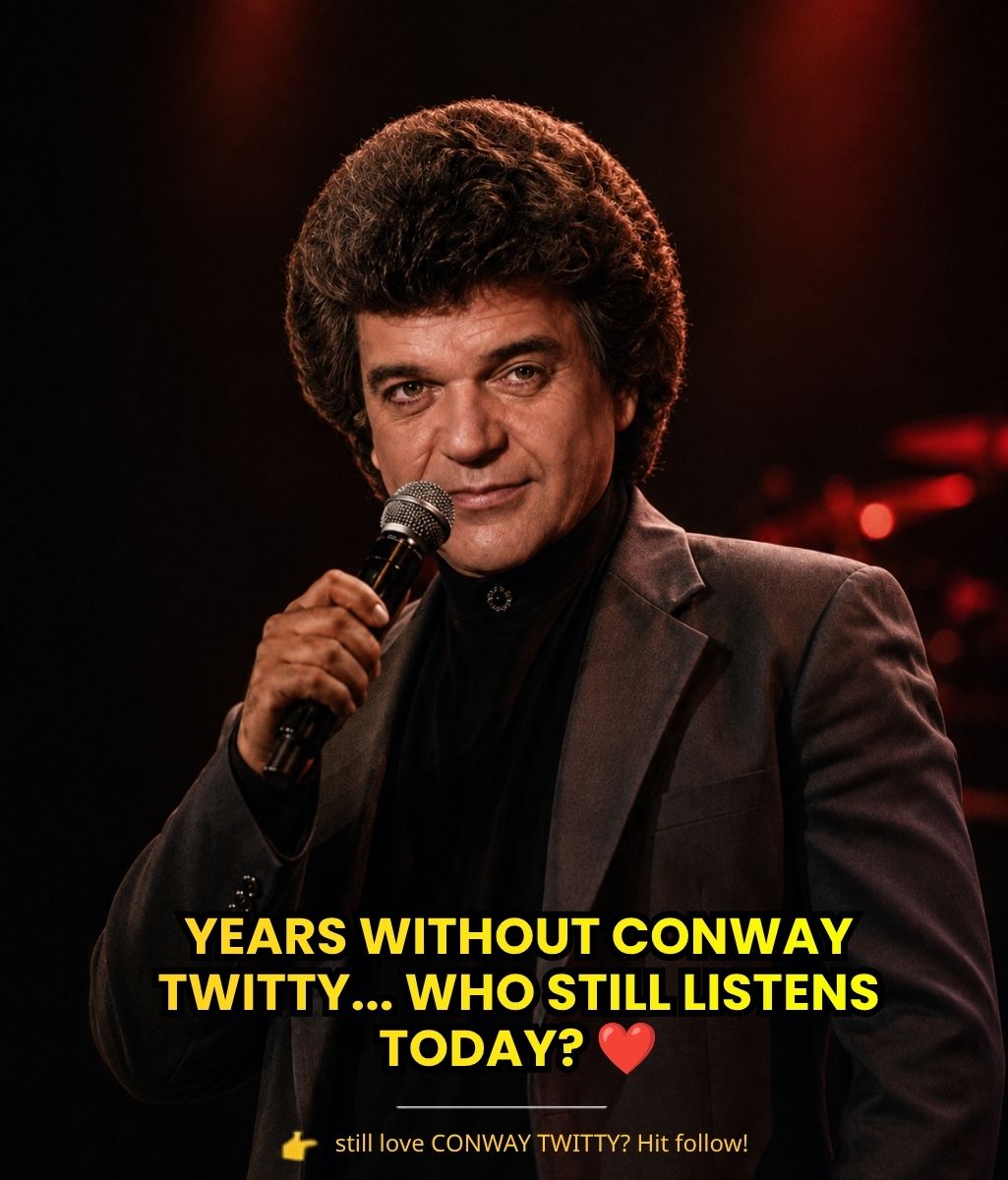
By the time Conway Twitty recorded “The Rose,” the song was already famous. Many listeners knew it through Bette Midler’s emotional performance associated with the 1979 film of the same name, and it seemed difficult to imagine another singer making such a recognizable song feel personal again. Yet Conway approached it from a completely different musical world, and his 1983 country version proved that the same words could carry a remarkably different emotional weight in another voice.
“The Rose” was written by Amanda McBroom, whose lyrics used simple images to explore love, fear, hope, and the courage required to open the heart again after disappointment. Bette Midler’s recording brought the composition to a huge audience and became closely identified with her voice. But beneath its pop success was something that country music had always understood well: a powerful story does not necessarily belong to only one style of music.
That was where Conway Twitty entered the picture. By the early 1980s, Conway had already spent years demonstrating an unusual ability to take songs from outside traditional country music and reshape them around his own voice. He was less interested in simply copying an earlier performance than in discovering what the song could become when filtered through his restrained, conversational delivery. “The Rose” offered exactly that opportunity because its emotional strength depended more on interpretation than elaborate production.
For Conway, however, making the song his own required a different approach. Bette Midler’s performance had established a powerful reference point, and simply recreating that arrangement would have given listeners little reason to choose Conway’s version. His strength had always been intimacy: he could make a large audience feel as though he were singing directly to one person. Rather than trying to overpower “The Rose,” Conway allowed the song to settle into the warm baritone and measured phrasing that country fans immediately recognized.
That change gave the recording a distinctly different personality. In Conway’s hands, “The Rose” feels less like a showcase and more like a reflection from someone who has lived long enough to understand what the words mean. His delivery allows the images in McBroom’s writing to unfold patiently, giving listeners time to absorb the contrast between fear and hope at the center of the song. The emotion comes not from forcing every line to sound dramatic, but from letting the lyric gradually reveal its meaning.
That approach was perfectly suited to Conway’s career by 1983. He was no longer a performer trying to prove that he belonged in country music; he had already accumulated an extraordinary run of hits and established himself as one of the genre’s most recognizable voices. What he could bring to “The Rose” was experience. A lyric about vulnerability, disappointment, and believing that something beautiful can still emerge after difficult times naturally sounded different coming from a singer whose audience had already traveled with him through decades of songs about regret and longing.
Country listeners responded. Conway’s version of “The Rose” became a major country success, reaching No. 1 on Billboard’s country chart in 1983. That achievement was especially remarkable because he had taken a song already strongly associated with another famous performer and given it enough of his own identity to succeed with an entirely different audience. It wasn’t simply a pop song wearing country instrumentation; by the time Conway finished with it, the recording sounded at home within his catalog.
There is also an interesting connection between “The Rose” and another successful chapter of Conway’s career. Only a year earlier, he had taken “Slow Hand,” previously a pop hit for the Pointer Sisters, and transformed it into a country No. 1. Both recordings demonstrated Conway’s gift for hearing possibilities in songs that Nashville audiences might not initially have considered country material. He understood that genre could change while the emotional center of a strong song remained intact.
More than four decades later, “The Rose” has gained another layer that Conway could never have anticipated when he recorded it. Conway died unexpectedly in 1993, only ten years after his version reached No. 1. Because his voice is now preserved entirely through the recordings he left behind, reflective performances such as this one can carry a bittersweet quality for longtime fans who remember hearing them when Conway was still alive and performing.
That does not mean “The Rose” was intended as a farewell, and its history should not be rewritten to make it one. Its lasting emotional power comes from something more genuine: Conway found a song that already meant something to millions of people and discovered a way to make it sound unmistakably like him. He did not need to erase what Bette Midler had done with “The Rose”; he simply showed listeners that a great song could bloom differently in another voice.
Today, hearing Conway Twitty sing “The Rose” offers a reminder of one of his greatest talents. He could recognize the emotional heart of a song, strip away what did not belong to him, and rebuild it around the voice country fans trusted for decades. What began as Amanda McBroom’s composition and became famous through Bette Midler found another life in 1983, when Conway Twitty turned “The Rose” into a country No. 1 that still carries his unmistakable signature.