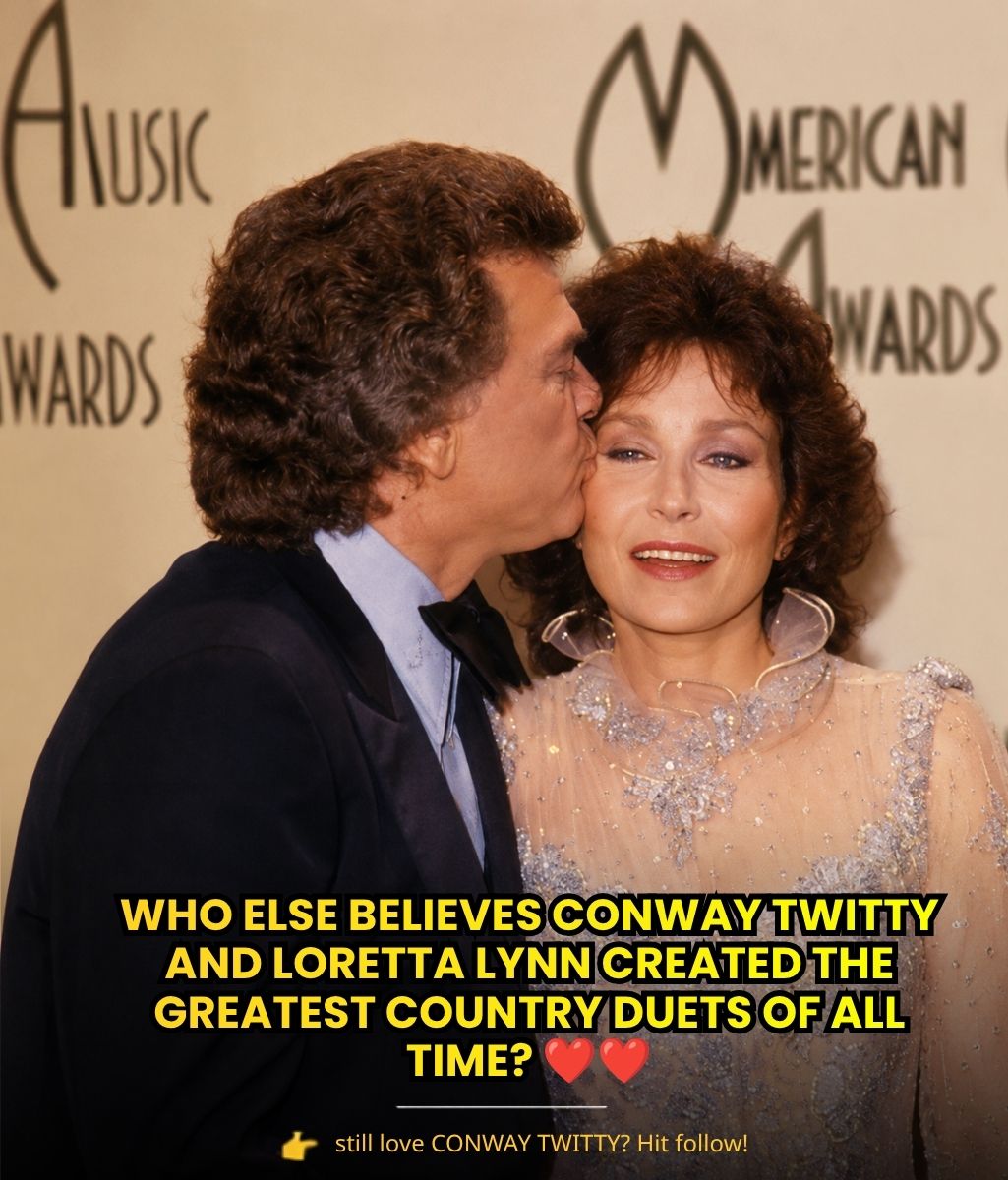
here were moments when Conway Twitty and Loretta Lynn stood together onstage and seemed to forget anyone else was in the room.
A glance. A smile. A lyric delivered just a little too convincingly.
For millions of country fans, the question became almost unavoidable:
Were Conway and Loretta really just singing together—or was there something more between them?
The rumors followed them for years.
And considering the songs they chose to sing, it wasn’t difficult to understand why.
But the real story behind one of country music’s greatest partnerships was more unusual—and perhaps more meaningful—than a secret romance.
It began with one song in 1971.
And almost immediately, Nashville knew it had found something special.
One Song Changed Everything
Before Conway Twitty and Loretta Lynn became inseparable in the minds of country fans, both were already major stars.
Loretta had built her reputation by singing with startling honesty about marriage, jealousy, betrayal, and the struggles women rarely heard discussed so openly on country radio.
Conway had developed an entirely different kind of magnetism.
His deep voice and emotionally charged delivery could make a love song feel almost uncomfortably intimate.
Then their voices met.
In 1971, they released “After the Fire Is Gone.”
The song told the story of two married people finding something outside their marriages that was missing at home.
That alone was provocative.
But Conway and Loretta didn’t simply sing it.
They made the conversation inside the song feel believable.
“After the Fire Is Gone” became a No. 1 country hit and launched what would become one of the most successful duet partnerships in country music history.
But success created another problem.
The better Conway and Loretta became at playing lovers in their songs, the harder it became for audiences to separate the characters from the people singing them.
And their next records weren’t exactly going to calm those suspicions.
The Songs Kept Giving Fans Reasons to Wonder
After “After the Fire Is Gone,” the hits kept coming.
“Lead Me On.”
“Louisiana Woman, Mississippi Man.”
“As Soon as I Hang Up the Phone.”
“Feelins’.”
Again and again, Conway and Loretta stepped into songs built around desire, temptation, separation, and complicated relationships.
The chemistry was extraordinary.
Loretta could sound playful one moment and wounded the next.
Conway could answer with the kind of low, intimate delivery that had already made him one of country music’s great romantic singers.
When they stood together, neither seemed uncomfortable playing into that tension.
Quite the opposite.
They teased each other. They laughed together. They performed with the ease of two people who genuinely enjoyed being around one another.
And audiences noticed.
Soon, the question wasn’t just whether they sounded good together.
Fans began wondering whether some of that affection continued after the microphones were turned off.
There was just one rather significant complication.
They Both Had Lives Outside the Duet
While Conway and Loretta were singing about forbidden attraction, their real personal lives existed far beyond the characters on their records.
Loretta was married to Oliver “Doolittle” Lynn, the husband whose turbulent marriage with Loretta would inspire some of the most brutally honest songs of her career.
Conway also had his own marriages and family life.
That made the romantic intensity of their performances even more fascinating.
They could walk onto a stage, sing like two people caught in a complicated love affair, and then return to completely separate lives.
Yet the rumors didn’t disappear.
If anything, their growing success together made them stronger.
Because by the early 1970s, Conway and Loretta weren’t simply another Nashville pairing.
They were becoming country music royalty.
And the industry kept rewarding them for it.
Four Straight Years at the Top
Beginning in 1972, Conway Twitty and Loretta Lynn won the CMA Vocal Duo of the Year award four consecutive times—from 1972 through 1975.
Few partnerships have ever dominated the category like that.
Their recordings sold.
Their performances drew crowds.
Their chemistry became part of their public identity.
And their songs encouraged listeners to imagine an entire relationship between them.
In a strange way, Conway and Loretta were playing two roles at once.
There were Conway and Loretta, the real people.
And then there were Conway and Loretta, the couple inside the songs.
For fans, those two versions could become difficult to separate.
But what existed between them offstage was not the scandal many people expected.
It was something far harder to define.
Loretta Never Needed to Pretend Conway Meant Nothing to Her
This is where their story becomes more interesting than simply saying:
“They were only friends.”
Because “only friends” almost undersells it.
Conway and Loretta clearly shared enormous affection and professional trust.
They spent years recording together.
They toured together.
They stood beside one another through a massive period of their careers.
And Loretta spoke about Conway with a warmth that made it obvious he occupied a special place in her life.
But there is no established evidence that Conway Twitty and Loretta Lynn carried on a secret romantic affair.
Their closeness was real.
The love their fans sensed may also have been real.
But love does not always mean romance.
And that distinction may be the key to understanding what made Conway and Loretta so convincing together.
They didn’t have to fake the affection.
They simply transformed it into something different whenever the song began.
Still, there was another element that made their bond unusual.
They Trusted Each Other Enough to Make the Songs Dangerous
Imagine singing “After the Fire Is Gone” with someone you barely knew.
The song could easily sound theatrical.
Now imagine singing it with someone whose timing you understand, whose humor you know, and whose musical instincts you trust completely.
Suddenly the smallest things matter.
A look.
A pause.
The way one singer answers the other.
That was where Conway and Loretta became special.
They weren’t simply singing at the same time. They were reacting to one another.
That gave their duets a sense of intimacy difficult to manufacture in a studio.
And once audiences believed the emotional conversation, the rumors almost became inevitable.
Perhaps that is why Conway and Loretta never needed an actual romance to convince listeners.
Their friendship gave them something almost as powerful: trust.
But eventually, even one of country music’s greatest partnerships had to change.
And when Conway was suddenly gone, Loretta’s reaction revealed just how deeply that relationship had mattered.
When Conway Died, the Duet Could N
ever Really End
Conway Twitty died unexpectedly in June 1993.
He was only 59.
For country music, it meant losing one of the genre’s most recognizable voices.
For Loretta Lynn, it meant losing something much more personal.
The man who had stood beside her on some of the biggest recordings of her career was suddenly gone.
There would be no next duet session.
No familiar voice answering hers.
No Conway waiting for his line.
And this is where decades of rumors begin to feel almost beside the point.
Because whatever label outsiders tried to place on their relationship, Loretta had lost someone who had been woven deeply into both her career and her life.
Their partnership had lasted far beyond one hit record.
It had become part of who fans believed Conway Twitty and Loretta Lynn were.
Which leaves one final question.
If they weren’t secretly lovers, why did their performances feel so intensely personal?
Maybe Fans Were Hearing Something Real After All
The mistake may have been assuming that chemistry could only come from romance.
Conway Twitty and Loretta Lynn proved otherwise.
What audiences heard between them was not necessarily fictional.
The affection was real.
The trust was real.
The comfort was real.
The years of shared music were real.
What the songs did was take that genuine connection and temporarily turn it into something romantic.
For three minutes, Conway and Loretta could become lovers.
Or spouses.
Or two people tempted to cross a line.
Then the song ended.
And the friendship remained.
That may explain why their records have survived so well.
“After the Fire Is Gone.”
“Lead Me On.”
“Louisiana Woman, Mississippi Man.”
“Feelins’.”
They weren’t simply two famous singers paired together by a record company.
They became one of country music’s defining duet teams because listeners believed something happened whenever their voices met.
And maybe the fans weren’t entirely wrong.
There was something between Conway Twitty and Loretta Lynn.
It just wasn’t necessarily the secret romance people imagined.
It was a friendship, a musical trust, and a connection strong enough to make millions of listeners believe every love story they sang.
Sometimes the greatest chemistry in country music doesn’t need an affair behind it.
Sometimes two people simply understand each other so well that, once the music begins, the line between friendship and a love song almost disappears.