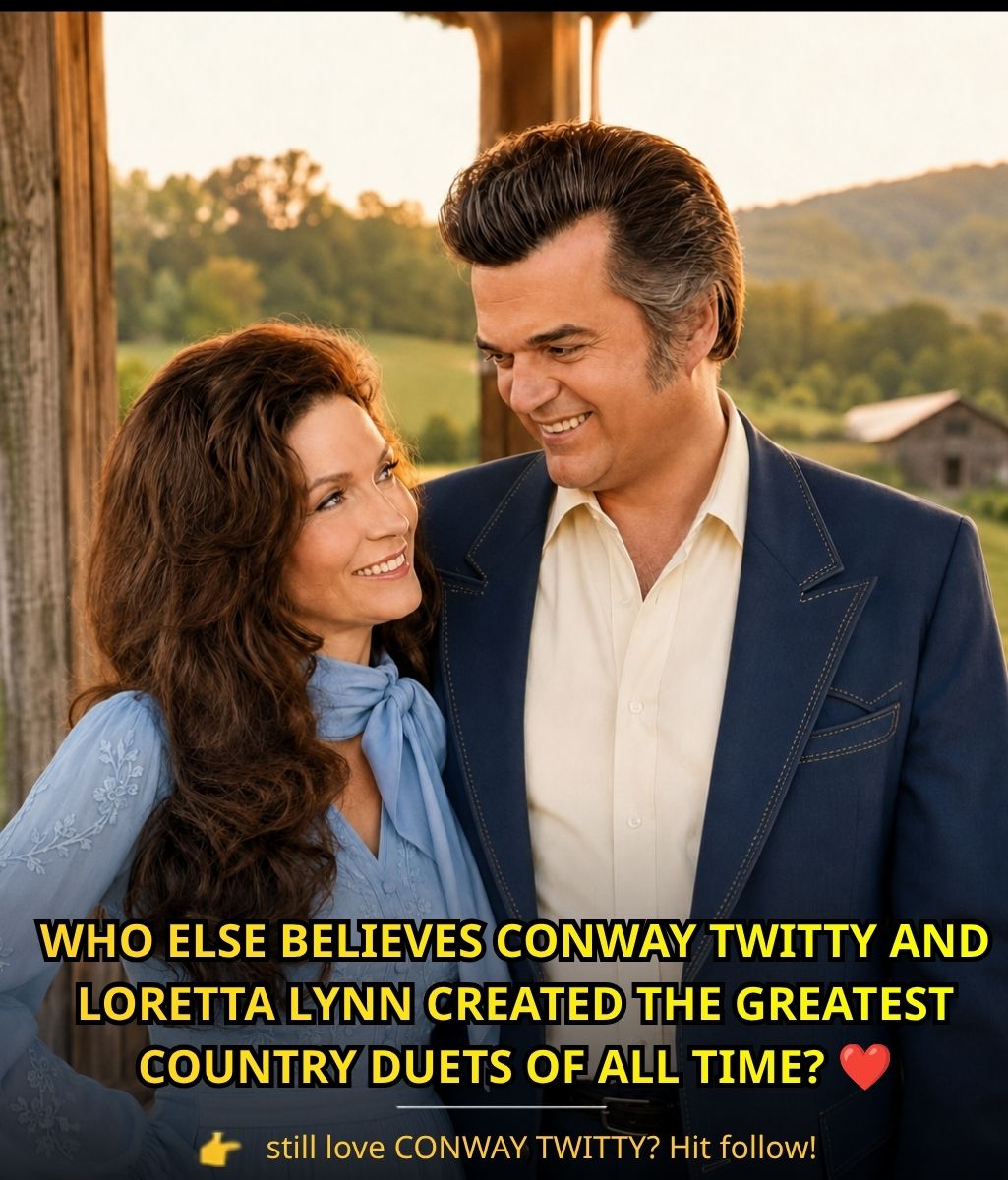
THEY WERE NEVER HUSBAND AND WIFE — yet for years, Conway Twitty and Loretta Lynn shared the kind of chemistry that made millions of country fans wonder whether the songs were telling only part of the story. Every time they stood side by side onstage, traded a lyric, or exchanged one of those knowing smiles, the question seemed to return: was this simply great performance, or was there something deeper between them?
The fascination was easy to understand. Conway and Loretta did not sing together like two stars who had been paired for commercial reasons. They sounded natural, comfortable, and completely believable. Their voices seemed to meet in the middle of every song, and their timing made even the most complicated emotions feel effortless. When they sang about loneliness, temptation, heartbreak, or desire, audiences did not simply hear characters in a song. They often felt as though they were watching two people reveal something private.
That feeling became even stronger because of the songs they chose. “After the Fire Is Gone,” “Lead Me On,” “Louisiana Woman, Mississippi Man,” “As Soon as I Hang Up the Phone,” and “Feelins’” were not distant, impersonal songs. They were built around love, conflict, longing, and relationships that did not always fit neatly into simple categories. Conway and Loretta had the rare ability to step into those stories so completely that fans sometimes forgot where the performance ended.
Their partnership became one of the most successful in country music history. Together, they scored multiple No. 1 singles, released a long run of duet albums, won major industry awards, and helped define the sound of country duets in the 1970s. But the charts only explain part of why people still remember them. Plenty of successful singers have shared hits. Very few created the kind of emotional connection that Conway and Loretta seemed to find every time they stepped toward the same microphone.
Naturally, that chemistry created rumors. Fans watched the way Conway looked at Loretta, the way she answered him, the teasing between songs, and the easy familiarity that came from years of performing together. For some listeners, it became difficult to believe that such chemistry could exist without romance behind it. Yet there is no solid evidence that Conway Twitty and Loretta Lynn carried on a secret love affair, and their story does not need one to be compelling.
What made their bond unusual was the level of trust behind it. A great duet requires something different from a solo performance. Each singer has to listen, react, leave space, and know exactly when to push forward or pull back. Conway and Loretta learned how to do that at an extraordinary level. Neither needed to overpower the other. Loretta could bring fire and vulnerability into a verse, while Conway could answer with the smoothness and restraint that made his voice so recognizable. Together, they created the illusion of an intimate conversation even in front of thousands of people.
That trust also came from years of shared success. Their careers were separate, but their duet work became a world of its own. Audiences expected a certain spark whenever the two names appeared together, and Conway and Loretta understood how to deliver it without making the performance feel forced. The more songs they recorded, the more natural the partnership became, and the more fans began attaching their own stories and assumptions to what they saw.
Behind the rumors, however, was something quieter and more lasting: respect, loyalty, and friendship. Loretta spoke warmly of Conway long after his death, and the two families remained connected through the legacy of the music they made together. That connection later became even more visible when their grandchildren, Tayla Lynn and Tre Twitty, began performing the songs made famous by their grandparents. The fact that another generation could step into those songs decades later says something about how deeply Conway and Loretta’s partnership had become woven into country music history.
When Conway died unexpectedly in 1993, the meaning of those old performances changed. Fans could still play the records and watch the television appearances, but there would never be another new Conway-and-Loretta duet. Suddenly, the smiles, jokes, and glances preserved on film felt more valuable. Songs that had once sounded playful or flirtatious took on the weight of memory, because listeners knew the partnership had come to an end.
Loretta’s own words in later years made clear how much Conway still meant to her. She spoke about missing him and about the pride she believed he would have felt seeing the next generation carry the music forward. That sentiment did not require a hidden romance to be meaningful. In some ways, it made the story more powerful. What Conway and Loretta shared was not easily reduced to one label, because it was built from years of music, friendship, mutual understanding, and a creative connection that few performers ever find.
That may be the real reason people still talk about them. Fans spent decades trying to decide whether Conway Twitty and Loretta Lynn were secretly in love, but perhaps the more interesting truth is that their connection did not need to fit that familiar story. They found something rare enough on its own: two voices that understood each other, two performers who could make an audience believe every word, and a partnership strong enough to survive fame, rumors, changing musical trends, and even death.
All these years later, the magic is still there. Put on “After the Fire Is Gone” or “Louisiana Woman, Mississippi Man,” and for a few minutes Conway and Loretta are together again. The voices meet, the chemistry returns, and the same old question quietly rises in the minds of listeners who never stopped wondering about them.
Maybe that is why their story still matters. They were not husband and wife. There is no verified secret romance waiting to be uncovered. But what they created together was real enough to make generations of fans believe there had to be more — and memorable enough that people are still asking about it decades later.