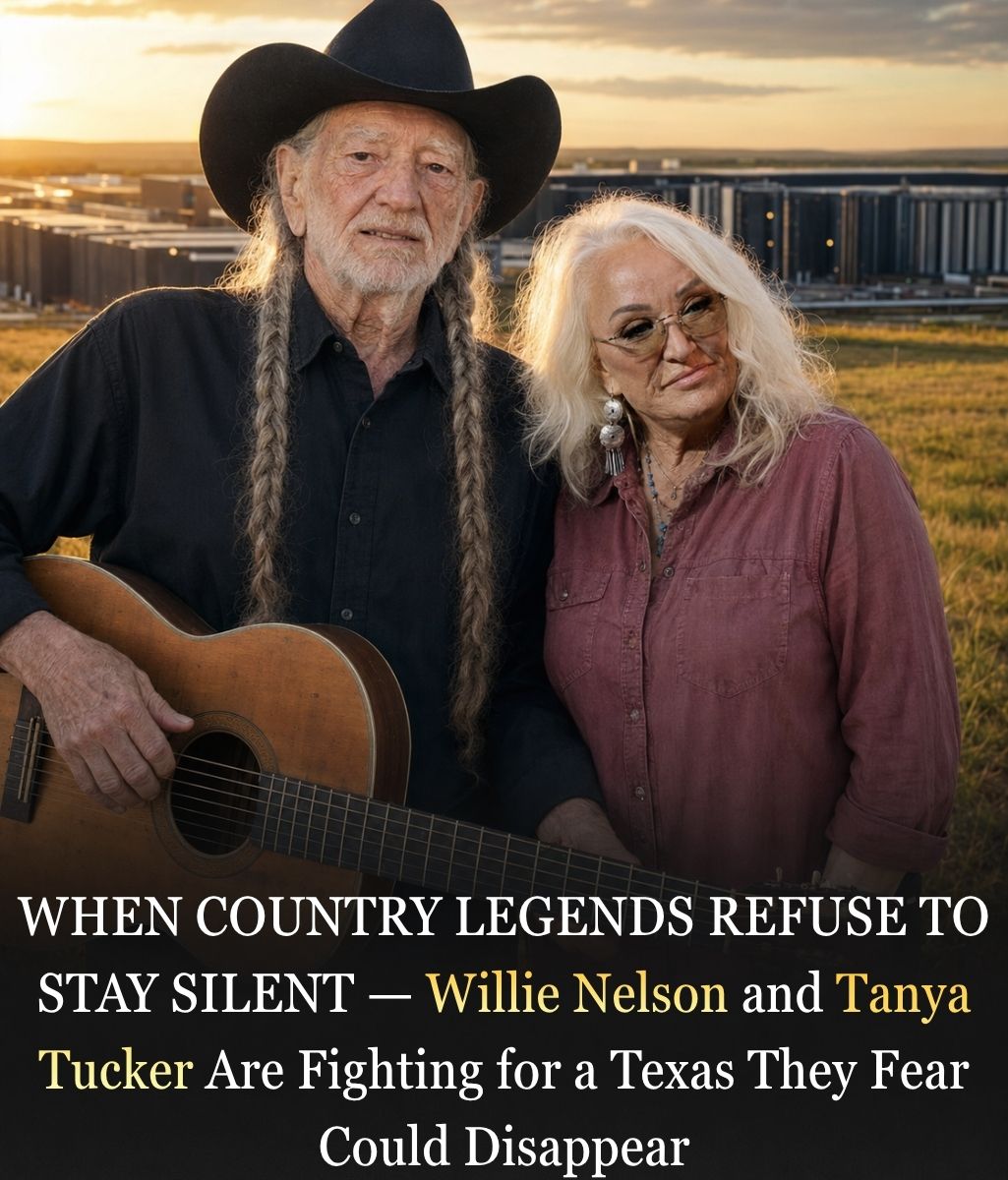
After lifetimes spent singing about ordinary Americans, Willie Nelson and Tanya Tucker are using something even more powerful than another hit record—their voices—to stand beside rural Texans fighting to protect land, water, and a way of life that cannot simply be rebuilt once it is gone.
For Willie Nelson and Tanya Tucker, Texas has never been merely the name of a state printed beneath a birthplace. It is part of the landscape that shaped their music—the open country, ranches, small towns, long highways, working families, and fiercely independent spirit heard across generations of country songs. Now, at a stage of life when both legends could easily step away from public battles, their names have become connected to two growing conflicts over the future of rural Texas. Nelson has spoken out against the rapid expansion of data centers and the pressure they could place on farmland, water, and small communities, while Tucker has joined opposition to proposed 765-kilovolt transmission corridors that critics fear could permanently alter ranches and countryside across Central Texas. Their concerns involve different projects, but underneath them lies the same question: How much of rural Texas should be sacrificed in the name of development before people realize what cannot be replaced?
For Willie Nelson, that question is hardly new. His connection to farmers stretches across decades, most famously through his work as a co-founder of Farm Aid, which began in 1985 as an effort to support family farmers during a devastating agricultural crisis. More than forty years later, Nelson is still speaking about the people who work the land. In July 2026, he publicly criticized the spread of large data centers into rural communities, describing concerns over their water consumption, noise, artificial light, and the conversion of agricultural land. His message came amid a much larger debate in Texas, where data-center development is accelerating and state officials are attempting to understand its potential demands on already valuable resources. The Texas Tribune reported that data centers could account for 3% to 9% of the state’s total water use by 2040, compared with less than 1% today, according to an estimate cited in a University of Texas at Austin analysis.
Those numbers help explain why Nelson’s words carry such emotional weight. For a technology company, water may appear as a resource requirement on a planning document. For a farmer or rancher, water can determine whether a family operation survives another generation. Wells, aquifers, grazing land, and productive soil are not abstract environmental concerns to people whose livelihoods depend on them. Nelson’s warning also touches something larger than one industry. He has argued that rural communities derive their strength from local people, open spaces, family farms, and their connection to the land—not simply from the arrival of enormous industrial projects promising economic growth. His intervention gives small communities something they often struggle to obtain on their own: national attention. A rancher speaking at a local meeting may be heard by dozens. Willie Nelson saying the same concern aloud can make millions pay attention.
Tanya Tucker has stepped into another Texas battle carrying similar concerns about land and identity. In 2026, Tucker joined actor Dennis Quaid and affected Texans in opposing proposed 765-kV transmission infrastructure across Central Texas. The project under review involves high-capacity power corridors potentially extending through multiple counties, and critics have raised concerns about private property, farming operations, wildlife habitat, property values, and the transformation of historic ranch landscapes. Tucker’s involvement places an internationally recognized country voice beside families who fear that decisions made far from their fences could permanently change land passed down through generations. Lawmakers have also called for additional review, while supporters of expanded transmission argue that Texas needs stronger infrastructure to meet growing electricity demand and maintain grid reliability. That distinction matters: the debate is not simply about electricity versus nature, but about how necessary infrastructure should be built, where it should go, and who bears the lasting cost.
For longtime country listeners, there is something deeply fitting about seeing Willie Nelson and Tanya Tucker involved in these conversations. Country music has always drawn much of its emotional power from land, home, family, work, independence, and memory. Those themes can sound sentimental when preserved inside a three-minute song, but for rural families they are practical realities. A pasture is not simply scenery when cattle depend on it. A family farm is not merely an attractive piece of countryside when generations have spent their lives keeping it alive. And a wide Texas horizon is more than an image on an album cover when it forms part of the identity of the people living beneath it.
Their celebrity cannot decide these disputes, nor does fame automatically make every argument correct. Texas faces genuine challenges involving electricity demand, economic growth, technology infrastructure, water security, and an expanding population. Data centers require power and cooling, while transmission projects can be essential to moving electricity across a rapidly changing grid. The difficult question is whether progress can occur without asking rural communities to surrender disproportionate pieces of what makes those communities worth protecting. That is where voices such as Nelson’s and Tucker’s become significant. They can force conversations that might otherwise remain buried in regulatory filings, corporate proposals, and meetings most Americans never hear about.
There is also an unmistakable symbolism in the timing. Willie Nelson is 93, and Tanya Tucker has spent more than five decades in the public eye. Neither needs another cause to make a name. Neither needs controversy to sell the story of an already extraordinary career. Yet they are lending their visibility to arguments involving ranchers, farmers, property owners, and rural communities at a moment when Texas is confronting enormous technological and energy expansion.
Perhaps that is what makes their involvement resonate beyond politics or infrastructure. A legend’s value is not measured only by records sold, awards collected, or nights spent beneath stage lights. Sometimes it is measured by what that person chooses to defend after the applause is no longer necessary.
Willie Nelson and Tanya Tucker built careers singing to people who understood what it meant to work, lose, endure, and hold on. Decades later, they are still speaking for that world—not from nostalgia, but from a belief that progress should never require forgetting the people, land, and resources that made Texas home in the first place.