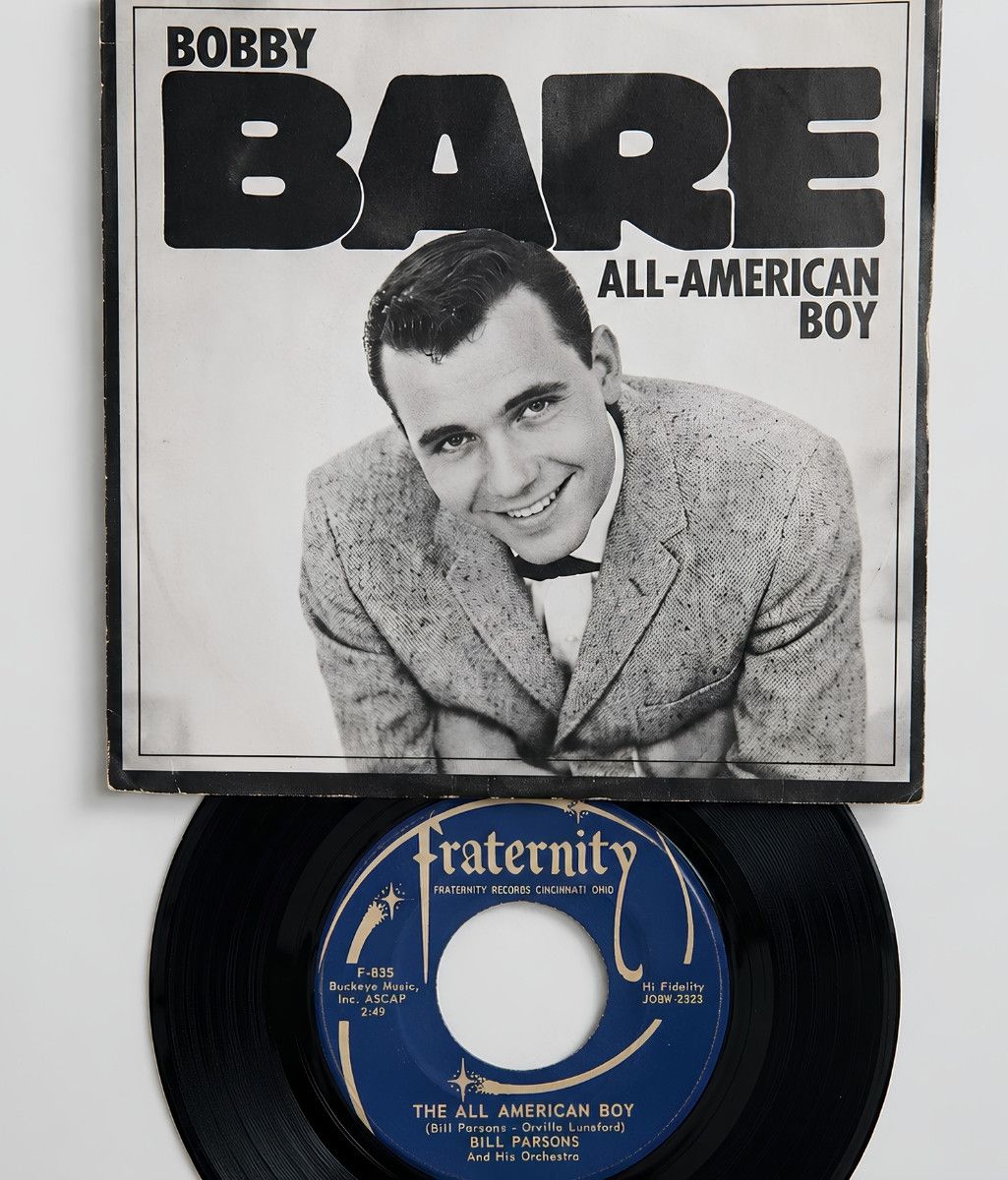
Before Bobby Bare became one of country music’s greatest storytellers, his voice had already captivated millions of listeners across America. Yet when his first major hit, “The All American Boy,” climbed to No. 2 on the Billboard Hot 100 in 1959, the public believed they were hearing another singer. It would become one of the most remarkable and bittersweet stories in country music history—a breakthrough that made Bobby Bare famous without anyone knowing his name.
Some artists spend years searching for the song that changes their lives. For Bobby Bare, that song arrived remarkably early. The only problem was that someone else received almost all the credit.
In the late 1950s, Bobby Bare was still an unknown young musician trying to establish himself in an industry where opportunities were scarce and success was never guaranteed. Like countless aspiring artists before him, he accepted recording sessions wherever he could, hoping that one performance might finally open the door to a lasting career.
That opportunity came with “The All American Boy.”
Bare’s warm, unmistakable voice brought the humorous novelty song to life with a sincerity and charm that immediately connected with listeners. Few people involved with the recording could have predicted what happened next. As radio stations across the United States began playing the record, demand exploded. The song quickly became one of the biggest hits in the country, eventually climbing to No. 2 on the Billboard Hot 100 and introducing millions of Americans to a voice they instantly loved.
But there was one extraordinary twist.
The name printed on the record was not Bobby Bare.
Because Bare remained under contract with another record company, releasing the recording under his own name created significant legal complications. To avoid a contractual dispute, Fraternity Records issued the single under the name of Bill Parsons, another singer associated with the label. What was intended as a practical business decision soon developed into one of the most unusual situations in popular music.
As “The All American Boy” became a nationwide sensation, audiences naturally assumed that Bill Parsons had recorded the song. Television producers invited Parsons to appear on programs promoting the hit, and he performed by lip-syncing to the recording that actually featured Bobby Bare’s voice. Meanwhile, the young singer whose performance had captured the nation’s attention remained almost completely invisible to the public.
Imagine hearing your own voice echoing across the country while watching someone else receive the applause.
For Bobby Bare, that became reality.
Although the recording opened doors within the music industry, it brought little of the public recognition that usually accompanies a hit of such enormous success. The financial rewards were also far smaller than many people might expect from a song that reached the top of the charts. At the very moment when his career should have been accelerating, the artist behind the performance remained largely unknown outside the recording business.
Many young musicians might have become discouraged after experiencing such a painful disappointment.
Bobby Bare chose another path.
Instead of allowing frustration to define his future, he continued writing, recording, and performing, believing that another opportunity would eventually arrive. His determination reflected the resilience that had shaped him since childhood, when poverty, personal loss, and hardship had already taught him never to surrender after a setback.
His patience would eventually be rewarded.
During the following years, Bobby Bare established himself as one of country music’s finest storytellers through timeless recordings such as Detroit City, 500 Miles Away from Home, Marie Laveau, and The Winner. His honest voice, compassionate storytelling, and remarkable ability to capture everyday life earned him the admiration of audiences around the world. Decades later, his extraordinary contributions were recognized with induction into the Country Music Hall of Fame, ensuring his place among the genre’s greatest legends.
Looking back today, the story of “The All American Boy” feels almost unbelievable. What should have been the triumphant beginning of a remarkable career instead became a hidden chapter known only to industry insiders for many years. Yet perhaps that unexpected setback ultimately strengthened the determination that would define everything Bobby Bare accomplished afterward.
Today, music historians recognize Bobby Bare as the true voice behind one of the late 1950s’ biggest hits. The truth has long since emerged, giving proper credit to the artist whose performance first captivated America. What once seemed like an unfortunate twist of fate has become one of country music’s most fascinating stories—a reminder that history does not always recognize greatness immediately.
Sometimes the world hears a legendary voice long before it learns the name behind it. For Bobby Bare, that remarkable journey began with a chart-topping song, a hidden identity, and the quiet determination to keep believing that one day the truth—and the recognition—would finally find its way home.