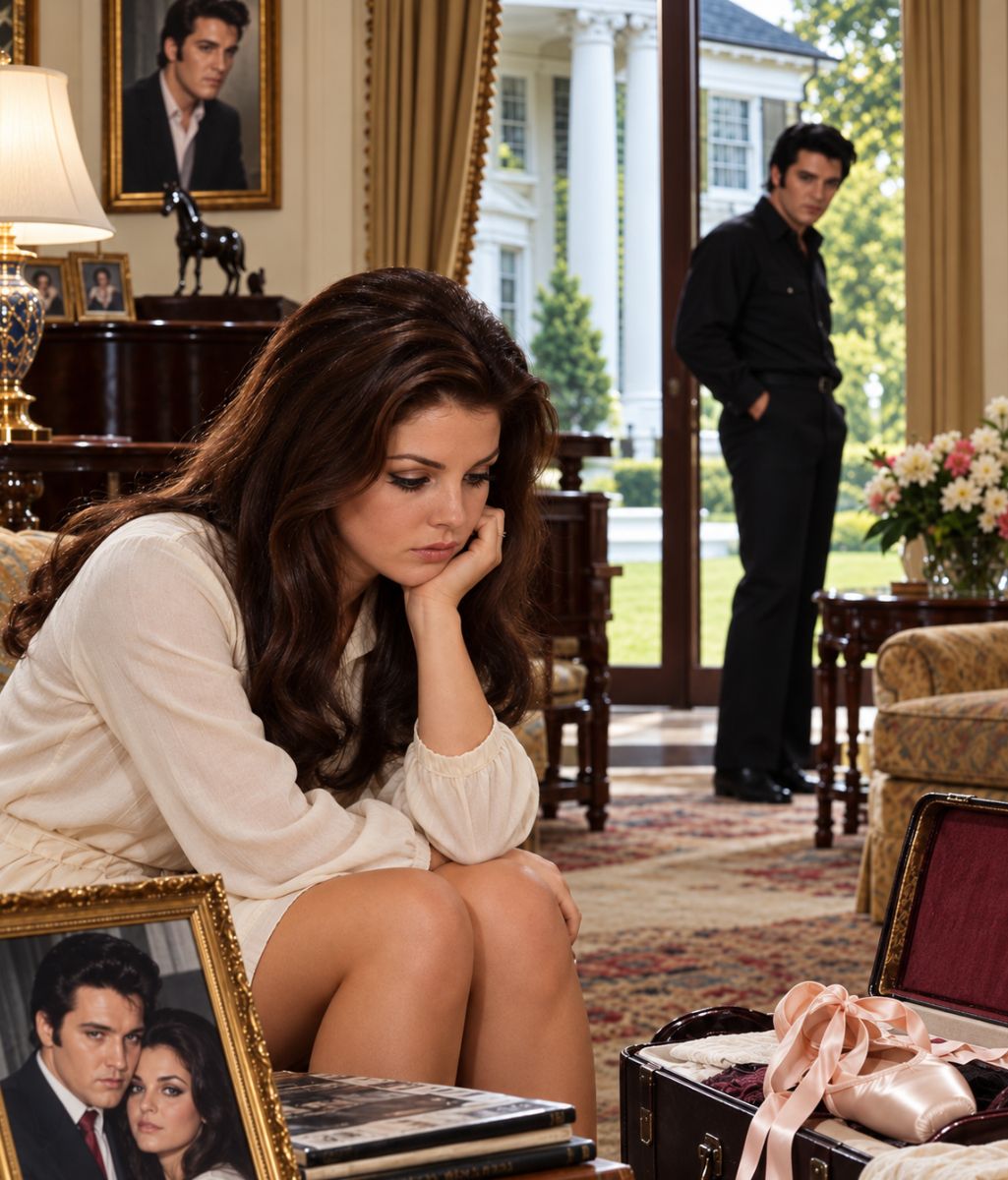
When Priscilla Presley first entered Elvis Presley’s world, Graceland seemed to represent everything a young woman could imagine about romance, glamour and possibility. The mansion was already becoming a symbol of Elvis’s success, filled with music, visitors, expensive furnishings and the constant energy surrounding one of the most famous men in the world. From the outside, it looked like the kind of life millions of people could only dream about.
Inside the gates, however, Priscilla gradually discovered that living close to Elvis could also mean living far away from an ordinary life of her own.
She had entered his world when she was still very young, and by the time she was living at Graceland, nearly every part of her daily routine revolved around Elvis. The people around him became her social circle, the house became her environment, and his schedule often determined when life felt active and when everything suddenly became quiet. Years later, Priscilla would describe that world as overwhelmingly male, dominated by Elvis’s entourage and the rhythms of his career. What appeared exciting to outsiders could feel intensely lonely from the inside.
That loneliness became especially difficult when Elvis was away.
During the years when he spent long stretches filming movies in Los Angeles, Priscilla often remained behind, waiting for his calls and wondering what was happening in a life she could not see. She later recalled counting the days until he returned and worrying about the women constantly surrounding him. Even while living inside one of the most famous homes in America, she could find herself alone with her thoughts, increasingly anxious about whether someone else might take her place.
The contradiction slowly became impossible to ignore.
Priscilla had many of the things that made Graceland appear magical, including beautiful clothes, horses, travel and access to a world of celebrity that few people would ever experience. Yet those things could not answer the deeper question beginning to form inside her: who was she when Elvis was not there?
That question became more urgent as the years passed.
After she and Elvis married in 1967 and welcomed Lisa Marie the following year, Priscilla tried to balance motherhood with the demands of being Elvis Presley’s wife. His touring schedule increased, his absences became longer and the insecurity she had already felt grew heavier. In her later writing, she described the isolation and helplessness of that period as emotionally exhausting, explaining that the life people envied from a distance had become something she no longer knew how to survive comfortably.
What made the situation so complicated was that Priscilla still loved Elvis.
Her decision to leave was not a simple rejection of him or of everything they had shared. It was increasingly about the realization that she had spent so much of her young life adapting to Elvis’s world that she had never fully discovered a separate identity of her own. Her publisher’s description of her later memoir puts that conflict plainly: after years inside Elvis’s life, she had reached a point where she did not know who she was outside it.
That is why the story of Graceland looks different when told from Priscilla’s side.
The mansion was never simply a prison, and she has never reduced her years with Elvis to one emotion. There was love, excitement, privilege and genuine happiness there, but those memories existed beside loneliness, anxiety and a growing desire for independence.
Eventually, Priscilla understood that leaving did not mean erasing the love she had felt.
It meant finding room to become someone beyond it.
Graceland had once looked like the center of Priscilla Presley’s dream, but over time she learned that even the most beautiful dream can begin to feel confining when there is no space left to discover who you are on your own.