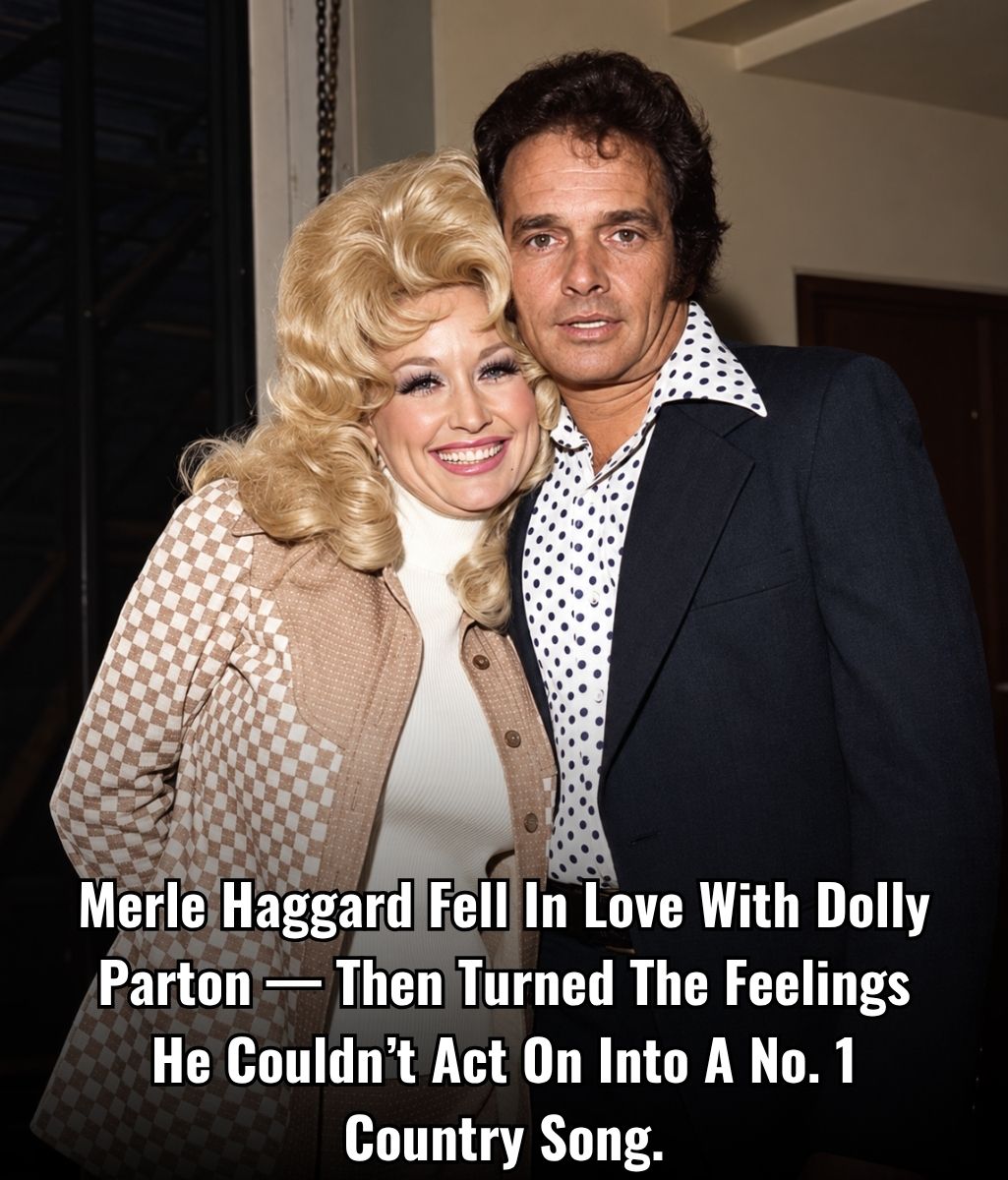
In the early 1970s, Merle Haggard and Dolly Parton found themselves spending long stretches of time together on the road, sharing stages, buses, conversations, songs, and the strange intimacy that develops when musicians spend months traveling from city to city. Both were already major country stars, but for Merle, the relationship gradually became something more complicated than friendship. Years later, he admitted that he had fallen deeply for Dolly, even though the circumstances made a real romance impossible.
Merle did not describe his feelings as a passing crush. In his 1981 memoir Sing Me Back Home, he wrote about Dolly with remarkable openness, remembering not only the glamorous performer audiences saw onstage but the young woman who would sit on the floor of his tour bus, talk about her dreams, and radiate an almost overwhelming confidence about the future. Merle said he had fallen in love not merely with Dolly’s public image but with the person underneath it.
At the time, however, Dolly was married to Carl Dean, whom she had wed in 1966. Merle’s own personal life was complicated as well, and Dolly made her position clear. According to Merle’s account, she repeatedly reminded him that she loved Carl and was not going to turn their friendship into something else. That boundary did not erase Merle’s feelings, but it did leave him with something country songwriters have always understood particularly well: emotion with nowhere to go.
So Merle wrote.
The song became “Always Wanting You,” a painfully direct title for exactly what he was experiencing. Instead of disguising the situation behind an elaborate fictional story, Merle turned the frustration of wanting someone he could not have into a traditional country love song. The emotional tension was simple: desire remained, but the relationship he imagined could never actually become his.
Then Merle did something even more revealing.
After writing the song, he called Dolly in the middle of the night — accounts place the call at around 3 a.m. — and sang it to her over the telephone. Merle later remembered staring at the receiver while he performed, desperately wishing he could see Dolly’s face and know what she was thinking as she listened. By the time he finished, he said he was so overwhelmed that he could barely remember exactly how she responded.
Dolly later remembered the situation with her characteristic mixture of humor and honesty. She acknowledged knowing that Merle had feelings for her and said she did not know whether to feel embarrassed or flattered by the song. What never changed, however, was the boundary she had already drawn around her marriage to Carl. Whatever Merle felt, Dolly was not going to turn it into an affair.
The remarkable part is what happened after the private emotion became public music.
Released in February 1975 on Merle’s album Keep Movin’ On, “Always Wanting You” climbed to the top of Billboard’s country chart and remained at No. 1 for two weeks. It became Merle Haggard’s 20th country chart-topper, proving once again that some of country music’s most successful songs begin with situations the writer would probably rather not be living through.
The timing made the story even more intertwined with Dolly. On the same album, Merle recorded Dolly’s “Kentucky Gambler,” which also became a No. 1 country hit. That recording gave Dolly an important songwriting milestone: it became her first No. 1 as a songwriter through another artist’s recording. In other words, while Merle was turning his feelings for Dolly into one chart-topper, he was also taking one of Dolly’s own compositions to the top.
Their musical connection continued after the romantic tension had passed. Merle later recorded Dolly’s “The Seeker,” while Dolly recorded his “You’ll Always Be Special to Me.” They remained friends, and decades later Merle still spoke about Dolly with extraordinary admiration. In one of his later interviews, he described her as one of the most charismatic people he had ever known, proof that the affection had never turned into bitterness simply because the relationship he once imagined never happened.
Dolly felt affection for Merle too, but in a different form. When he died in 2016, she remembered him as one of country music’s greatest singers and songwriters and said she had loved him “like a brother.” The words quietly captured the difference between the relationship Merle once wanted and the friendship Dolly ultimately chose.
That is what makes “Always Wanting You” such an unusual piece of country history. It was not merely another heartbreak song created from imagination. Its emotional core came from one of the genre’s greatest songwriters struggling with feelings for another future legend who was sitting only a few feet away on tour buses and backstage rooms — close enough to inspire him, but never truly available to him.
Merle Haggard could not change Dolly Parton’s answer, and he could not turn that longing into the relationship he wanted. What he could do was something he had done throughout his life: take an emotion that hurt, place it inside a melody, and let millions of strangers recognize themselves in it.
The romance never happened. The song did. And in 1975, the feelings Merle Haggard could not act on became “Always Wanting You” — a No. 1 country hit inspired by the woman he could never have.