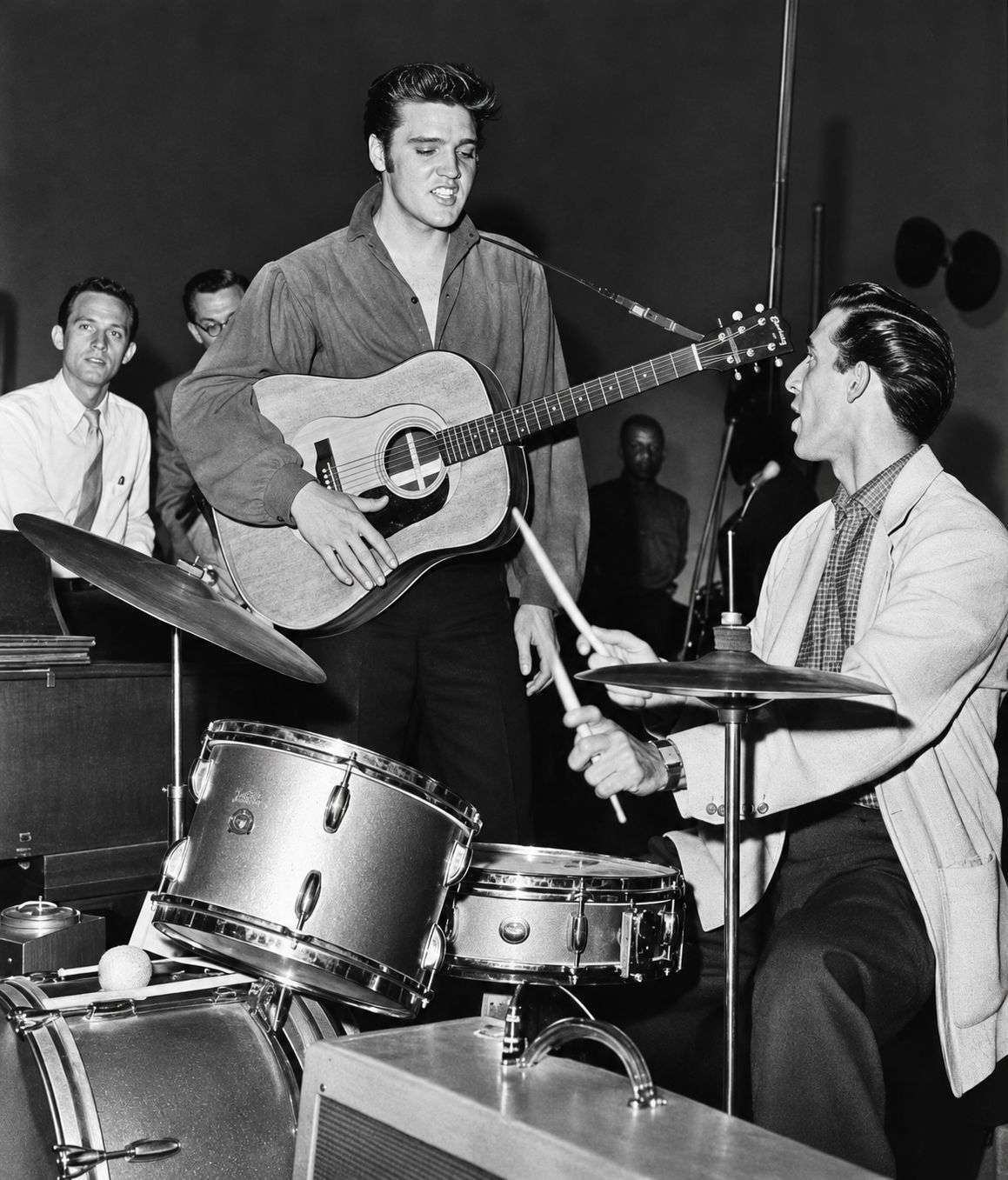
As families gather this Thanksgiving to celebrate the people, friendships and memories that have shaped their lives, one unforgettable moment from Elvis Presley’s extraordinary career seems particularly meaningful. It took place in 1968, when the King reunited with two musicians who had known him long before the Hollywood films, the enormous fortune and the overwhelming responsibilities of international fame.
Their names were Scotty Moore and D. J. Fontana, and together they had helped Elvis create a sound that changed popular music forever.
In 1954, when Elvis began recording at Sun Records in Memphis, Scotty Moore’s distinctive guitar playing helped establish the musical identity of a young singer who was still discovering his potential. D. J. Fontana subsequently became an essential part of the group, bringing the rhythmic energy that powered many of Elvis’s earliest rock-and-roll performances.
Alongside bassist Bill Black, they witnessed the remarkable transformation of a young man from Mississippi into an international sensation. They traveled together, performed before increasingly enthusiastic audiences and experienced the excitement of creating music unlike anything the public had heard before.
However, as Elvis’s career expanded into Hollywood, their professional paths gradually separated. By 1968, Elvis had spent much of the previous decade making movies, and the musical simplicity that had characterized his earliest recordings seemed increasingly distant.
That began to change when television director Steve Binder started developing what would eventually become the legendary ’68 Comeback Special. Inspired by the informal music sessions surrounding rehearsals, Binder wanted audiences to experience something more authentic than a carefully rehearsed television production. Elvis reunited with Scotty and D. J., giving the musicians an opportunity to rediscover the chemistry that had helped launch his career.
On June 27, 1968, inside an NBC television studio in Burbank, California, Elvis appeared dressed in black leather, surrounded by familiar musicians and friends. Rather than standing apart from everyone as the world’s most famous entertainer, he sat among them, laughing, exchanging jokes and returning to the songs that had brought them together years earlier.
There was something particularly moving about watching Elvis perform alongside men who remembered him before the world started calling him the King. Their shared musical history allowed the performance to unfold with a spontaneity that no elaborate Hollywood production could have recreated.
During the sessions, Elvis returned to songs such as “That’s All Right,” “Lawdy Miss Clawdy” and “Trying to Get to You,” rediscovering the raw energy and emotional freedom of his early recordings. At one point, he exchanged guitars with Scotty, bringing an even more powerful electric sound to the performance.
The reunion also carried a bittersweet sense of absence. Bill Black, who had played such an important role in their earliest recordings, had died in 1965 and could not be there to share the occasion. His absence served as a reminder that even the most treasured chapters of life cannot be completely recreated.
What makes the footage especially poignant today is knowing that the special would be the final occasion on which Scotty Moore and D. J. Fontana performed with Elvis. At the time, they were simply old musical partners enjoying an extraordinary opportunity to play together again, unaware of how precious those moments would eventually become to generations of fans.
When the special aired on December 3, 1968, it helped restore Elvis’s standing as one of the most compelling performers in contemporary music. Yet beyond its historical importance, the reunion revealed something deeply human about the man behind the legendary image. Despite everything Elvis had achieved, returning to the people who understood his musical beginnings brought out a warmth, humor and natural enthusiasm that remain unmistakable in the surviving footage.
This Thanksgiving, their reunion offers a beautiful reminder that success is rarely a journey taken entirely alone. Behind many extraordinary achievements are people who offered encouragement, shared difficult beginnings and believed in possibilities long before the rest of the world recognized them.
Elvis Presley became a king in the eyes of millions, but watching him laugh and make music beside Scotty Moore and D. J. Fontana in 1968 reminds us that some of life’s most meaningful treasures are not fame, wealth or applause, but the friendships and shared memories that helped make the journey possible.