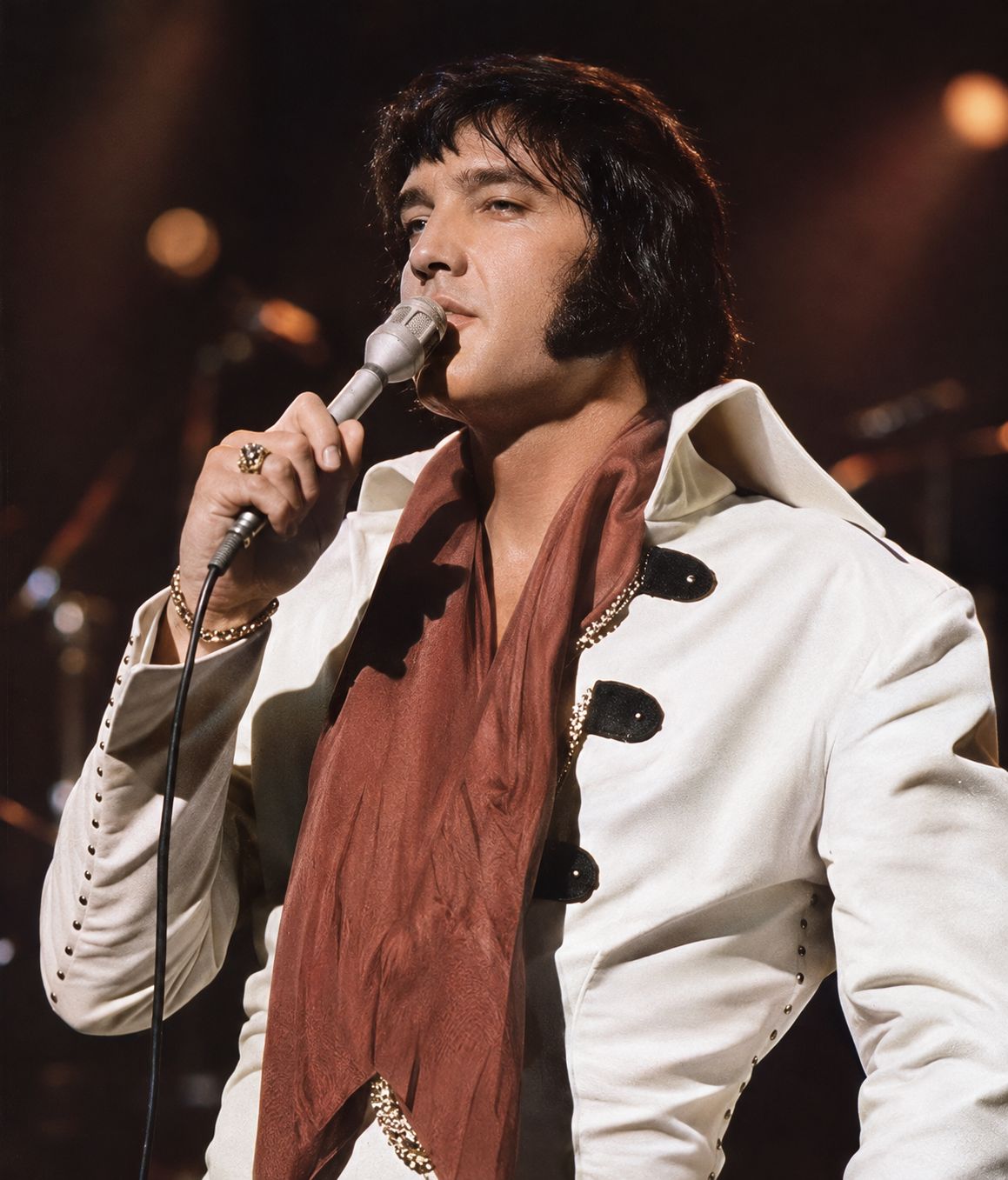
By the beginning of 1969, Elvis Presley was trying to prove that his greatest years were not already behind him.
After much of the 1960s had been dominated by Hollywood films and soundtrack albums, the spectacular success of his 1968 television special had reminded America what Elvis could still do when the music came first. A month later, he returned to Memphis and entered American Sound Studio, determined to record material that sounded contemporary, serious and alive.
Among the songs waiting for him was “In the Ghetto.”
Elvis immediately understood that it was different.
Written by Mac Davis, the song told the story of poverty repeating itself from one generation to the next. A child is born into deprivation, grows up surrounded by desperation and eventually dies violently, just as another child enters the same cycle.
For Elvis, recording something that socially direct carried a risk.
His longtime manager, Colonel Tom Parker, had repeatedly advised him to avoid “message songs,” fearing that taking a position on social issues could alienate part of his audience. Elvis’s friend Marty Lacker later recalled that during the session, Elvis expressed serious hesitation and said he did not think he should record the song.
Producer Chips Moman refused to let the moment pass.
Moman believed the song was a hit and reportedly told Elvis that if he did not want to record it, Moman wanted the song himself. That challenge apparently settled the matter. Elvis decided to go ahead and spent much of the January 20 session working through numerous takes until they had the performance they wanted.
The decision proved crucial.
Released in 1969, “In the Ghetto” reached No. 3 on the Billboard Hot 100, becoming Elvis’s first Top 10 single in several years and one of the records that confirmed his comeback was real. The Memphis sessions also produced “Suspicious Minds,” “Don’t Cry Daddy” and other recordings that restored Elvis as a major contemporary recording artist rather than simply a star associated with an earlier era.
What makes the story especially interesting is that Elvis did not approach the song casually.
There had been concern about how audiences might react to a wealthy white superstar singing about poverty in an inner-city neighborhood. Yet when Elvis was later asked why he had recorded a message song such as “In the Ghetto,” his answer was straightforward: he believed it was simply too good to pass up.
The song also connected unexpectedly with Elvis’s own past.
He had grown up poor in Tupelo, Mississippi, before his family moved to Memphis, and although his childhood circumstances were different from those described in Mac Davis’s lyric, Elvis understood what it meant to come from very little. That background gave his restrained performance a seriousness that separated it from many of the movie songs he had recorded during the previous decade.
The comeback did not stop there.
Later in 1969, “Suspicious Minds” reached No. 1, becoming Elvis’s first Billboard chart-topper since “Good Luck Charm” in 1962 and completing one of the most important career revivals in popular music.
But “In the Ghetto” had helped open the door.
Elvis Presley nearly walked away from the song because he understood the controversy it might create. Instead, he trusted the music, recorded it, and delivered one of the most socially conscious performances of his career. Fifty-seven years later, the record remains proof that one of the greatest moments of Elvis’s comeback began with a song he was not sure he should sing at all.