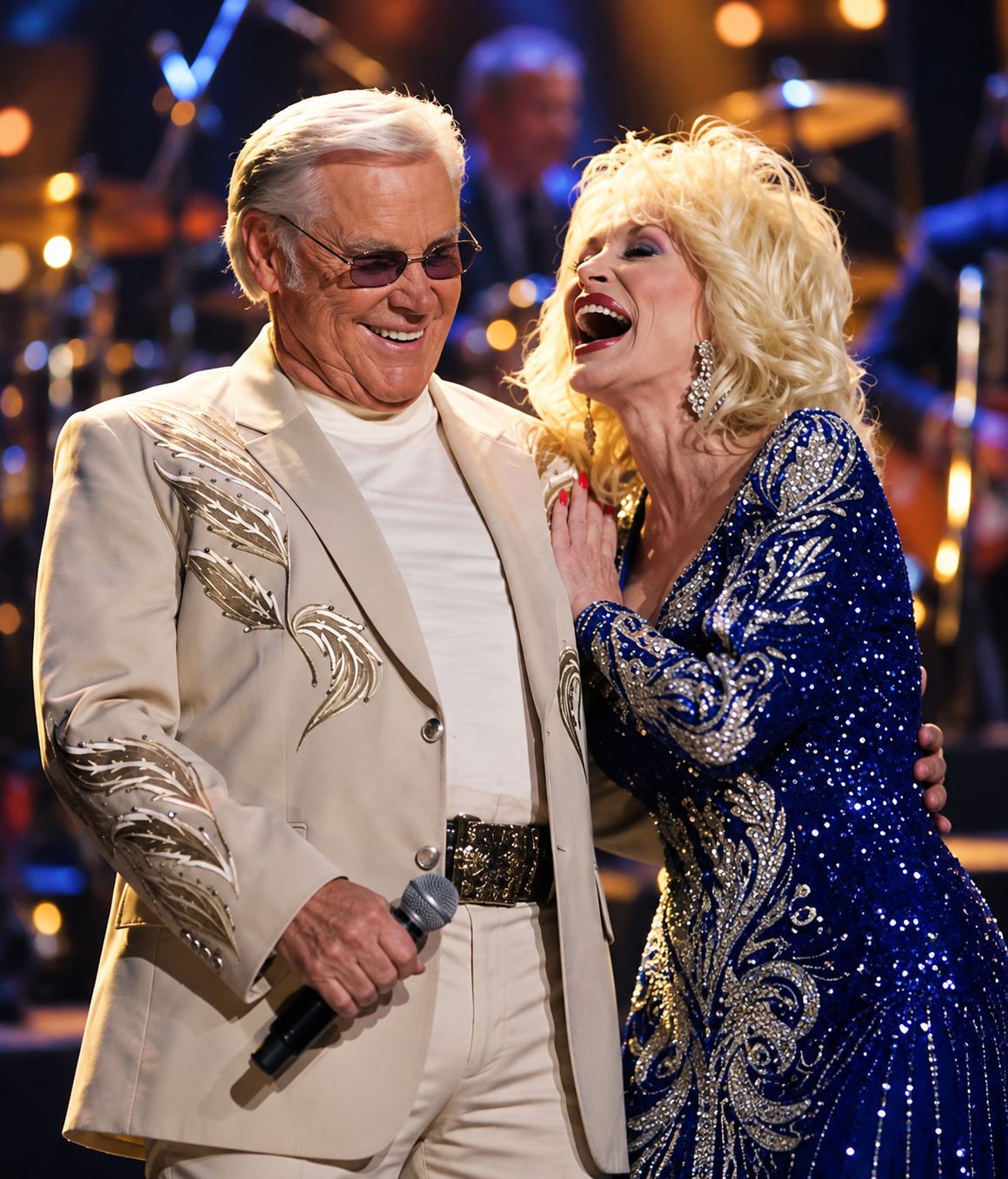
By 2005, George Jones had already lived through almost every chapter a country singer could survive. He had known enormous success, broken marriages, addiction, missed shows, public embarrassment and one of the greatest comebacks in country music history. His voice had changed with those years, becoming rougher and more fragile, but also more believable. When he entered the studio to record “The Blues Man” with Dolly Parton, the song sounded less like another cover and more like a reflection on the life he had actually lived.
Written by Hank Williams Jr., “The Blues Man” tells the story of a singer nearly destroyed by the life surrounding his music before love helps pull him back from the edge. For George, those words carried an uncomfortable familiarity. His struggles with alcohol and drugs had become public knowledge, and his repeated concert cancellations once earned him the nickname “No Show Jones.” Yet by the time he recorded the song, he had also experienced something the lyrics understood just as deeply: survival.
That is where Dolly’s presence changed the recording.
She did not need to compete with George’s weathered voice. Instead, her warmer, clearer tone seemed to answer it, creating the feeling of two people looking back at a difficult life from opposite sides of the same story. The performance was included on George’s 2005 album Hits I Missed…And One I Didn’t, a collection built around songs he admired and wished he had recorded himself. Their version of “The Blues Man” became one of the album’s most memorable collaborations.
The pairing carried another layer of meaning because Dolly had admired George for years.
After his death in 2013, she remembered him as her all-time favorite singer and one of her favorite people, a tribute that revealed how highly she regarded both the artist and the man. Long before their duet, Dolly had even performed George’s “You Gotta Be My Baby” during her first Grand Ole Opry appearance as a 13-year-old in 1959. In a remarkable way, George’s music had been present near the beginning of her journey, and decades later their voices finally met on record.
That history makes “The Blues Man” feel different today.
George was not simply singing about a fictional musician who nearly lost everything. By then, listeners knew enough about his life to hear pieces of his own story inside the song: the drinking, the chaos, the lonely spotlight and the long road back. Dolly’s voice beside him added tenderness rather than judgment, making the duet feel less like a confession and more like someone standing beside a man who had survived his worst years.
Near the end of George’s life, the connection between the two legends was still growing. In early 2013, reports said George had enlisted Dolly’s songwriting help for what he expected to be his final album, with Jones praising her abilities and saying he was waiting for her guidance on what to sing. George died that April before the project could become the final chapter they had imagined.
That unfinished plan gives their earlier duet an added weight now.
“The Blues Man” was never meant to be a goodbye, but hearing George Jones and Dolly Parton together today makes it feel almost like one. Two legendary voices met for a song about falling, surviving and finding someone who helps you keep going — and for George Jones, few songs could have told that story more truthfully.