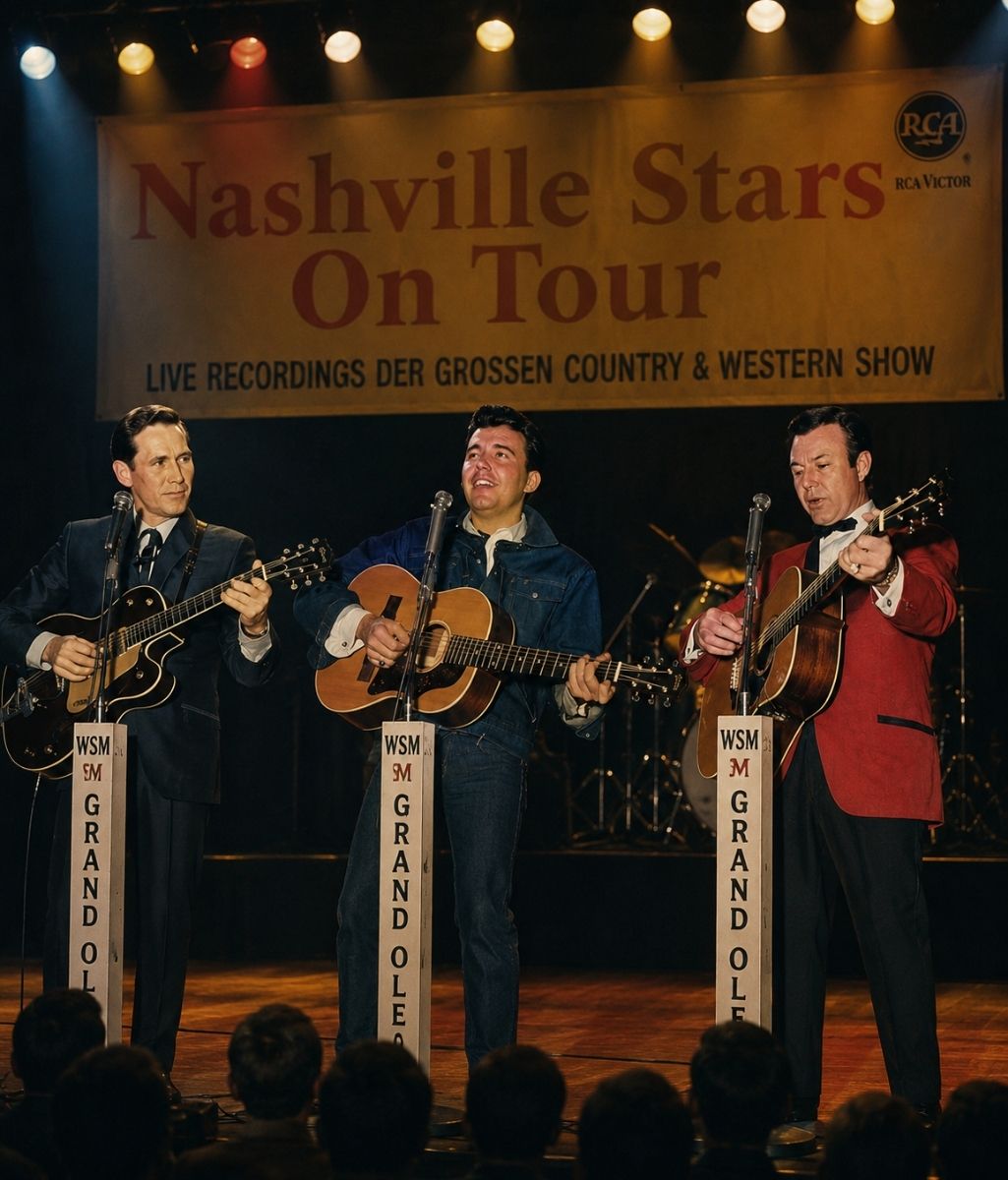
Long before country music became a familiar sound far beyond the borders of the United States, Bobby Bare was part of a generation of artists helping introduce Nashville’s music to audiences thousands of miles from home. In the early 1960s, when international touring was far less routine for country performers than it would become in later decades, Bare traveled to Europe during a remarkable period in the genre’s history, appearing in the company of celebrated figures including Jim Reeves and Chet Atkins. Looking back more than sixty years later, those early journeys seem like much more than another series of concerts. They belonged to an important chapter when country music was beginning to discover just how far its stories, melodies, and voices could travel.
Today, it is easy to forget how different the world of country music looked in the early 1960s. Nashville was already becoming a major recording center, and the Nashville Sound was helping country records reach listeners who might never have considered themselves traditional country fans. But taking that music overseas was another matter entirely. There was no social media, no streaming service, and no instant way for an American performer to reach millions of listeners in another country. Records, radio broadcasts, television appearances, and live performances were the bridges connecting artists with distant audiences. That made an overseas appearance something special. When country musicians crossed the Atlantic, they were not simply promoting themselves — they were carrying a distinctly American musical tradition into places where many listeners had rarely experienced its stars in person.
Bobby Bare was especially well suited to that changing era. His career would eventually become associated with songs that emphasized storytelling, personality, and an understated honesty that never seemed forced. He possessed the kind of voice that did not need unnecessary decoration. Bare could make a song feel lived-in, as though the story existed long before anyone decided to put it on a record. That quality would later help establish him as one of country music’s most respected interpreters, but during those early years, he was still building the career that would make his name familiar to generations of listeners.
Then there was Jim Reeves, whose smooth baritone had already demonstrated that country music could travel remarkably well. Reeves possessed a polished vocal style that crossed musical boundaries, and his popularity outside the United States became an important part of his legacy. To overseas listeners discovering American country music, Reeves represented a sophisticated side of Nashville — warm, elegant, and immediately recognizable. Standing in the same broad international movement as an artist like Reeves placed Bobby Bare near the center of something much larger than a single performer’s career.
And alongside them was Chet Atkins, a man whose influence on Nashville is almost impossible to measure. Atkins was not merely an extraordinary guitarist. As a musician, producer, and industry figure, he played a major role in shaping the polished Nashville Sound that helped country music reach a broader audience. His approach proved that the genre could evolve without losing the emotional honesty at its core. When names such as Bobby Bare, Jim Reeves, and Chet Atkins appeared in the story of country music reaching audiences abroad, they represented three very different strengths: Bare brought the storyteller’s instinct, Reeves brought the unmistakable voice, and Atkins brought musicianship and a vision for where Nashville music could go next.
What makes this chapter particularly fascinating today is how little attention these early international efforts sometimes receive compared with the enormous global tours of later country stars. Modern audiences are accustomed to seeing American performers appear in major arenas across Europe. In the early 1960s, however, the idea carried a different sense of adventure. Traveling overseas required more effort, communication was slower, and artists could not know exactly how audiences thousands of miles from Nashville would respond. Yet the music found listeners.
That fact revealed something important about country music: its stories did not need an American address to be understood. Songs about home, hardship, loneliness, hope, family, work, and the passing of time could reach people regardless of where they lived. A listener in Europe might never have walked through a Tennessee town or driven an American country road, but the emotions inside those songs needed no translation. The details might have been American, but the feelings were universal.
For Bobby Bare, these experiences came around the beginning of one of the most important periods of his career. He would go on to record songs that became country standards and build a reputation as an artist willing to follow a story wherever it led. His catalog would eventually include classics such as “Detroit City,” “500 Miles Away from Home,” and “Marie Laveau,” while his independent spirit would make him an important figure in the broader evolution of Nashville music. Yet before many of those chapters were fully written, Bare had already experienced something that relatively few American country performers of his generation could claim: seeing firsthand that the music had an audience far beyond home.
There is also something wonderfully fitting about Bobby Bare being part of that story. He never seemed like an artist who needed enormous spectacle around him. Much of his appeal came from simplicity — a strong song, an unmistakable voice, and a story worth hearing. Those qualities travel remarkably well. They worked on American radio, they worked on Nashville stages, and they could work before listeners on the other side of the Atlantic.
More than six decades later, country music is unquestionably international. Fans around the world can hear a new Nashville release seconds after it appears. American country stars routinely perform overseas, and classic recordings remain available to listeners who were not even born when the original records were made. That world did not appear overnight. It grew gradually, carried outward by records, radio signals, musicians, promoters, and pioneering tours that proved there was an audience waiting beyond America.
And somewhere in that early story stands Bobby Bare — traveling far from Nashville during a time when taking country music overseas still felt like stepping into largely unexplored territory. Alongside legendary names such as Jim Reeves and Chet Atkins, he belonged to a generation that helped demonstrate something the world would eventually understand very clearly: country music might have deep American roots, but the stories inside it could belong to anyone willing to listen.