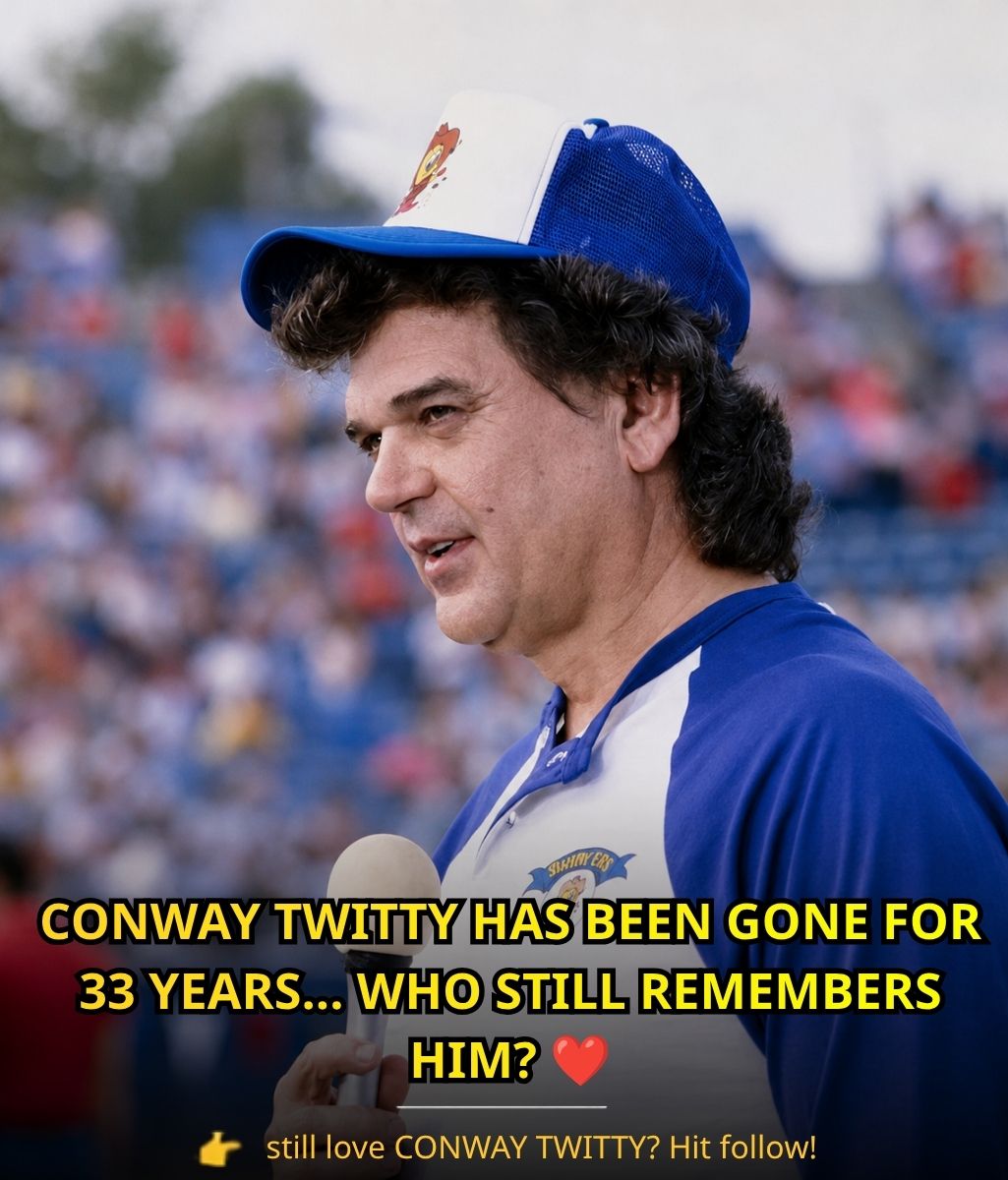
For millions of country music fans, Conway Twitty will always be remembered standing beneath the stage lights, microphone in hand, singing the songs that made him one of the most successful voices in country music history. But there was another place where Conway looked surprisingly at home: a baseball field. A remarkable old photograph captures him far removed from the polished suits and romantic performances most fans remember, dressed instead in a blue-and-white baseball uniform and holding a microphone with a stadium crowd behind him. At first glance, it might look like nothing more than a country superstar enjoying an afternoon at the ballpark. But once you know Conway’s history, the photograph tells a much bigger story.
Before the Stage Lights, There Was Baseball
Born Harold Lloyd Jenkins in 1933, the future Conway Twitty grew up with two passions that would compete for an important place in his early life: music and baseball. Long before “Hello Darlin’,” “Linda on My Mind,” and “I’d Love to Lay You Down” made his voice recognizable across America, baseball was much more than a casual pastime for him. The young Harold took the game seriously and showed enough promise that a future connected to baseball once seemed possible. For a young man who had not yet become Conway Twitty, the idea of spending his life on a baseball diamond was hardly unimaginable.
Music, however, kept pulling him in another direction. Harold Jenkins eventually chose to pursue the uncertain life of an entertainer, and that decision would transform him into the man millions came to know as Conway Twitty. What followed was an extraordinary career that moved from rock and roll into country music and ultimately produced an enormous collection of hits. Yet success never completely erased his affection for baseball. Even after he became a major star, the sport remained part of his world.
Fame Never Took Baseball Away From Conway
That connection helps explain why photographs of Conway at celebrity sporting events are so fascinating today. Fans are accustomed to seeing the serious, smooth Conway standing behind a microphone and delivering one of those unmistakable love songs. Seeing him dressed for the ballpark reveals a completely different side of the man — one that existed long before the fame, hit records and screaming audiences. In a way, these photographs allow fans to glimpse Harold Jenkins underneath the Conway Twitty image.
As Conway’s career grew, Nashville also provided opportunities for music stars to step away from their usual surroundings and participate in celebrity baseball and softball events. These gatherings brought entertainers together in a setting where they could joke, compete, interact with fans and often help support charitable causes. For audiences, that was part of the appeal: they weren’t simply watching famous singers perform another song. They were seeing personalities they loved behaving more like neighbors and friends than distant stars.
Conway Twitty and the Nashville Sounds
Conway’s relationship with baseball went beyond simply appearing at celebrity games. When professional baseball established a stronger presence in Nashville during the late 1970s, Conway became connected with the Nashville Sounds, which began play in 1978. He was among the country music figures associated with the team’s early ownership group, creating an almost perfect intersection between two important parts of his life. By that point, Conway certainly didn’t need another career — he was already one of country music’s biggest stars — but baseball clearly still meant something to him.
That makes the old ballpark photograph especially interesting. Conway appears comfortable in his blue-and-white uniform, microphone in hand, with the crowd blurred behind him. There is no dramatic concert lighting, no romantic duet partner standing beside him and none of the carefully controlled atmosphere of a major country performance. Instead, fans see Conway in an environment connected to something he had loved long before country music made him famous.
The Conway Twitty Fans Rarely Got to See
Even the playful imagery on Conway’s baseball clothing adds personality to the photograph. It feels far removed from the intensely romantic image that became attached to songs like “Hello Darlin’” and “I’d Love to Lay You Down.” Yet that contrast is exactly what makes photographs like this so appealing decades later. They remind us that the public image of Conway Twitty represented only one part of a much larger life.
Conway was not simply the man who walked onto a stage, sang a love song and disappeared backstage afterward. He was a musician, businessman and entertainer with passions that existed beyond recording studios and concert halls. Baseball offered him a connection to his younger years and perhaps even to the life he once imagined before anyone knew the name Conway Twitty. The more successful he became, the more remarkable that connection seems.
What If Conway Had Chosen Baseball Instead?
Looking back, it creates an irresistible question: What if Conway Twitty had chosen baseball instead of music? No one can know how far that road might have taken Harold Jenkins, but we certainly know what happened because he chose the other one. Conway went on to build an extraordinary recording career spanning rock and roll, pop and country, while his legendary partnership with Loretta Lynn produced some of country music’s most beloved duets.
Imagine country music without “Hello Darlin’.” Imagine never hearing “Linda on My Mind,” “That’s My Job,” or the unmistakable chemistry of Conway and Loretta. An entirely different decision early in his life could have meant that one of country’s most recognizable voices never reached the radio at all. Fortunately for generations of listeners, music won the competition for Conway’s future. But judging by the role baseball continued to play in his life, he never completely forgot the other dream.
One Photograph, Two Possible Lives
That’s why this photograph becomes more meaningful once you know the story behind Conway’s relationship with baseball. Without that history, it is simply an entertaining old picture of a famous country singer standing at a ballpark. With the history, it becomes a reminder of the other road Conway Twitty’s life might have taken and of a passion that remained with him even after music brought him extraordinary success.
Conway Twitty died in 1993, but his recordings continue to preserve the voice that made him a country legend. Photographs like this preserve something slightly different: glimpses of the man beyond the records. For one brief moment, we aren’t simply looking at Conway Twitty, the superstar. We’re looking at Harold Jenkins, standing on a baseball field and still connected to a game he loved before the world knew his name.
Country music got Conway Twitty — but part of Harold Jenkins never stopped loving the baseball diamond.