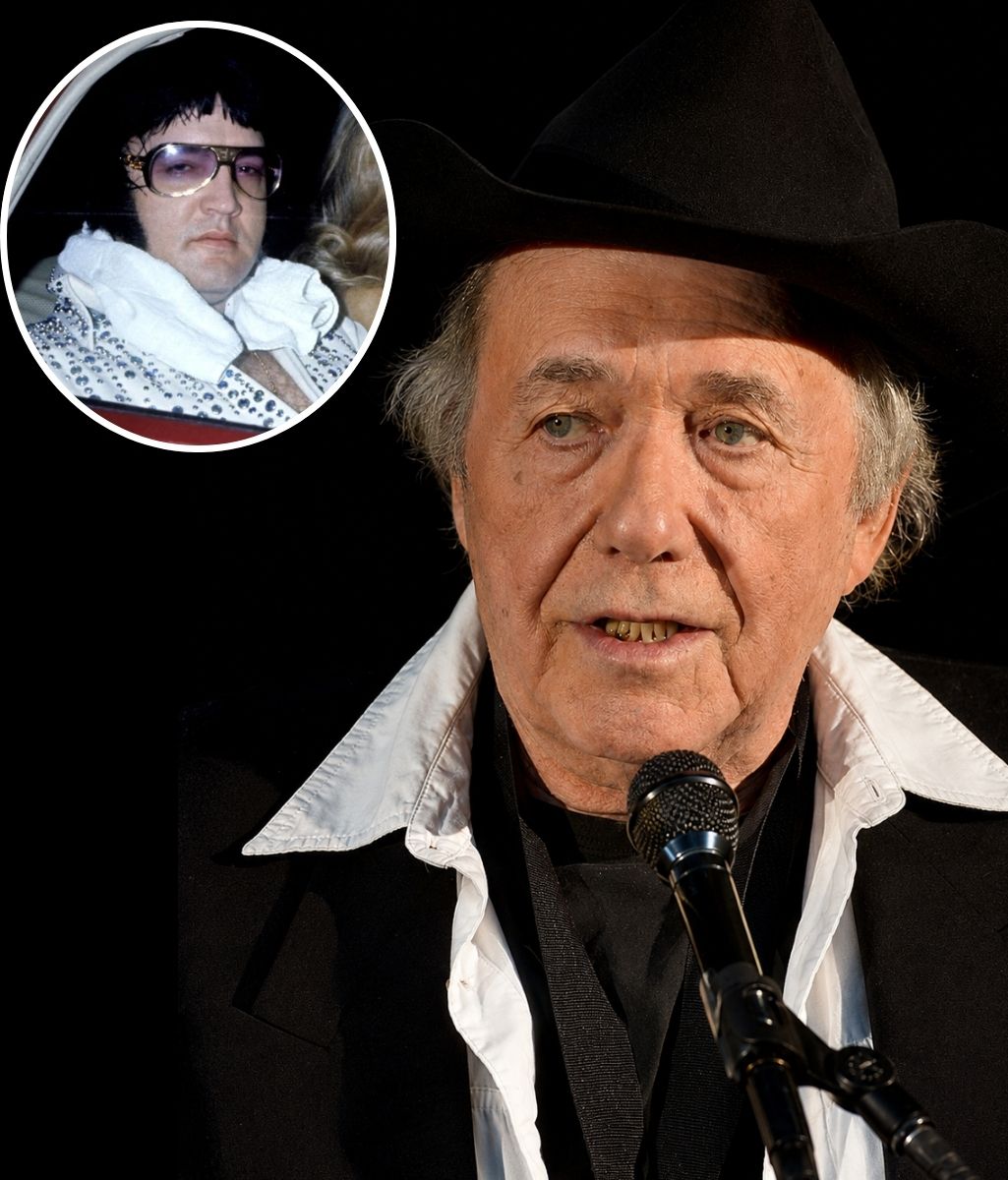
Long before Bobby Bare became one of Nashville’s most respected storytellers, another young Southern singer was already changing American music at breathtaking speed. Elvis Presley represented something completely new: a performer who could move between country, blues, gospel, and rock and roll while attracting an audience larger than almost anyone had imagined. Bare belonged to that same generation, and like countless young musicians of the late 1950s, he could hardly ignore what Elvis was doing.
The connection between the two men became particularly interesting in 1958, when Bare wrote and recorded “The All American Boy.” The song was a humorous story about a young rock-and-roll singer who suddenly becomes famous, only to have his career interrupted when he is called into military service. The parallels with Elvis were obvious. Presley had been drafted into the U.S. Army in 1958 at the height of his fame, turning his military service into a major national story.
Bare’s song captured that extraordinary cultural moment. It was not a straightforward biography of Elvis, but the King’s sudden rise and military induction clearly formed part of the inspiration behind its central character. For a struggling young Bobby Bare, Elvis represented what was happening to American music in real time: a new kind of fame, a new audience, and a new possibility for young singers from modest Southern backgrounds.
Ironically, “The All American Boy” also became one of the strangest episodes of Bare’s early career.
Bare recorded the demo shortly before entering the Army himself. While he was away, the recording was released under the name Bill Parsons, even though the voice listeners heard was Bobby Bare’s. The song became a major hit, reaching millions of listeners while the young man actually singing it initially received little public recognition.
For Bare, it was an early introduction to the unpredictable nature of the record business. He had written and sung a successful record inspired partly by the biggest star in America, yet his own name was missing from the label.
That experience makes the contrast between Bare and Elvis even more fascinating.
Elvis quickly entered a world of extraordinary fame. His career was tightly controlled by his longtime manager, Colonel Tom Parker, and access to Presley became increasingly limited as his celebrity grew. Bobby Bare followed a very different path. After his early rock-and-roll experiences, he eventually moved toward Nashville and country music, where he found the environment that suited his personality and musical instincts.
Bare became deeply connected to Nashville’s community of musicians and songwriters. His career was shaped not only by his own recordings but by friendships, informal gatherings, and his willingness to help other artists. When he encountered Waylon Jennings performing in Phoenix, for example, Bare recognized his talent and helped draw RCA’s attention to him. Later, his office became one of the informal gathering places where musicians could talk, play songs, and simply spend time together.
That world was almost the opposite of the isolation surrounding Elvis at the height of his fame.
Although Bare admired what Elvis represented musically, there is no widely documented personal friendship between the two men, and no strong public record showing that they developed a meaningful relationship. Their careers existed within overlapping generations of American music, but their daily worlds were very different. Elvis increasingly operated inside an enormous celebrity machine, while Bare became part of Nashville’s comparatively close-knit community of singers and songwriters.
That distance adds a bittersweet element to the story.
Bare could appreciate Elvis not merely as a superstar, but as another Southern musician whose life had been transformed by music. Both men had come from modest backgrounds. Both experienced rock and roll during its explosive early years. Both possessed voices instantly recognizable to their audiences. Yet the lives created by their success could hardly have been more different.
For Elvis, fame eventually meant extraordinary pressure and an increasingly protected private world. For Bare, success often meant sitting around with musicians, discovering songwriters, helping younger artists, and building friendships that lasted for decades.
It would be tempting to turn their connection into a lost friendship or secret encounter, but the more compelling truth is simpler. Bobby Bare did not need to know Elvis personally for Elvis to leave an impression on his early musical imagination.
“The All American Boy” stands as evidence of how powerful the Elvis phenomenon had become by 1958. Presley’s story was already large enough to inspire another young musician to turn that moment into a song—and that song unexpectedly became an important part of Bobby Bare’s own career.
Years later, Bare would earn his own place in country music history through “Detroit City,” “500 Miles Away from Home,” “Marie Laveau,” and countless other recordings. He no longer needed to stand in anyone’s shadow.
Still, there is something remarkable about looking back at the beginning.
Before Bobby Bare became a Nashville legend, Elvis Presley helped symbolize the musical revolution unfolding in front of him. Their careers would travel in different directions and never become the personal relationship fans might imagine today.
But for one unforgettable song in 1958, their stories came remarkably close to crossing.