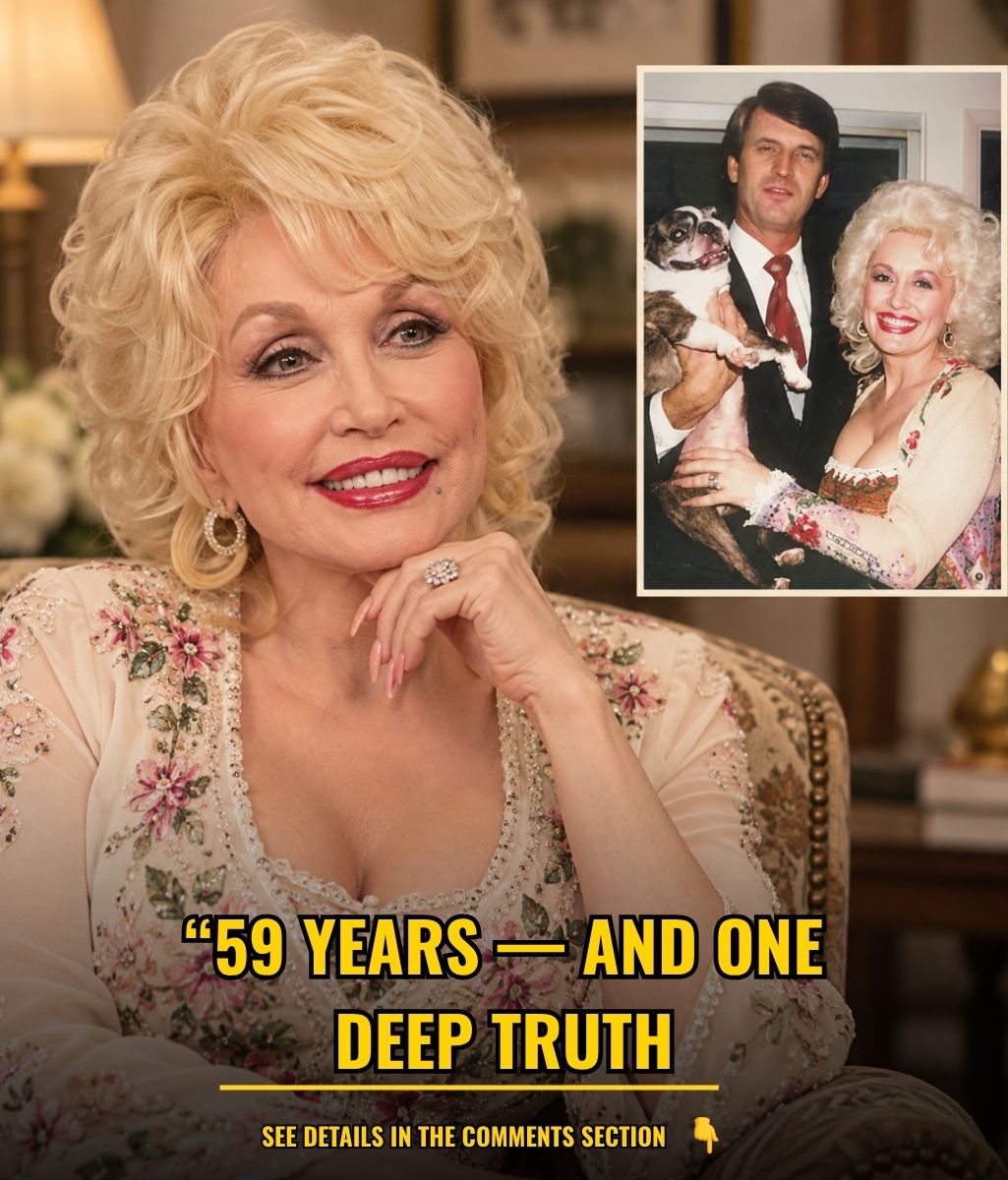
For nearly six decades, Dolly Parton lived one of the most unusual love stories in show business. She was one of the most photographed women in America, while her husband, Carl Dean, spent most of his life avoiding cameras. Dolly traveled the world beneath spotlights and rhinestones; Carl preferred home, quiet roads, and ordinary routines. To outsiders, they seemed almost impossibly different, yet Dolly repeatedly said those differences were not a problem. In fact, they were part of the reason their marriage lasted.
Dolly met Carl in 1964, shortly after arriving in Nashville. She was 18, ambitious, and determined to build a music career, while Carl had little interest in becoming part of the entertainment world. Two years later, on May 30, 1966, they quietly married in Ringgold, Georgia, after Dolly’s record label reportedly encouraged her to delay marriage. Dolly and Carl chose each other anyway, and that decision set the tone for almost everything that followed. As Dolly became increasingly famous, Carl became even more protective of his privacy. Rather than forcing their two worlds together, they learned to let them exist side by side.
For decades, fans wondered how a woman with such an enormous public personality could remain married to a man who seemed almost invisible. Dolly’s answer was usually delivered with humor. When people asked for the secret to their marriage, she famously joked that the key was essentially to “stay gone.” There was truth behind the joke. Dolly traveled constantly for work, while Carl remained largely outside the business. Instead of treating that distance as a threat, Dolly said it gave them something important: when they were together, they actually enjoyed being together. Their relationship was not built around attending every red carpet together. It was built around returning home.
The life Dolly described at home looked nothing like her public image. She remembered Carl bringing her the first yellow daffodils of spring and sometimes writing a small poem to go with them. She talked about cooking food they both loved, packing it into a basket, climbing into their camper, and finding a quiet riverbank for a picnic. On other nights, Dolly might suddenly decide to make dinner feel special by bringing out the crystal, cloth napkins, and “real china” instead of the paper plates they often used simply to avoid washing dishes. That may have been the real secret fans often missed: their marriage survived not because every day was dramatic, but because so much of it was ordinary.
Carl did not need to become Mr. Dolly Parton, and Dolly did not need Carl to become a celebrity. He could remain himself, and she could remain herself. That freedom seems to have mattered enormously to Dolly. Her entire career was built around an unusually strong sense of identity. She resisted people telling her how to dress, how to sing, what kind of music to make, and what kind of woman she was supposed to be. At home, she had a husband who did not seem interested in changing any of that.
Their differences could even become part of the fun. Dolly loved glamour, while Carl preferred simplicity. Dolly thrived around crowds, while Carl famously avoided them. Even at Dollywood, a place carrying Dolly’s name and personality everywhere, Carl reportedly preferred visiting quietly, sometimes buying his own ticket and walking around without drawing attention to himself. Dolly later remembered that he would notice practical things such as crowd flow and bathroom placement rather than behaving like the husband of the park’s famous owner. It is hard to imagine a better symbol of their marriage: Dolly built the spectacle, Carl quietly walked through it, and somehow they met in the middle.
There were romantic stories too. “Jolene” was partly inspired by Dolly’s teasing jealousy over a beautiful red-haired bank employee who showed interest in Carl. The woman was not actually named Jolene — Dolly borrowed that name from a young fan — but the episode became one of the sparks behind one of the most famous songs in country music. Yet Dolly and Carl’s marriage survived far beyond that playful jealousy. They renewed their vows for their 50th anniversary in 2016, returning to the promise they had made in a tiny Georgia church half a century earlier. Ringgold remained special to them, and Dolly later said they would sometimes return around their anniversary, traveling there in their camper and revisiting the place where their marriage began.
Then, in March 2025, Carl died at age 82. For Dolly, the loss shattered a structure that had quietly supported almost her entire adult life. She later described theirs as a great old love story and acknowledged that people who had never experienced such a long bond might not fully understand the emptiness left behind. She said Carl would remain forever in her heart and memories.
That is when decades of jokes about “staying gone” suddenly sounded different. For almost 59 years, Dolly could leave because Carl was still there to come home to. The distance had never meant emotional separation; it worked because there was always a return. Behind one of the loudest, brightest careers in entertainment history was a relationship built on something surprisingly quiet: two people allowing each other enough room to remain themselves while still choosing to come back together again and again.
Carl never needed Dolly to become less Dolly, and Dolly never needed Carl to become someone he was not. Perhaps that was why she could hardly imagine life without him. He was not simply the man waiting behind the scenes while she became a legend. He was the private home inside a public life — the person she could return to when the costumes came off, the cameras disappeared, and Dolly Parton could simply be Dolly.