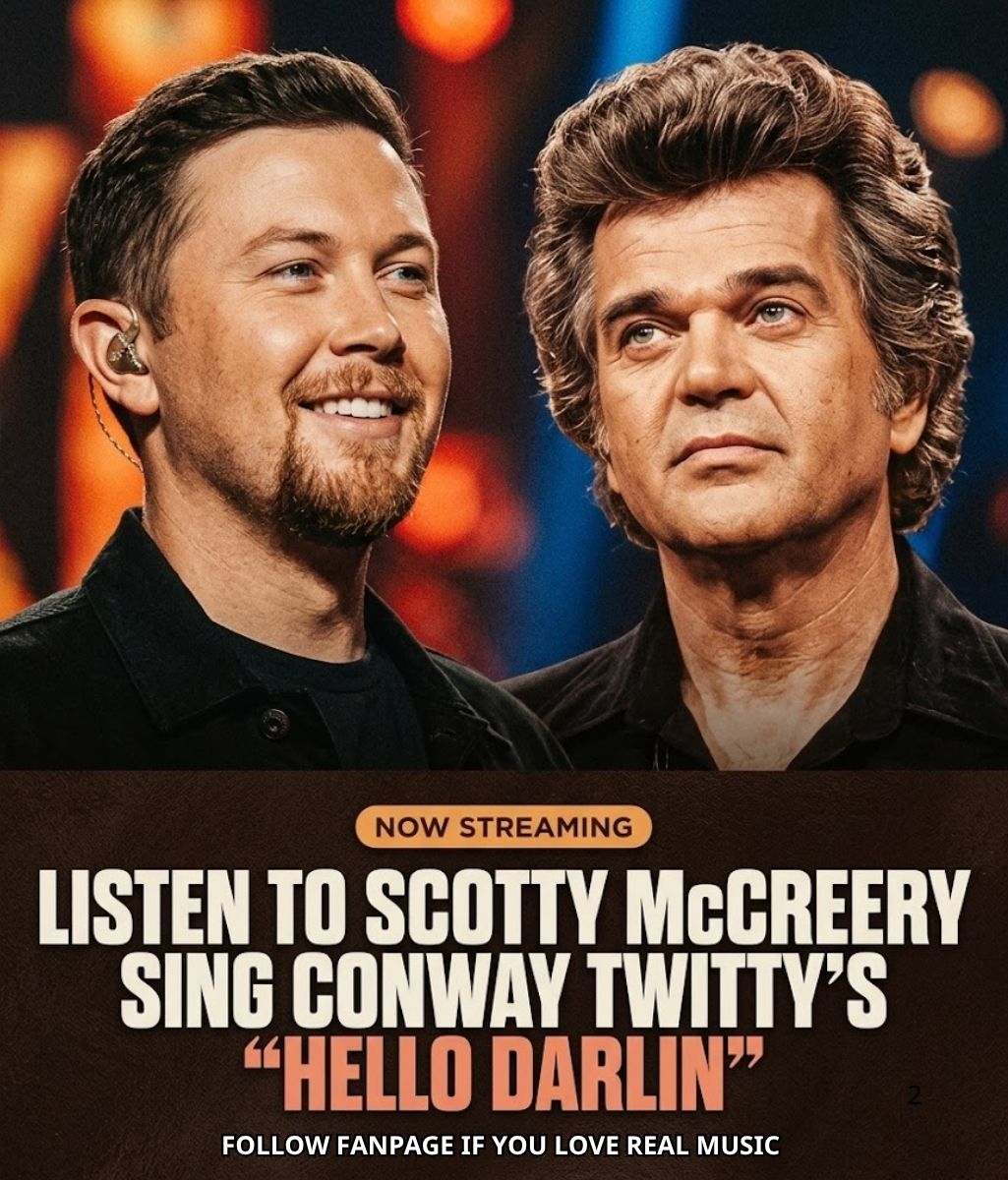
After a brief performance clip reached millions of viewers, Scotty McCreery gave Conway Twitty’s signature classic a full recording—bringing one of country music’s most recognizable songs to another generation without losing the heart of the original.
For longtime country music fans, it takes only two words to recognize what is coming next: “Hello, darlin’.” More than half a century after Conway Twitty turned that simple greeting into one of the most unforgettable openings in country music, the song has found its way back into the spotlight through Scotty McCreery. A short clip of McCreery singing the classic drew enormous attention online, reportedly surpassing 40 million views, and the response revealed something remarkable. Listeners were not simply reacting to a familiar melody. Many were reconnecting with a song tied to another time, another radio, another kitchen table, or perhaps someone they once heard singing along. Now, with McCreery releasing a complete version, that brief viral moment has become something deeper: a respectful meeting between two generations of country music.
When Conway Twitty released “Hello Darlin’” in 1970, he was already building the country career that would eventually define his legacy. Yet this song became something special even among his many hits. The spoken opening was unmistakable, immediately creating the feeling that Conway was addressing one person rather than an audience of thousands. From there, the song unfolded with regret, tenderness, and the painful realization that time does not always repair what has been lost. Conway did not need dramatic vocal tricks to make the story convincing. His strength came from restraint. He sounded like a man trying to remain composed while confronting a memory that still mattered, and that emotional simplicity helped turn “Hello Darlin’” into one of his signature recordings.
That makes revisiting the song a difficult challenge for any singer. Conway’s voice is so closely connected with “Hello Darlin’” that imitation would immediately feel unnecessary. McCreery wisely approaches the song from another direction. His naturally deep baritone carries the weight needed for the material, but he does not appear interested in becoming Conway Twitty for a few minutes. Instead, he respects the structure and emotional character of the original while allowing his own voice to carry the story. The result feels familiar without becoming a copy, which may be one reason the performance connected so strongly with listeners who already knew every line.
There is also something fitting about McCreery taking on this particular classic. Since first becoming widely known as a young singer, his deep voice and traditional country influences have often separated him from more pop-oriented corners of modern country music. His appreciation for the genre’s history has remained visible throughout his career, and “Hello Darlin’” gives him material where understatement matters more than spectacle. The song does not need to be reinvented. It needs to be understood. McCreery allows pauses to matter, gives the words room to settle, and lets the sadness emerge naturally rather than forcing it forward.
For older listeners, that restraint may be the most powerful part of the tribute. Country songs from earlier generations often depended on storytelling that unfolded patiently. A singer did not always need a huge arrangement or an explosive final chorus. Sometimes a few carefully delivered lines were enough to create an entire world. “Hello Darlin’” remains a perfect example. Beneath its simple language is a painfully recognizable situation: meeting someone from the past, attempting polite conversation, and realizing that feelings thought to be buried are still close to the surface. The song has survived because the emotion inside it never belonged only to 1970.
The extraordinary online reaction to McCreery’s performance also says something about the continuing reach of Conway Twitty. Decades have passed since Conway last stood on a stage, yet the opening words of one of his most famous songs can still command attention. Some of the millions who encountered McCreery’s clip undoubtedly knew the original immediately. Others may have discovered the song through a singer from a younger generation. That is how musical legacies continue—not simply through museums, awards, or anniversary celebrations, but through moments when an old song unexpectedly becomes meaningful again.
There is a temptation whenever a classic is revisited to compare every note with the original and decide which version is better. But that misses what makes a tribute like this valuable. Conway’s recording does not need replacing, and McCreery’s version does not attempt to erase it. The original remains Conway’s. What McCreery can offer is another doorway into the song, giving longtime listeners a reason to return while allowing newer audiences to discover why those two opening words once became instantly recognizable across country music.
For fans who remember hearing Conway on the radio when his records were new, the experience can carry an additional layer of emotion. Music has a strange ability to preserve moments that ordinary memory allows to fade. A voice can suddenly return someone to a car ride decades ago, a family home that no longer exists, or an evening spent listening to records with people who are now only memories. When McCreery begins “Hello Darlin’,” some listeners are hearing far more than a song. They are hearing pieces of their own history.
And perhaps that is the greatest compliment this tribute can give Conway Twitty. More than fifty years after “Hello Darlin’” first reached listeners, the song still does not sound like something that belongs behind glass. Its language remains direct, its regret remains recognizable, and its melody still carries the same quiet ache. McCreery’s performance does not bring the song back because it never truly disappeared. Instead, it reminds another generation why it stayed.
Country music will continue changing, as it always has. New voices will arrive, new sounds will dominate the radio, and another generation will decide what the genre means to them. But every so often, a singer reaches backward and finds a song strong enough to cross the distance unchanged. Scotty McCreery found one in “Hello Darlin’.”
Conway Twitty gave those two words a place in country music history. Decades later, Scotty McCreery has spoken them again—not to replace the voice that made them famous, but to remind millions of listeners why they never forgot it.