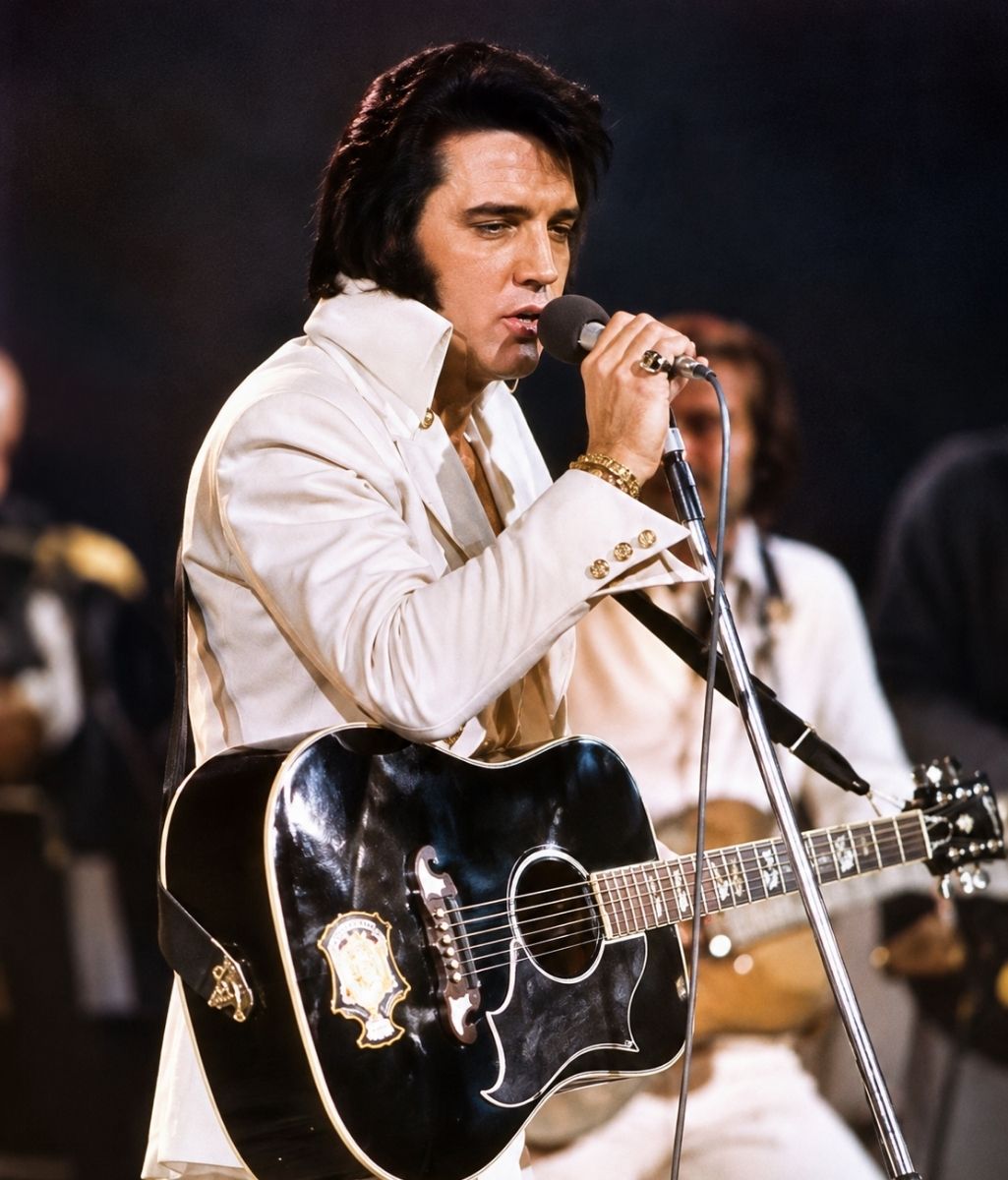
By 1972, Elvis Presley appeared to have conquered every fear a performer could possibly experience. He had survived the controversy surrounding his early career, become an international recording sensation, starred in dozens of Hollywood films and returned triumphantly to live entertainment. Wearing his unmistakable jumpsuits and commanding audiences with remarkable confidence, Elvis seemed like a man who belonged onstage more naturally than almost anyone in music history.
Yet during the production of Elvis on Tour, the King revealed a surprisingly vulnerable side of himself that stood in striking contrast to the superstar audiences believed they knew.
Filmed during his April 1972 American tour, the documentary followed Elvis through concerts, rehearsals, backstage preparations and the demanding routine of traveling between cities. While the performances captured his extraordinary ability to connect with audiences, the interviews offered something considerably more intimate: an opportunity to hear Elvis reflect on his career in his own words.
Perhaps his most surprising admission concerned something that had troubled him since the beginning of his career. Despite nearly two decades of performing before enormous crowds, Elvis acknowledged that he had never completely overcome his fear of appearing onstage.
“I’ve never gotten over what they call stage fright,” Elvis admitted, explaining that the nervousness returned with every performance and that he never became entirely comfortable with it.
For someone whose name had become synonymous with confidence and charisma, the revelation was remarkable. Millions of people watched Elvis move effortlessly across the stage, joke with his musicians and interact with enthusiastic fans, yet few would have imagined that the man behind those performances continued to experience the same anxiety that had accompanied his earliest appearances.
Elvis also explained that every audience deserved a performance that felt fresh and exciting, regardless of how many concerts he had already completed. The people sitting in front of him might be seeing him for the first and only time, which meant that familiarity with the songs could never become an excuse for giving them anything less than his best.
The interviews also revealed how deeply gospel music remained connected to his personal identity. Elvis recalled that even after completing demanding schedules in Las Vegas, he and his musicians would sometimes continue singing gospel songs together until daylight. These private sessions offered a striking contrast to the elaborate productions that defined his public career, reconnecting him with the musical traditions he had known since childhood.
Another revealing subject was his relationship with Hollywood. Although his films had brought enormous commercial success, Elvis expressed dissatisfaction with aspects of his acting career and the limitations of the material he had been given. His desire to return to live audiences reflected a deeper need to reconnect with the spontaneity and emotional freedom that had originally attracted him to performing.
Decades later, renewed attention to the interviews surrounding Elvis on Tour, including archival material explored in Baz Luhrmann’s EPiC: Elvis Presley in Concert, has offered audiences an even greater appreciation of the man behind the famous image. His reflections reveal an artist who remained ambitious, emotionally sensitive and determined to connect with his audience despite the pressures of extraordinary fame.
Looking back, the most remarkable discovery from those interviews may not be an unknown scandal or a sensational confession, but the realization that Elvis never became immune to the uncertainties of being human. Behind the extravagant costumes and overwhelming applause was a man who still experienced nervousness, found comfort in gospel music and wanted every audience to leave with an unforgettable memory.
More than half a century later, Elvis on Tour remains powerful because it allows fans to see something beyond the legend. The King of Rock and Roll could command an entire arena while quietly battling his own fears, and perhaps that vulnerability was part of what made his performances so extraordinary in the first place.
Video