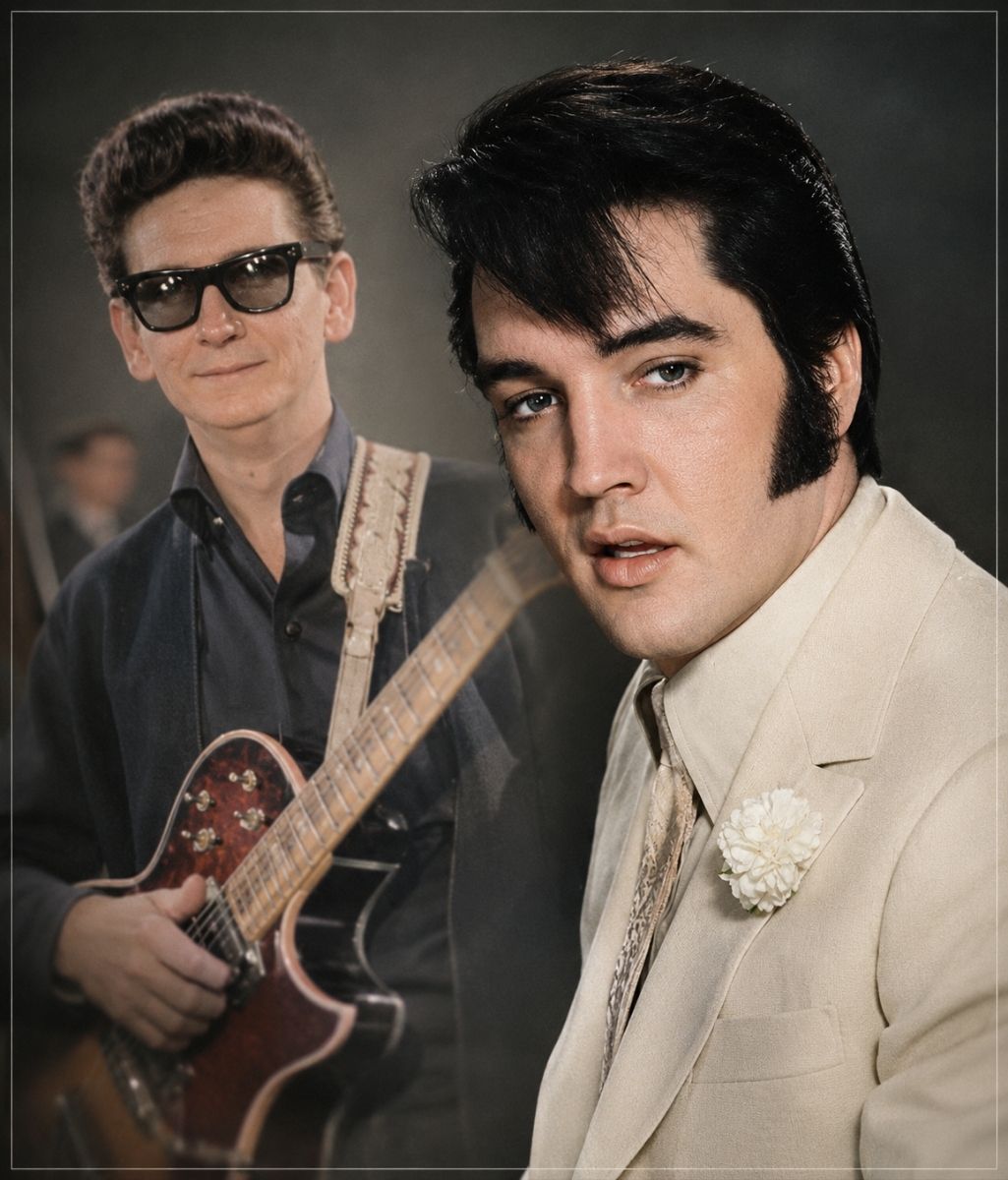
Elvis Presley built his career partly by taking songs that already existed and making them sound completely new. He could move from gospel to country, blues, rock and ballads with remarkable ease, and songs such as “Hound Dog,” “Blue Christmas,” “Are You Lonesome Tonight?” and “You’ll Never Walk Alone” showed how comfortable he was interpreting material written or recorded by other people. Yet there was one singer whose songs Elvis seemed unusually reluctant to touch, and that singer was Roy Orbison.
Elvis admired Orbison enormously. During one of his Las Vegas performances, he famously referred to Roy as “the greatest singer in the world,” and that admiration was not merely casual praise. Roy had also seen Elvis perform during the early days of rock ’n’ roll and was deeply impressed by the energy and instinct he brought to the stage. The two men moved through many of the same musical circles, shared connections to Sun Records and followed each other’s careers for years, which makes Elvis’s relative avoidance of Orbison’s signature songs even more interesting.
Roy’s recordings were built around an extraordinary vocal range and a dramatic style that often pushed songs toward something almost operatic. “Crying,” “Running Scared,” “In Dreams” and “Only the Lonely” depended heavily on the particular sound of Orbison’s voice, especially the way he could move from quiet restraint to soaring emotional peaks without losing control. Elvis may have respected that uniqueness too much to compete with it, because although he was famous for making other people’s songs his own, he never made a full commercial recording of a Roy Orbison song. The closest he appears to have come was briefly singing a line from “Running Scared” while recording “Tomorrow Never Comes” in 1970.
The story of “Only the Lonely” adds another layer to that relationship. Orbison co-wrote the song in 1960 and reportedly offered it to other major performers, including Elvis, but Elvis did not record it. Roy eventually decided to take the song for himself, and that decision helped transform his career. “Only the Lonely” became one of Orbison’s first major international breakthroughs and established the emotional, dramatic vocal style that would define much of his greatest work.
In hindsight, Elvis’s decision not to record the song almost feels appropriate. He was one of the few singers powerful enough to attempt almost anything, but he also understood what made another artist special. Roy Orbison had a voice unlike anyone else, and Elvis did not need to prove that he could imitate it or outsing it. His admiration for Roy may have been exactly why he chose to leave those songs alone rather than turn them into another demonstration of his own versatility.
There is no verified conversation in which Roy Orbison asked Elvis why he refused one particular song, and there is no documented “shocking confession” that followed. What the historical record does reveal is something more believable and, in many ways, more meaningful: Elvis Presley, a man famous for making other people’s songs his own, seemed to understand that some songs already belonged completely to the singer who first gave them life. When it came to Roy Orbison, respect may have been the reason he chose not to compete at all.
Video