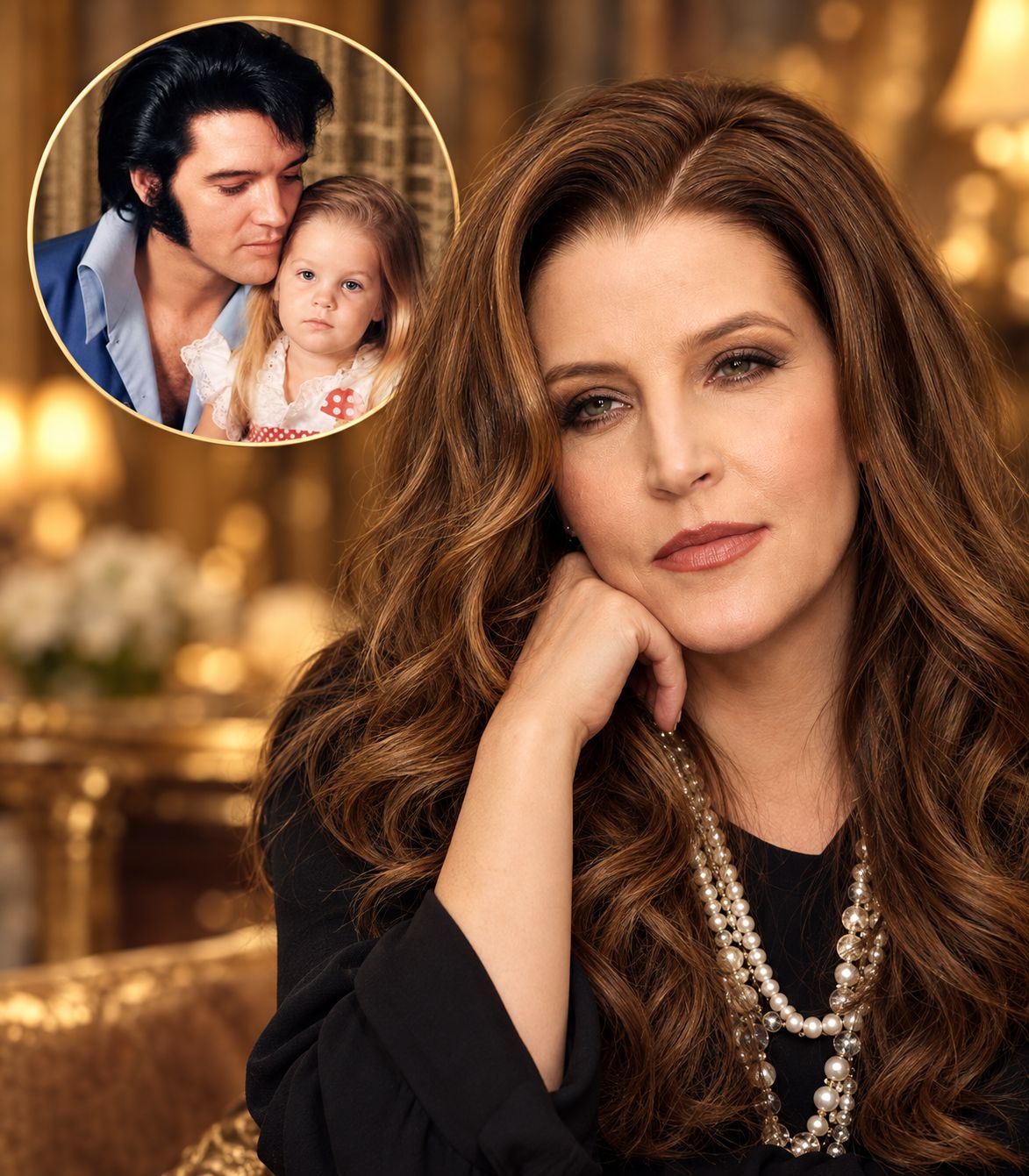
To millions of people around the world, Elvis Presley was the King of Rock ’n’ Roll. He was the voice that changed popular music, the man whose performances created scenes of excitement unlike almost anything audiences had seen before, and the cultural figure whose name became inseparable from American entertainment. Yet to Lisa Marie Presley, he was something far more ordinary and far more complicated.
He was simply her father.
Lisa Marie was only nine years old when Elvis died in 1977, but the memories she carried throughout her life offered a rare glimpse of a man the public never fully knew. Fans saw the jumpsuits, the stage lights, the famous smile, and the crowds surrounding him. Lisa Marie remembered a father who would sit upstairs at Graceland just to be near her, wake her in the middle of the night, take her on spontaneous adventures, and sometimes spoil her far more than her mother would have allowed.
In later interviews, Lisa Marie described the upstairs rooms at Graceland as some of the most precious parts of her childhood. Her room was close to Elvis’s, and she recalled that he would sometimes create a space in her room where he could watch television while staying near her. Those quiet hours became especially important in her memory because they belonged almost entirely to the two of them, away from the public image surrounding Elvis.
That version of Elvis was far removed from the legend.
Lisa Marie remembered him taking her to a pet store late at night to get a dog and then, in typical Elvis fashion, buying dogs for many other people as well. She remembered the freedom of Graceland, riding golf carts around the property and getting away with behavior that might have been stopped immediately in a more ordinary household. Elvis could be indulgent with his daughter, and Lisa Marie admitted that she sometimes took full advantage of that freedom.
She described herself as very much “a Daddy’s girl.” Around Elvis, she felt protected and adored, even though life at Graceland could also be chaotic. Employees and people around the house were often reluctant to discipline her because Elvis remained the unquestioned authority. Lisa Marie later joked about how wild she could be as a child, knowing that few people wanted to risk making her father unhappy.
But beneath those affectionate memories was another side of the story.
As Lisa Marie grew older, she became increasingly honest about the fact that even as a child, she understood that something was wrong with her father. Her posthumously published memoir, From Here to the Great Unknown, revealed that she worried about losing Elvis long before his death. As a young girl, she even wrote words expressing her fear that her father might die. That fear did not come from knowing medical details or understanding the complicated realities surrounding his health. It came from a child noticing changes in someone she loved.
That is perhaps the most revealing part of Lisa Marie’s memories.
The public saw Elvis performing.
She saw what happened when the performance ended.
She knew what it was like to live in the same house as the most famous entertainer in America and yet understand, even without fully understanding why, that fame could not protect him from everything.
That awareness makes her recollections of the happier moments even more meaningful. Lisa Marie once remembered Elvis waking her in the middle of the night simply because he wanted to sing to her. To most people, being awakened at that hour would have been irritating. To Lisa Marie, decades later, those memories became priceless because they preserved something the world could never reproduce: Elvis singing not for an audience, but for his daughter.
There were no tickets.
There was no stage.
There were no television cameras.
There was simply a father and a child inside their home.
That distinction mattered deeply to Lisa Marie. Throughout her life, she often seemed determined to separate the man she knew from the enormous mythology surrounding his name. She understood why millions of people loved Elvis Presley, but she also carried memories that belonged to no one else.
To fans, Graceland became a shrine.
To Lisa Marie, it was home.
She knew the upstairs rooms that tourists never entered, the private routines, the unusual hours, and the small family moments preserved behind doors that remained closed to the public. Returning to Graceland could therefore be both comforting and painful. She once described the house as almost like having her childhood preserved in a capsule, something very few people ever experience.
That preserved world also made it impossible to completely separate herself from her father’s legacy.
Lisa Marie spent much of her adult life trying to establish an identity beyond simply being Elvis Presley’s daughter, yet she never denied the enormous emotional influence he had on her. When she recorded posthumous duets with Elvis, including “In the Ghetto” and later “Where No One Stands Alone,” the performances carried a weight that no ordinary musical collaboration could have created. For Lisa Marie, singing with her father’s recorded voice was not simply a tribute to an icon. It was a way of reconnecting with someone she had lost when she was still a child.
Her memories also complicate the image of Elvis as an untouchable superstar.
Lisa Marie did not describe a perfect man.
She described someone she adored, someone who could make childhood feel exciting and unpredictable, but also someone whose struggles frightened her before she was old enough to fully understand them.
That honesty is what makes her perspective so important.
The world had already heard thousands of stories about Elvis Presley from musicians, friends, journalists, managers, and fans. Lisa Marie offered something entirely different. She remembered the father behind the phenomenon.
She remembered the man upstairs at Graceland.
The man who wanted to sit nearby while she watched television.
The man who could turn an ordinary night into an unexpected adventure.
The man she tried to sneak past when she was getting into trouble.
And eventually, the man she became afraid she might lose.
For decades, fans searched for the “real Elvis” behind the photographs and performances. Lisa Marie may have come closer than anyone to explaining why that search could never be completed through fame alone.
The Elvis she knew was not always the confident King standing beneath the stage lights. He was a loving, indulgent, complicated father whose greatest performances, in her memory, sometimes happened in the middle of the night when the only person listening was his little girl.