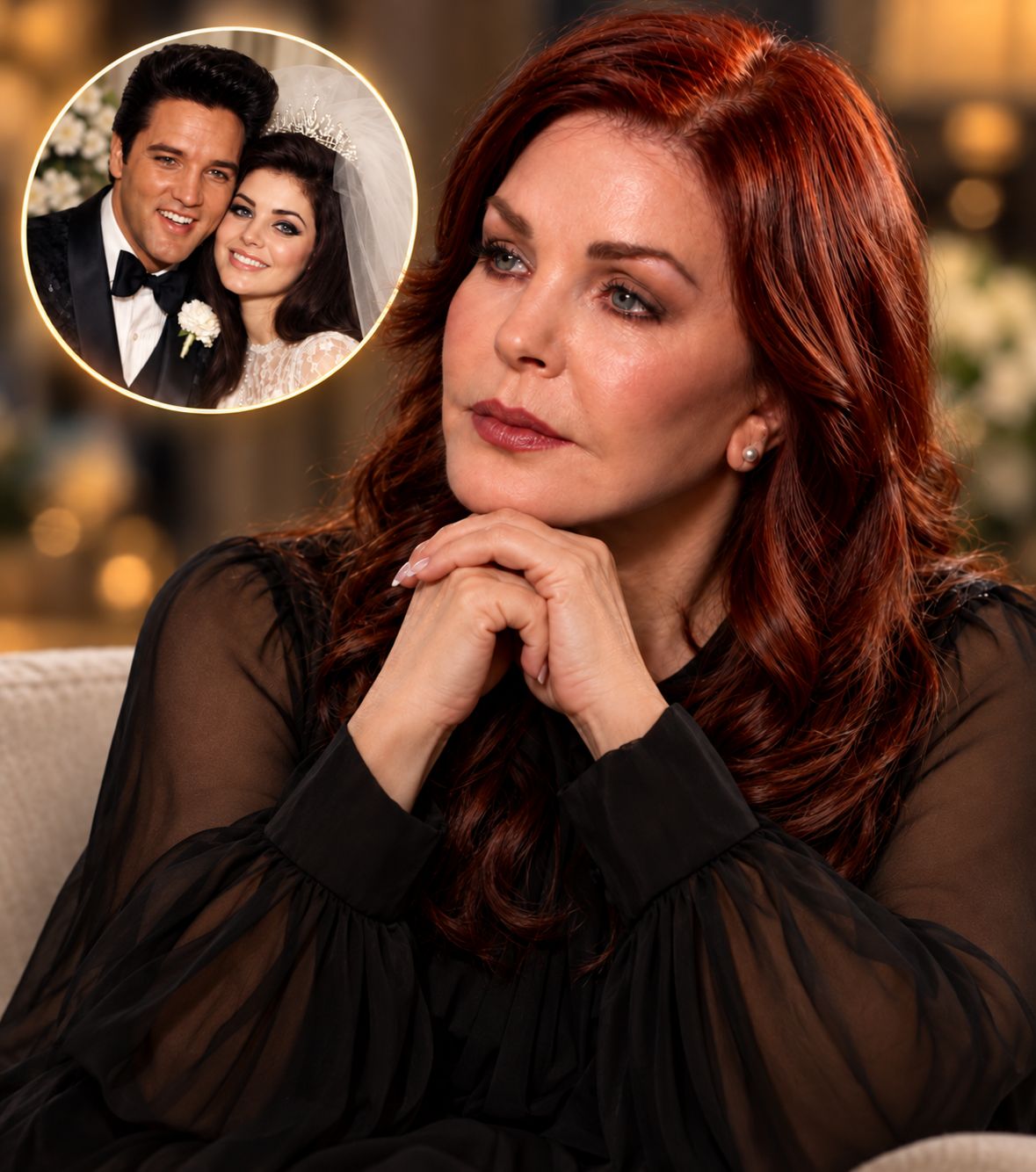
At 81 years old, Priscilla Presley has lived with the memory of Elvis Presley’s final days for nearly half a century. To the world, Elvis was the King of Rock and Roll, a performer whose voice, charisma, and presence changed popular music forever. But to Priscilla, the final chapter of his life was never simply the ending of a legend. It was the loss of someone she had known in ways the public never could.
What makes her memories so powerful is how ordinary some of the final moments seemed at the time.
Priscilla has written that she spoke with Elvis just two days before his death on August 16, 1977. Nothing in that conversation convinced her that their next contact would never happen. In her recollection, Elvis sounded good, which made the news of his death even more impossible to understand when the phone call finally came. The man who had seemed so permanent in her life was suddenly gone.
That detail changes the way many fans may think about Elvis’s final days.
History often compresses a life into a few dramatic images. People remember the jumpsuits, the Las Vegas performances, the crowds outside Graceland, and the tragic announcement that Elvis Presley had died at only 42 years old. But for those closest to him, there was no clean transition between the living Elvis and the legend who became frozen in time after his death.
There were still conversations.
There were still plans.
There was still the expectation that another phone call would come.
According to Priscilla, that is part of what made the loss so difficult to accept. Elvis had talked about things he still wanted to do, both musically and personally. In her memory, he did not seem like a man who believed his story was finished. She had worried about him, but she never imagined that his life would end so young.
That may be one of the most revealing parts of her account.
By 1977, the public image of Elvis had become enormous. He was no longer simply a singer from Memphis. He was an American symbol, instantly recognizable almost anywhere in the world. Yet behind that image was still a man thinking about his next song, his next plan, and what might come afterward.
Priscilla had seen both sides.
She had known the superstar surrounded by fans, cameras, musicians, and expectations, but she had also known the man who returned to Memphis because Graceland still felt like home. In a 2025 CBS interview, Priscilla reflected on that contrast, saying Elvis would repeatedly return to Memphis because that was where he felt rooted.
That sense of home makes the events of August 1977 even more haunting.
When Priscilla received the call telling her Elvis was dead, her first concern quickly turned to their daughter, Lisa Marie Presley, who was at Graceland. Priscilla later recalled hearing Lisa’s voice on the phone and realizing that their daughter was trying to understand why everyone around her was crying.
The scene at Graceland that followed was far removed from the glamorous world the public associated with Elvis.
Priscilla remembered the house as feeling empty and strangely lifeless without him. She described family members moving through the rooms in shock, with Elvis’s father, Vernon Presley, devastated by the loss of his only son. For those inside the house, this was not the death of an icon. It was a father losing his child, a daughter losing her father, and people who had built their lives around Elvis suddenly realizing that the center of that world was gone.
Outside Graceland, however, there was almost no privacy.
Crowds gathered.
Cameras arrived.
Fans came to mourn.
The public wanted to say goodbye to the man whose music had been part of their lives for decades. But for Priscilla and the family, that meant grief had to unfold while the entire world was watching.
That contrast is important because it reveals a side of Elvis’s story that fame often hides.
The bigger the legend became, the harder it was for the people closest to him to experience anything privately.
Even his death immediately became part of public history.
Inside the house, however, there were small, deeply personal moments that had nothing to do with celebrity. Priscilla later wrote that she and Lisa Marie waited until they could have a private moment to say goodbye. Lisa had a bracelet engraved with a message for her father, and Priscilla helped her place it on Elvis before they both kissed him goodbye.
For Priscilla, that moment seems to have made the reality impossible to avoid.
Until then, there had still been shock, disbelief, movement, family members, phone calls, and arrangements. But standing beside Elvis in silence meant confronting the fact that the man she had known for so much of her life would never call again.
That realization stayed with her.
Priscilla later described waking up after his death and having to remind herself that Elvis was no longer there. She had become accustomed to the idea that even after their divorce, Elvis would always somehow remain part of her life. Their marriage had ended in 1973, but the bond between them had not simply disappeared. In a 2025 interview, she said she remained deeply in love with him even after deciding she could no longer live within the life that surrounded him.
That distinction matters.
Priscilla did not leave because Elvis had become meaningless to her.
She left because she felt she needed to discover an identity outside the enormous world built around him.
She later explained that she had spent years living within Elvis’s life and eventually needed to understand who she was apart from being Elvis Presley’s wife. Their separation allowed her to search for independence, but it did not erase the affection, history, and connection between them.
That is why the final days still carry such emotional weight.
Elvis was no longer her husband, but he was still family.
He was still Lisa Marie’s father.
He was still the person who had shaped a large portion of Priscilla’s young life.
And perhaps most importantly, he was still someone she expected to hear from again.
When fans remember Elvis Presley today, it is easy to see only the icon: the young rebel of the 1950s, the movie star, the comeback performer dressed in black leather, or the Las Vegas entertainer surrounded by lights and applause.
Priscilla’s memories reveal something quieter.
They reveal a man who still had plans, still had people who loved him, and still seemed capable of another chapter right up until there was no next chapter at all.
That may be the side of Elvis that is hardest to understand from photographs and concert footage.
For the public, August 16, 1977 became the day the King died.
For Priscilla, it was the day ordinary expectations suddenly disappeared.
There would be no more unexpected calls.
No more visits.
No more familiar voice on the other end of the telephone.
No more assumption that Elvis would always be somewhere in Memphis, somehow continuing to occupy his place in the world.
Nearly five decades later, that may be what remains most painful in Priscilla Presley’s memories.
Elvis Presley was a legend to millions, but in his final days, he was still simply a man with unfinished plans, unfinished conversations, and people who never imagined they were about to lose him.
And perhaps that is the truth that makes his final chapter feel more human than any headline ever could.