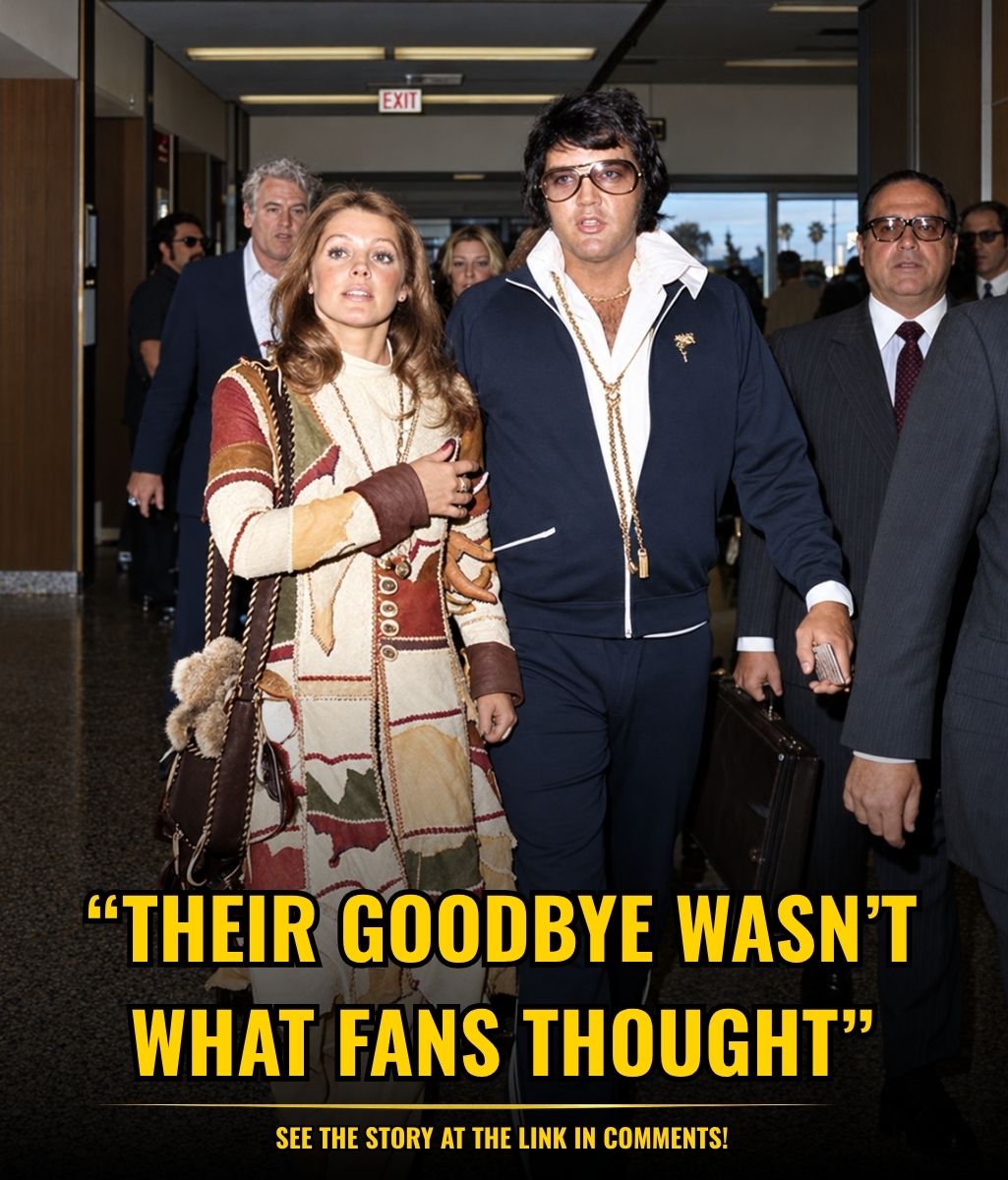
By October 1973, the marriage between Elvis Presley and Priscilla Presley was officially coming to an end. They had spent years together under extraordinary pressure, from Elvis’s global fame and constant touring to the strains that had gradually developed inside their private life. The divorce itself was not unexpected, but what happened when they walked out of the courthouse created an image that still feels unusual more than half a century later.
They were photographed holding hands.
The divorce was finalized on October 9, 1973, in Santa Monica, California. Rather than leaving through separate doors or appearing cold toward one another, Elvis and Priscilla emerged looking remarkably close. Photographs from that day show them walking together after the hearing, and the image became a visual reminder that ending a marriage did not necessarily mean erasing every feeling that had existed inside it.
Their relationship had already gone through enormous changes by then.
Elvis and Priscilla married in Las Vegas in 1967 and welcomed their daughter, Lisa Marie Presley, the following year. The public saw them as one of entertainment’s most glamorous couples, but Priscilla later described a marriage complicated by Elvis’s absences, the demands of his career, and the difficulty of developing an independent identity while living beside one of the most famous men in the world.
When Priscilla eventually chose to leave, she repeatedly explained that the decision did not come from an absence of love.
Years later, she said she had not divorced Elvis because she stopped loving him. Instead, she felt she needed to discover more of the world and understand who she was outside the life they had built together. That distinction helps explain why their final day as husband and wife looked so different from the bitterness often associated with celebrity divorces.
The marriage was ending, but their connection was not.
Graceland’s official timeline states that after the divorce, Elvis and Priscilla continued to be close friends. They shared custody of Lisa Marie, and Elvis did not operate under a rigid visitation schedule. He continued spending time with his daughter regularly, which kept the former couple connected as parents even after their legal relationship had changed.
Priscilla has also spoken in later years about how their friendship continued after the divorce. She recalled Elvis appearing at her home unexpectedly and emphasized that they did not leave the marriage as enemies. Their lives had separated, but he remained emotionally significant to her.
That is what makes the photographs from October 1973 so powerful.
There is no dramatic confrontation visible in them.
There is no obvious attempt to avoid each other.
Instead, there are two people who had just legally ended a six-year marriage walking away from the courthouse side by side.
Then there is another story that makes the moment even more emotional.
According to Dolly Parton, Priscilla later told her that Elvis sang “I Will Always Love You” to her as they walked down the courthouse steps following their divorce. Dolly had written the song as an emotional farewell to Porter Wagoner, and Elvis had famously wanted to record it before a publishing dispute prevented the recording from happening.
If Priscilla’s memory is taken as she told it to Dolly, the choice of song could hardly have been more appropriate.
The meaning of “I Will Always Love You” was never simply about romance continuing forever. Dolly originally wrote it about leaving someone important while still acknowledging love, gratitude, and everything that person had meant.
That emotional idea fits the Presley divorce almost perfectly.
Elvis and Priscilla were not staying married.
They were not pretending that the problems between them had disappeared.
But they were also not pretending that six years of marriage, a daughter, and years of shared memories had suddenly become meaningless.
The hand-holding reflected that complicated middle ground.
Their relationship after the divorce remained close enough that Priscilla later wrote and spoke about Elvis with deep affection. She has continued to describe him as one of the defining people in her life, even while also acknowledging the difficulties that made their marriage impossible to sustain.
The distinction matters because popular stories about famous couples are often reduced to simple endings.
They fall in love.
They marry.
Something goes wrong.
They divorce.
Then the story is supposedly finished.
Elvis and Priscilla did not fit that pattern.
After the divorce, they continued talking, co-parenting Lisa Marie, and remaining part of each other’s lives. Later accounts have even described moments when Elvis appeared to leave open the possibility that they might somehow reconnect, although that possibility disappeared forever with his death in August 1977.
That makes the courthouse photograph even sadder in hindsight.
Neither of them knew that Elvis had less than four years left to live.
Priscilla was walking away from a marriage, not from Elvis completely.
She expected there would still be conversations, visits, shared moments with Lisa Marie, and perhaps years in which their relationship could continue changing into something new.
Instead, time ran out.
That is why the image from October 9, 1973 continues to resonate.
It captures something more complicated than either reconciliation or rejection.
Their marriage was over.
Their problems had been real.
Their lives were moving in different directions.
But as they stepped away from the courthouse, they were still close enough to reach for each other’s hands.
For many couples, divorce photographs show distance.
Elvis and Priscilla left behind something very different.
They looked like two people saying goodbye to a marriage while refusing to erase the love that had once created it.
And sometimes, that is what makes a goodbye hurt the most.