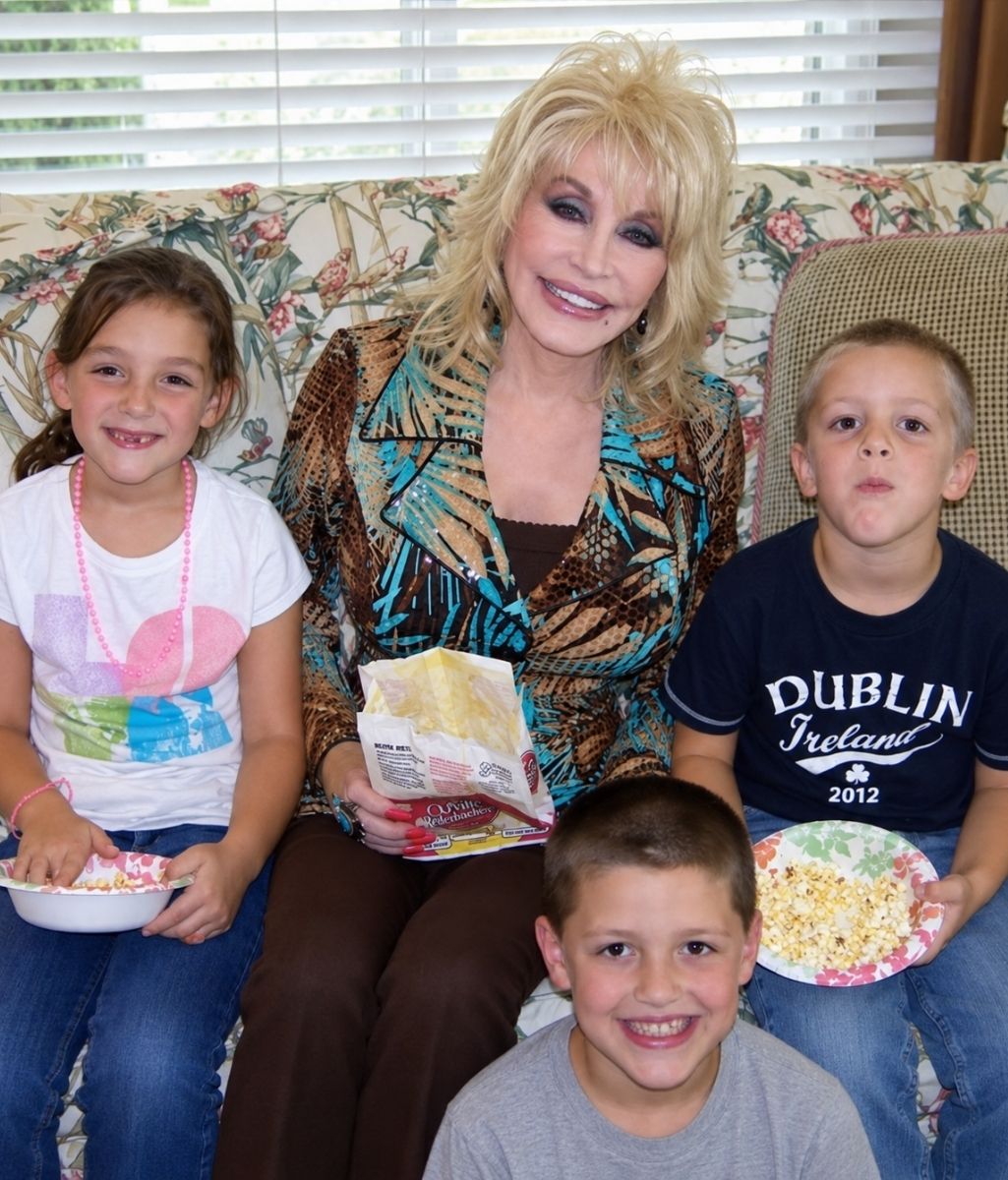
For most of her life, Dolly Parton was surrounded by children. She grew up in a family of 12, remained closely involved with her nieces and nephews, became a beloved godmother to Miley Cyrus, and eventually created one of the world’s largest childhood literacy programs. Yet there was one experience she never had herself: becoming a mother. Dolly and her husband, Carl Dean, whom she married in 1966, never had children together. Over the years, Dolly spoke openly about the fact that she had once imagined motherhood as part of her future. Like many young women, she had thought about what her children might be like and even considered what she might name them. But that chapter of life never came, and for a time, its absence carried real emotion.
Dolly later acknowledged that she and Carl had wondered what having children might have been like. As the years passed, however, she gradually began to view her life differently. Rather than defining herself only by what she had missed, she came to believe that perhaps her life had unfolded that way for a reason. She explained that not having children gave her an unusual degree of freedom: the freedom to travel, work relentlessly, create, and devote herself to children beyond her own family. Dolly reflected that if she had had children of her own, she might not have been able to accomplish everything she eventually did. She also spoke about believing that God had a plan, and that perhaps she was meant to care for children on a much larger scale rather than raising only her own.
That belief eventually became visible through one of the most meaningful missions of her life. In 1995, Dolly launched Dolly Parton’s Imagination Library in Sevier County, Tennessee, the place where she grew up. The idea was simple but powerful: every enrolled child from birth to age five would receive a carefully selected book in the mail each month at no cost to the family. The program also had a deeply personal origin. Dolly’s father, Robert Lee Parton Sr., was a hardworking man whom she admired enormously, but he had never learned to read or write. His lack of literacy stayed with her, and she created the Imagination Library partly to give children opportunities her father had never been given.
What began as a local initiative did not remain local for long. The program expanded across the United States and eventually reached Canada, the United Kingdom, Australia, and the Republic of Ireland. By 2003, it had mailed its one-millionth book, and in later years, it grew to the point of sending millions of books every month to children around the world. That scale gives Dolly’s reflections about motherhood an entirely different meaning. She never became a biological mother, but millions of children grew up receiving something with her name attached to it. A book arrived at the door, another arrived the next month, and another followed after that. For some families, Dolly Parton was not primarily the woman who sang “Jolene” or starred in 9 to 5. She was the reason a child had a growing collection of books at home.
Dolly’s connection with children also extended beyond philanthropy. She often described herself as having a natural bond with young people, and her nieces and nephews have spoken about the encouragement she gave them. She treated younger relatives as individuals rather than simply as members of the Parton family, supporting their education, careers, music, and personal choices while maintaining the playful “Aunt Dolly” identity that became as familiar privately as her public image was to fans. Still, Dolly did not present her charitable work as a simple replacement for the children she never had. Her reflections were more nuanced. As she grew older, she came to see that the life she actually lived allowed her to reach far more people than she might otherwise have been able to.
That acceptance appears to have brought her peace. Instead of spending her later years focusing on what might have been, Dolly increasingly spoke about what her circumstances had made possible. She could devote enormous energy to music, build businesses, support her relatives, fund charitable work, and help create a program that placed books directly into the homes of children she would never meet. The irony is deeply moving: a woman who never had a child call her “Mom” ultimately became associated with childhood reading on an international scale. The Imagination Library’s official mission is to inspire a love of reading by sending free, age-appropriate books to children from birth to age five, regardless of family income in participating communities. What began with Dolly’s memories of her father grew into one of the defining achievements of her life outside music.
That may be why Dolly’s story resonates so strongly with people whose lives did not unfold exactly as they once expected. She did not pretend that disappointment never existed. Instead, she refused to let absence become the final definition of her life. What she could not have in one form, she eventually gave in another—not to one child, not to a dozen, but to generations. Dolly Parton never became a mother in the traditional sense, but she eventually came to believe that perhaps her life had been designed differently for a reason. Through the Imagination Library, the woman who never had children of her own helped millions of other people’s children dream a little bigger.
Sometimes the life you imagined never arrives. Dolly Parton’s story suggests that what grows in its place can become even larger than you ever planned.