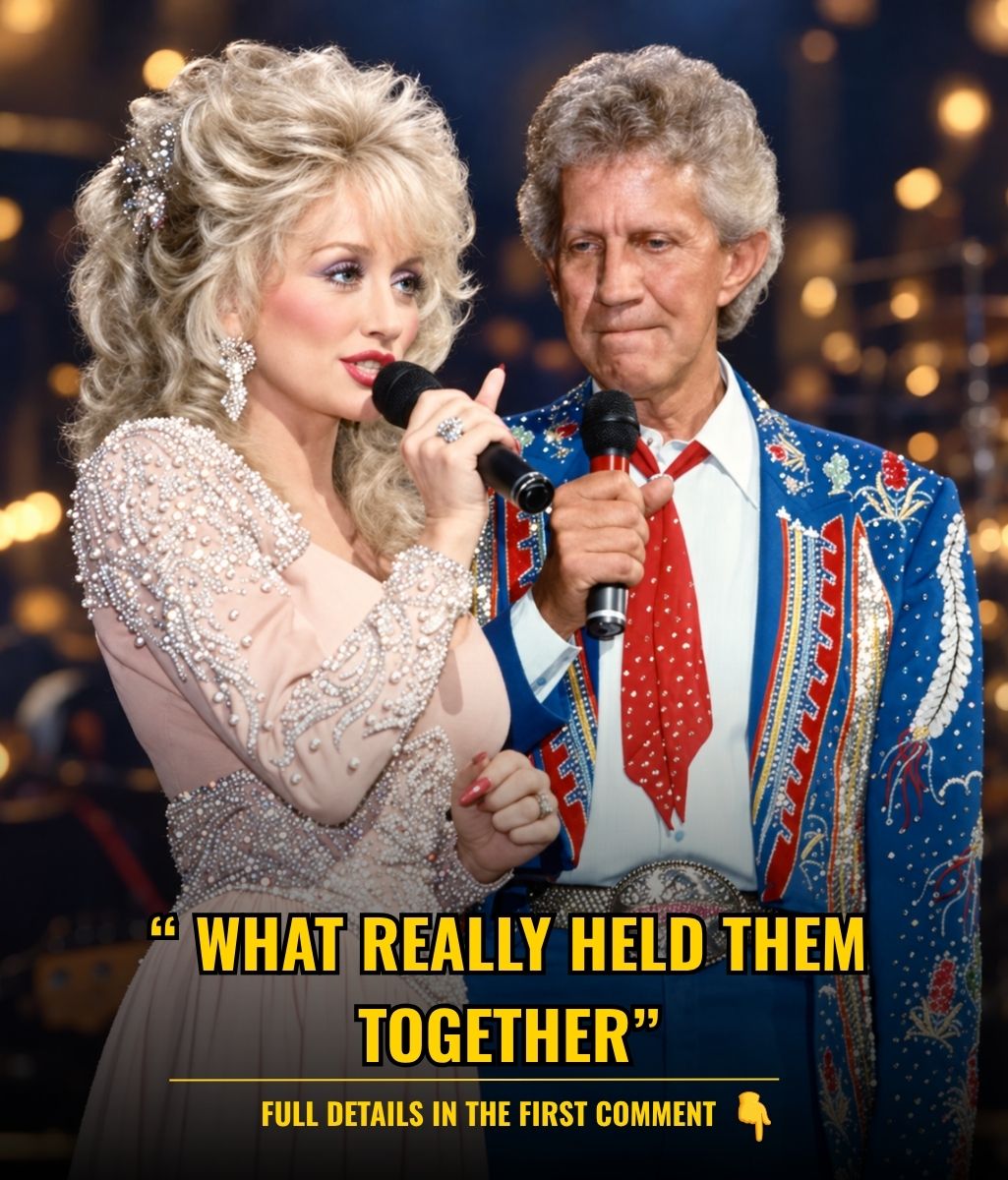
For years, Dolly Parton and Porter Wagoner looked almost inseparable. They stood side by side on television in carefully coordinated outfits, traded verses on country duets, toured together, recorded album after album, and became one of Nashville’s most recognizable partnerships. To audiences watching from home, their chemistry could sometimes look so natural that people wondered whether something romantic existed behind it. But the truth about what held Dolly and Porter together was both less scandalous and far more complicated.
Their connection began with opportunity.
In 1967, Porter invited Dolly to join The Porter Wagoner Show, a syndicated television program that was already reaching millions of country fans. Dolly had talent, songs, and enormous ambition, but Porter possessed something she did not yet have: a national platform. Appearing on his show helped introduce her to audiences far beyond Tennessee and led to her becoming part of the RCA Victor world in which Porter was already firmly established.
From the beginning, however, their relationship was never simply that of two equal stars casually deciding to sing together.
Porter became deeply involved in Dolly’s career. The Country Music Hall of Fame notes that he effectively served as producer and arranger on their duet albums and also supervised much of Dolly’s RCA solo output during those years. That meant the partnership reached into television, touring, recording, business, and creative decisions all at once. Their careers became financially and professionally intertwined in ways far deeper than what fans saw during a three-minute duet on television.
And it worked.
Between 1967 and 1974, Porter and Dolly became one of country music’s leading duos, recording a long run of albums and producing numerous Top 10 singles. Their partnership helped turn Dolly into a nationally recognized performer while also giving Porter a younger songwriting voice and duet partner whose popularity continued to rise. Eventually, Dolly was no longer simply “the girl singer” on his program. She was becoming a major star in her own right.
That success may have been exactly what made the relationship so difficult.
Dolly had always dreamed of building her own career. She wanted to write her own songs, make her own decisions, and eventually discover how far she could go outside another artist’s television show. Porter, meanwhile, had invested years into developing the partnership and had professional, financial, and creative interests tied to Dolly remaining within that system.
So the same structure that brought them together eventually began pulling them apart.
Dolly later described needing to leave in order to pursue the dreams she had carried since childhood. By 1974, she had made the decision to step away from The Porter Wagoner Show. Her official biography acknowledges that the split caused serious friction, while the Country Music Hall of Fame notes that the separation eventually produced angry words and legal action.
That is where one of the biggest misunderstandings about their relationship begins.
Because Dolly and Porter could be intensely emotional with one another, fans sometimes interpreted their bond as a hidden romance. Yet the evidence points toward something more complicated: they were two ambitious artists whose personal affection had become tangled with business obligations, creative dependence, loyalty, resentment, and enormous professional success.
Dolly could be grateful to Porter and still feel controlled by the partnership.
Porter could care deeply about Dolly and still resist losing an artist whose success had become intertwined with his own organization.
Both things could be true at the same time.
When Dolly finally realized ordinary conversation was not resolving the conflict, she did what she had always done when emotions became difficult to explain.
She wrote.
The result was “I Will Always Love You.”
The song is now usually heard as one of the great romantic farewells in popular music, especially after Whitney Houston transformed it into a worldwide hit decades later. But Dolly wrote it as a goodbye to Porter Wagoner as she prepared to leave his show. Her official album history describes the song plainly as her public farewell to Porter after seven years together.
That detail reveals exactly why their relationship is so difficult to reduce to a simple label.
Listen to the emotion in “I Will Always Love You.” There is affection in it, but also separation. Gratitude, but also determination. Dolly was essentially saying that Porter mattered enormously to her while also insisting that loving or appreciating someone did not mean allowing them to decide the rest of her life.
That was the real conflict.
Dolly did not need to stop caring about Porter in order to leave him professionally.
She simply needed freedom more than she needed the safety of the partnership.
The breakup became bitter enough that legal disputes followed, but even that was not the end of their story. Over time, the anger softened. Dolly and Porter repaired much of their relationship, appeared together again, and publicly acknowledged what they had meant to one another. The Country Music Hall of Fame notes that despite the legal conflict following Dolly’s departure, the pair ultimately resolved their differences.
That reconciliation may be the clearest evidence of what had actually held them together in the first place.
It was not a secret affair.
It was not merely a television contract.
And it was not simply money.
At the center was music, along with an unusually complicated form of loyalty between two people who had helped transform one another’s careers. Porter gave Dolly access to an audience that accelerated her rise dramatically. Dolly brought songs, personality, talent, and eventually enormous star power into the partnership. Each benefited from the other, but over time Dolly grew beyond the structure that had originally helped her succeed.
Porter may have helped open the door.
Dolly eventually had to decide whether she was willing to walk through it alone.
Her decision changed country music history.
After leaving the show, Dolly’s solo career accelerated. She became CMA Female Vocalist of the Year in 1975 and 1976, won Entertainer of the Year in 1978, expanded into pop crossover success, and built the independent career she had believed was waiting for her.
Yet she never erased Porter from her story.
That may be the part fans sometimes miss when trying to decide whether the two loved or hated each other. Their relationship was never that simple. They could fight bitterly and still recognize what they had created together. Dolly could resent aspects of the partnership while remaining deeply grateful for the opportunity Porter had given her.
And decades later, the song she wrote while trying to leave him became the perfect explanation.
“I Will Always Love You” was not Dolly saying she wanted to stay. It was Dolly saying she cared enough to leave without pretending the years together had meant nothing.
That is what really held Dolly Parton and Porter Wagoner together: not romance, but music, ambition, gratitude, dependence, conflict, and a bond strong enough to survive even the breakup that nearly destroyed it.
In the end, Dolly had to walk away from Porter to become completely herself.
But she never had to erase him to do it.