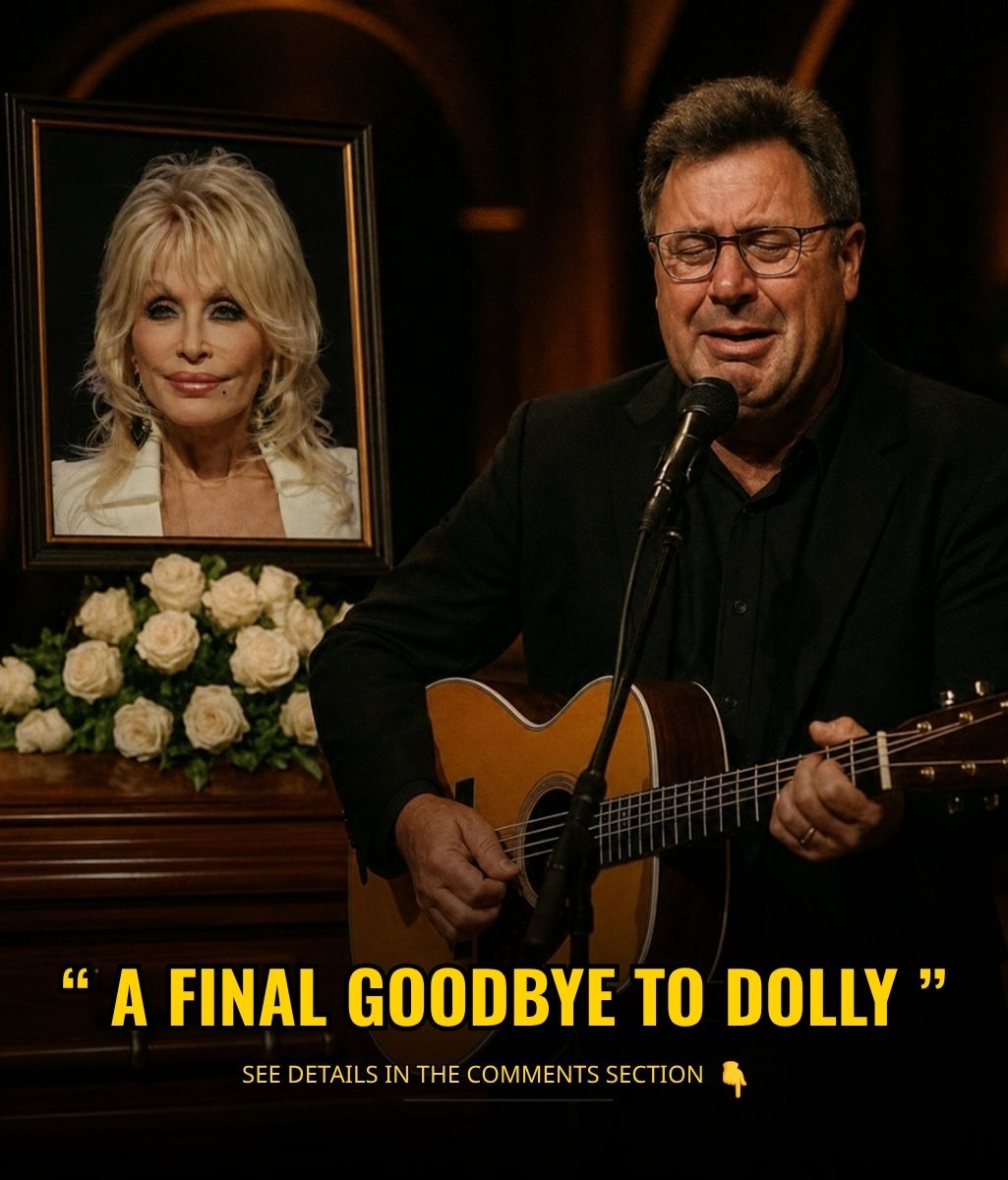
Some country songs seem to wait quietly for the moment when life gives them a new meaning. Vince Gill’s “Go Rest High on That Mountain” has carried grieving families through funerals and memorials for more than three decades, but following the death of Dolly Parton, the song has begun to feel painfully appropriate all over again. What was written from Vince Gill’s own experience with loss now sounds almost like the farewell countless country fans wish they could sing to Dolly themselves.
The song was never written for Dolly. Its roots go back to 1989, when Vince was deeply affected by the death of fellow country singer Keith Whitley. Vince began writing after Whitley’s passing but could not bring the song to completion. Several years later, when Vince lost his older brother Bob in 1993, grief pulled him back to those unfinished words and finally gave him the emotional strength to finish them.
That history is important because “Go Rest High on That Mountain” was born from real mourning rather than from an attempt to write a conventional hit. Vince understood what it meant to lose someone whose voice and presence had become part of your life, and that experience gave the recording a weight that listeners immediately recognized. With Patty Loveless and Ricky Skaggs providing harmony vocals, the song became something larger than the circumstances that inspired it.
Over time, families began using the song at funerals and memorial services across America. It became one of those rare recordings that people turned to when ordinary language no longer seemed sufficient, eventually joining the small group of country and gospel songs almost inseparable from grief itself. The Library of Congress described it as a song that has provided comfort and catharsis to listeners for decades, and in 2026 it was selected for the National Recording Registry.
That is why hearing it after Dolly’s death feels different.
For generations of fans, Dolly was not simply another singer whose career eventually came to an end. Her voice had been present at weddings, family gatherings, long drives, difficult years, and ordinary afternoons for more than half a century. Songs such as “Coat of Many Colors,” “Jolene,” “9 to 5,” and “I Will Always Love You” became attached to people’s memories, which meant her death felt strangely personal even to people who had never met her.
When an artist occupies that kind of place in people’s lives, a song about letting someone finally rest can suddenly become almost unbearable.
There is also another reason Vince Gill’s song fits this moment so naturally. “Go Rest High on That Mountain” does not focus only on death. Beneath the sorrow is a sense of release, faith, and the belief that someone who has completed their earthly journey can finally find peace. That spiritual foundation makes the song especially fitting when thinking about Dolly, whose Christian faith remained central to the way she talked about life, success, generosity, and mortality.
Dolly spent decades openly discussing the faith she learned as a child in East Tennessee. Church music, gospel harmony, and belief in God were woven into her earliest memories, and those influences never disappeared even after she became one of the biggest entertainers in the world. In the final period of her life, people close to her continued describing that same faith and optimism as part of the way she faced serious health struggles.
The emotional connection becomes even stronger when remembering what Vince’s song has already meant inside country music. In 2013, Vince performed it with Patty Loveless at the funeral of George Jones, one of the most unforgettable memorial performances in the genre’s history. Vince became so overwhelmed that at moments he struggled to continue singing, while Patty remained beside him and helped carry the performance forward.
That moment revealed why the song has endured. Even its writer was not protected from the grief contained inside it.
Today, with Dolly gone, fans are experiencing something similar. A recording written decades ago for entirely different losses suddenly seems capable of expressing what many people cannot put into their own words. The song does not need Dolly’s name in its lyrics to feel connected to her passing because its message was always broad enough to belong to anyone who has had to say goodbye.
Dolly’s own legacy makes that connection even more poignant. She spent more than six decades creating music, helping children through the Imagination Library, supporting communities in times of crisis, and continually finding new ways to give something back. In the days after her death, streams of her music surged dramatically around the world, showing just how many people were returning to her voice as a way of processing the loss.
That is what grief often does. It sends us back to music.
Sometimes we return to the songs of the person we lost, and sometimes we reach for another song that somehow knows what we are trying to say. For many country fans, “Go Rest High on That Mountain” has filled that role for years.
Now Dolly Parton has become part of that long story of remembrance.
Vince Gill did not write the song for her, and there is no need to pretend that he did. The power comes from something more genuine: a song born from Vince’s own grief has become a place where listeners can now carry theirs.
After Dolly Parton’s passing, “Go Rest High on That Mountain” no longer sounds only like Vince Gill’s song about loss. For many country fans, it now sounds like one final message to Dolly — that her work here is finished, her songs will remain, and she can finally rest high on that mountain.