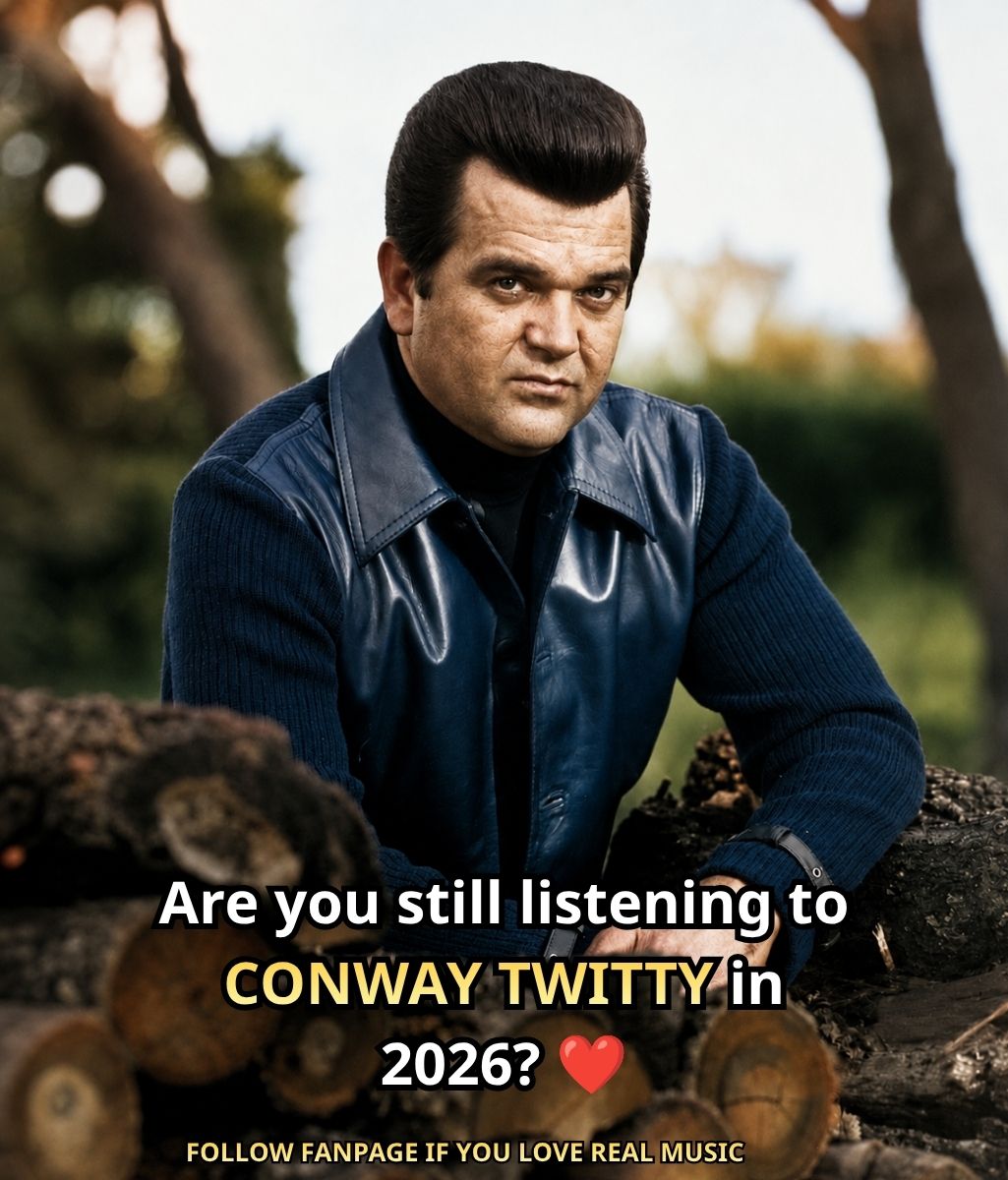
Conway Twitty rarely explained himself from the stage, but behind that quiet discipline was a relentless performer who carried enormous pressure, kept working through exhaustion, and left country music grieving a loss that came without warning.
Conway Twitty was never the kind of entertainer who filled a concert with long speeches, rehearsed jokes, or stories about every song. While many performers used conversation to build a relationship with the crowd, Conway relied almost entirely on his music. He would step toward the microphone, look into the audience, and begin singing with little ceremony. One song often followed another with barely enough silence for the applause to fade. He believed the audience had come to hear him sing, and he treated that expectation almost like a personal promise. His restraint did not make him distant. Instead, it created an unusual intensity, allowing thousands of people to feel that he was singing privately to each one of them.
That quiet stage presence became one of the most recognizable elements of his career. Conway did not need exaggerated movements or dramatic introductions to command attention. A steady glance, a carefully delayed phrase, or the first two words of “Hello Darlin’” could change the atmosphere of an entire venue. His live recording titled “Why Don’t You Ever Talk on Stage?” even acknowledged the question fans had long asked about his unusual performance style. The title revealed that Conway understood his silence had become part of his public identity. Yet he never abandoned it, because his confidence rested in the songs rather than in unnecessary conversation.
Behind that controlled exterior, however, was an artist carrying the demands of an exceptionally long and productive career. Conway had first achieved international fame in rock and roll with “It’s Only Make Believe” before taking the enormous risk of rebuilding himself as a country performer. The transition required patience, persistence, and a willingness to walk away from the musical identity that had already made him famous. By the time he became known as one of country music’s greatest romantic voices, he had learned that success could disappear unless an artist continued proving himself. That knowledge may help explain the discipline with which he approached recording and touring. Conway did not treat applause as a guarantee. He treated every performance as something that had to be earned again.
The price of that discipline was rarely visible to the people watching from their seats. Audiences saw the tailored clothes, the controlled expression, and the singer who appeared completely certain of what he was doing. They did not always see the hours spent traveling between towns, the repeated nights onstage, the pressure to protect a legendary voice, or the exhaustion that could accumulate behind the curtains. Conway’s performances were serious because he respected the work. He gave the crowd the songs they had carried through marriages, separations, loneliness, and memory. Even when the road became physically demanding, he continued behaving as though the listener in the last row deserved the same commitment as the first audience he had ever faced.
That sense of responsibility makes the final night of his life especially painful to remember. On June 4, 1993, Conway became ill while performing at the Jim Stafford Theatre in Branson, Missouri. After the show, he collapsed aboard his tour bus and was taken to a hospital in Springfield. Doctors performed emergency surgery, but Conway died during the early hours of June 5 from an abdominal aortic aneurysm. He was only 59 years old. Country music had not been prepared for a farewell because Conway had not announced one. There had been no carefully planned retirement tour, no final speech, and no opportunity for fans to understand that they were hearing him for the last time.
That suddenness gave his death an almost unbearable emotional weight. Only hours earlier, he had still been doing what he had done for decades: traveling, stepping beneath the lights, and giving the audience another performance. Then the man whose voice had seemed permanent was gone. The silence that followed was unlike the controlled silence he had used onstage. This time, there would be no opening note after it. His death closed one of country music’s most extraordinary careers in a manner that reflected the sacrifice behind it—Conway remained connected to the road and the stage until the final day of his life.
The tragedy also changed the way listeners heard his last recordings. Conway’s final solo studio album, “Final Touches,” had been recorded between March 1992 and May 1993 and was released on August 31, nearly three months after his death. It had not been conceived as a deliberate farewell, yet its title suddenly carried a meaning no one could ignore. The older voice, measured phrasing, and reflective atmosphere now sounded like the closing pages of a story whose ending had arrived too soon. Every pause seemed heavier because listeners knew there would be no new chapter recorded afterward.
It is tempting to romanticize exhaustion and describe relentless work as proof of greatness. But Conway’s story also reveals the human cost hidden behind professional devotion. The schedule, the responsibility, and the need to remain worthy of the audience’s trust demanded more than fans could see. His quietness may have protected some of that private burden. He rarely stood beneath the lights and described how tired he felt or how difficult the road had become. He did not ask the audience to carry his troubles. He simply sang, allowing the emotion inside the music to express what he chose not to explain.
That was why his death felt personal to so many people who had never met him. Conway’s songs had entered private places in their lives. His voice had been present during first dances, late-night drives, broken relationships, reconciliations, and years that disappeared more quickly than anyone expected. When he died, listeners were not only mourning a successful entertainer. They were mourning the voice attached to their own memories. Country artists and fans responded with shock because a man who had given so much of himself through music had vanished almost immediately after leaving another stage.
Conway Twitty’s legacy is often measured through his hit records, his celebrated duets with Loretta Lynn, and his transformation from rock-and-roll star into a towering country figure. Yet his deeper legacy may be found in the seriousness with which he approached every song. He did not need to tell audiences how committed he was. They could hear it in the way he delivered a line, preserved a pause, and refused to place anything unnecessary between the story and the listener.
Conway Twitty spent his career proving that silence could be powerful—but after his final performance, country music discovered how painful silence could become. He rarely spoke about the sacrifices behind the songs. He simply carried them, night after night, until the road demanded more than even he could give.