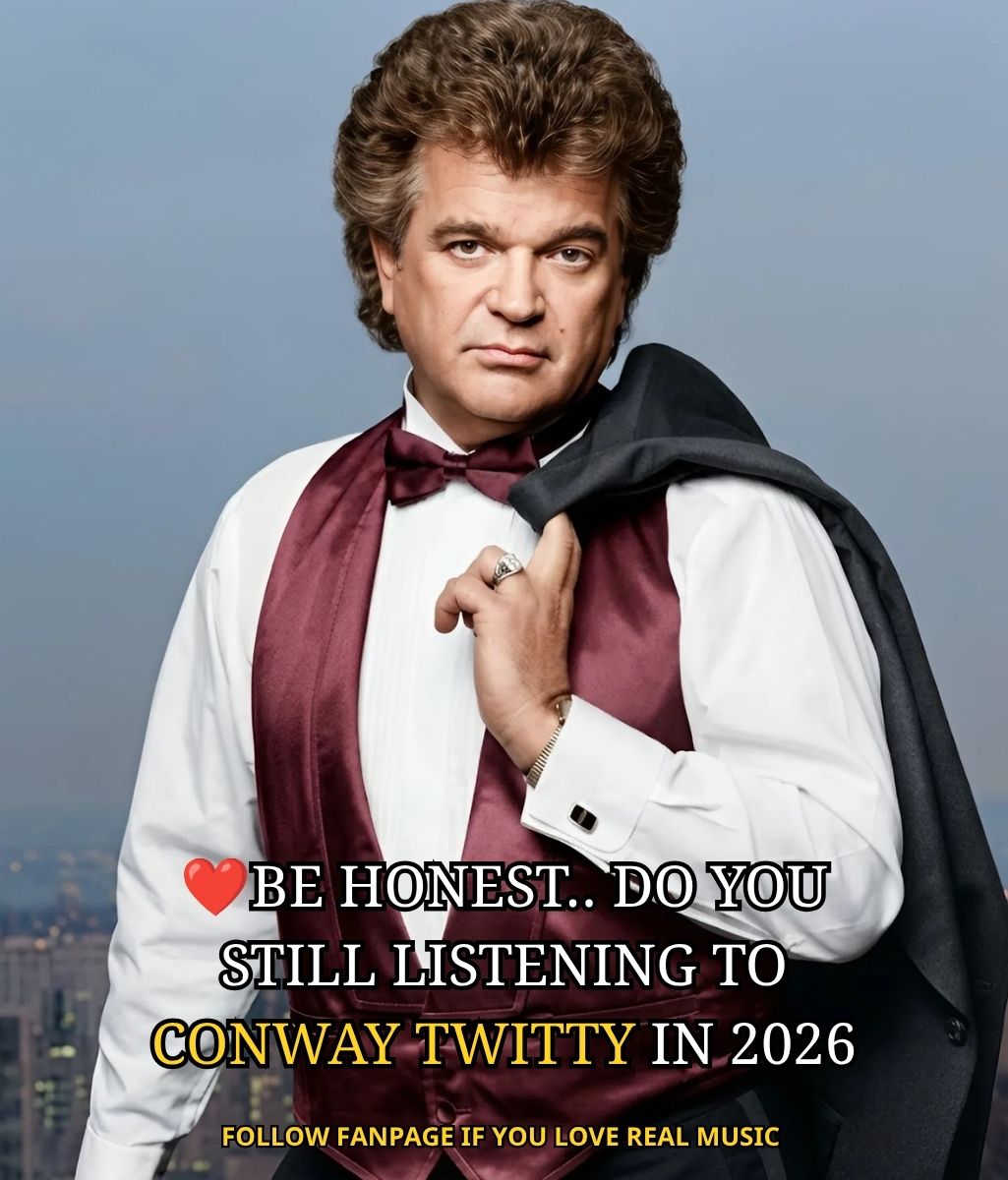
Conway Twitty is often remembered for the records, the chart success, the unmistakable voice, and the long list of songs that helped define an era. But the deeper story is that he thought far beyond the next hit. From the beginning, Twitty seemed to understand that a lasting career required more than talent. It required identity, instinct, emotional truth, and the courage to trust decisions that might not make immediate sense to everyone else. Even his name reflected that mindset. Born Harold Lloyd Jenkins, he eventually adopted the stage name Conway Twitty, a name created from place names he encountered on a map. Whether viewed as a branding decision or simply a memorable creative choice, it gave him something distinctive—an identity that sounded larger than one moment in popular music. Over time, the name itself became inseparable from country history.
That instinct for simplicity also shaped the way Twitty approached songs. “Hello Darlin’” became one of the clearest examples of how he could take an ordinary human moment and turn it into something unforgettable. The phrase itself was simple. There was no need for elaborate imagery or complicated language. Twitty understood that sometimes the strongest emotion comes from restraint. A former couple meeting again, a greeting carrying years of memory, regret, tenderness, and things left unsaid—that was enough. His delivery did the rest. Rather than trying to overwhelm listeners with vocal theatrics, he allowed the emotion to sit quietly inside the words. He seemed to understand that country music could be most powerful when it sounded less like performance and more like truth.
That same artistic intuition became even more visible in his partnership with Loretta Lynn. Their voices were dramatically different. Conway brought smoothness, control, and a sense of intimacy, while Loretta brought directness, strength, and the unmistakable honesty that had defined her own career. On paper, the contrast might have seemed unusual. In practice, it became one of the most effective combinations country music had ever heard. Their 1971 album “We Only Make Believe” helped establish them as a major duet team, and songs such as “After the Fire Is Gone” and “Lead Me On” showed how naturally their voices could answer one another. Twitty understood that contrast could create chemistry. He did not need a partner who sounded like him. He needed someone who could bring a completely different emotional force into the same song. Loretta did exactly that.
Their duet recordings also revealed something broader about Twitty’s musical thinking. He knew that a great performance was not only about singing well—it was about making the audience believe the story. When Conway and Loretta traded lines, the songs often felt like conversations rather than formal duets. One voice could sound wounded, the other defensive. One could sound hopeful, the other uncertain. Their personalities remained distinct, but that difference made the performances stronger. Twitty recognized the dramatic potential of two contrasting voices sharing one emotional space, and the success of those recordings helped secure their place among the most celebrated duet partnerships in country music.
His sense of legacy also extended beyond his own spotlight. Twitty was not only thinking about how his music would be remembered; he was also thinking about family and the next generation. His daughter Joni Lee became part of that story through the song “Don’t Cry Joni.” The recording paired father and daughter and became a major success, giving Joni Lee an early platform in country music. What made the moment meaningful was not simply the commercial result. It showed another side of Conway: a father willing to bring his child into the world that had defined his own life. The duet turned family into musical memory, creating a recording that connected his personal life with his public legacy in a way listeners could immediately understand.
Twitty also had an extraordinary instinct for recognizing when inspiration had arrived. One of the most famous stories from his early career involves “It’s Only Make Believe.” Written with drummer Jack Nance in 1958 during a touring stop in Hamilton, Ontario, the song reportedly came together in roughly twenty minutes. There was no elaborate writing camp, no lengthy studio planning, and no indication that the moment would become historic. Yet Twitty and Nance captured something universal: the pain of loving someone who may never love you in return. The song became a massive international hit and changed Twitty’s career forever. What mattered was not how long it took to write, but how quickly he recognized that the feeling was worth following.
That moment says a great deal about his creative instincts. Some artists need perfect circumstances before they can create. Twitty seemed willing to respond whenever the idea appeared. He could take a fragment of emotion, shape it quickly, and trust that audiences would recognize themselves inside it. That ability later carried naturally into country music, where emotional clarity mattered more than complexity. His greatest strength was rarely about making songs complicated. It was about knowing what not to remove from them.
Perhaps that is why Conway Twitty still feels larger than his statistics. The numbers are impressive, but they do not fully explain why his music lasted. His real vision was his ability to understand what listeners would remember long after trends changed. A memorable name. A simple phrase. Two contrasting voices. A father and daughter sharing a song. A twenty-minute burst of inspiration becoming an international hit. None of those moments depended on spectacle. They depended on instinct.
Twitty’s career moved through rock and roll, country, solo success, famous duets, family recordings, and decades of changing musical tastes. Yet beneath all of those chapters was the same idea: he understood that legacy is built by recognizing the right moment before anyone else knows how important it is. He knew when to change direction, when to simplify a song, when to share the microphone, and when to trust an idea that arrived without warning.
That is what makes Conway Twitty more than a successful country singer. He was an artist with a remarkable ability to see possibility in things that looked ordinary at first—a name on a map, a simple greeting, an unexpected vocal pairing, a family duet, a song written in minutes. What others might have seen as small moments, Conway Twitty repeatedly turned into pieces of history.