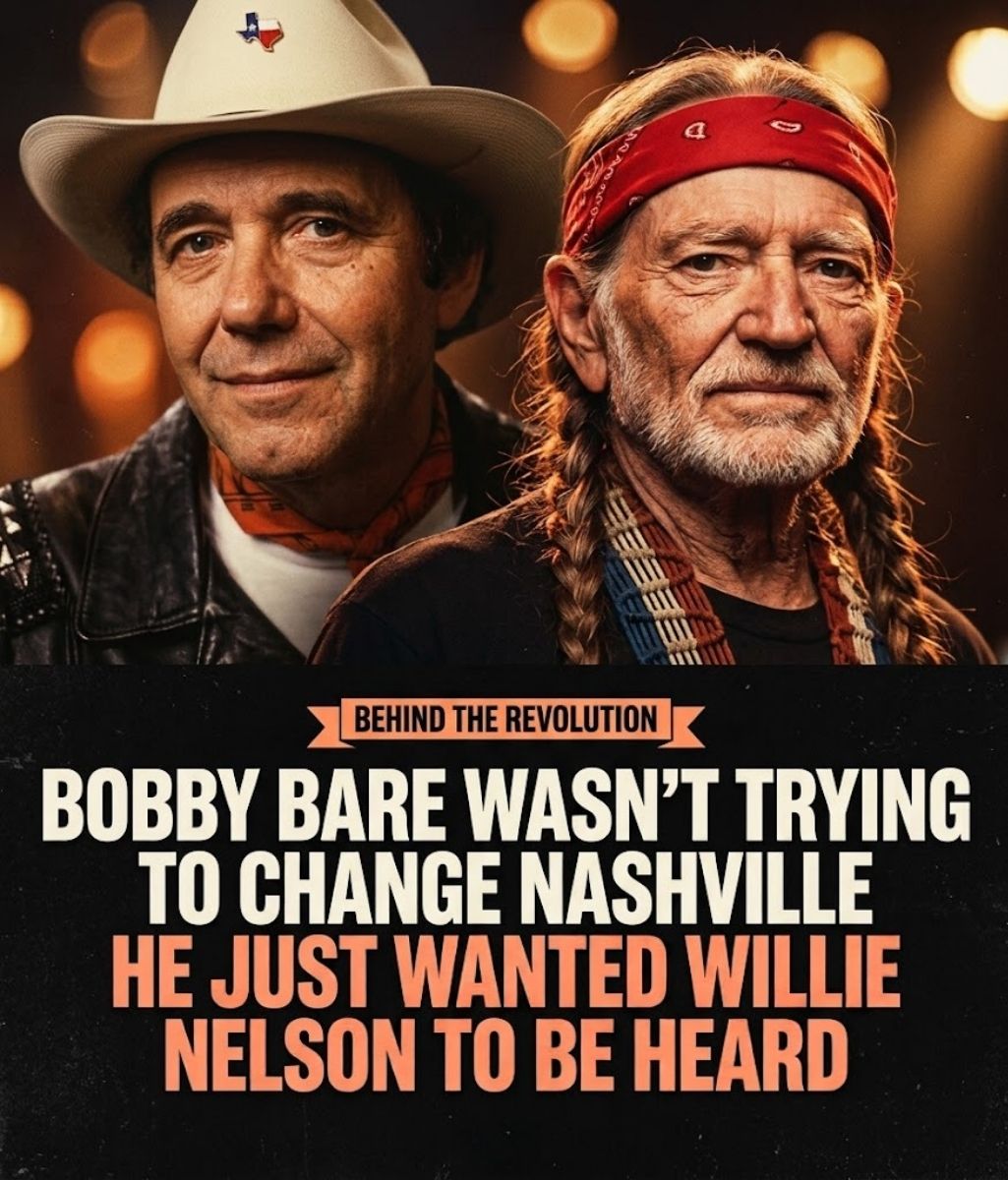
Before country music learned to celebrate outsiders, Bobby Bare recognized something in Willie Nelson that many people in Nashville still struggled to understand. Willie already possessed the qualities that would eventually make him unmistakable: an unconventional voice, deeply personal songs, unusual phrasing, and a way of writing about loneliness, regret, love, and restless living without making any of it sound manufactured. But in an industry that often rewarded familiar voices and carefully controlled presentation, being different could be both a gift and a problem. Bobby Bare was not trying to create a movement when he paid attention to Willie. He was not planning a rebellion against Nashville. He simply heard something real, and he believed real songs deserved to be heard.
That instinct was central to Bare’s own career. He had never been particularly comfortable allowing the music business to decide exactly what kind of artist he should become. Across the years, he moved between country, folk, rock-influenced sounds, humor, and narrative songwriting with the confidence of someone who trusted a powerful song more than a fashionable formula. Bare understood that great country music did not always arrive in perfect packaging. Sometimes it came from a writer whose voice sounded unusual. Sometimes it came from a lyric that was too honest, too strange, or too personal to fit comfortably beside everything else on the radio. Where others might have heard something difficult to market, Bare often heard individuality. That made him especially receptive to songwriters who did not fit easily inside Nashville’s established expectations.
Willie Nelson was one of those writers. Long before the braided hair, the packed arenas, and the image that would eventually become part of American culture, Willie was trying to build a place for himself in Nashville through his songs. His writing was already remarkable. He could take complicated feelings and reduce them to lines that sounded simple only because they were so carefully understood. His melodies did not always travel where listeners expected, and his phrasing could seem almost conversational, as though he were singing slightly behind or around the beat instead of marching directly through it. What some people regarded as awkwardness would eventually become one of the most recognizable styles in country music. Bare understood that difference did not need to be corrected. It needed room.
Their connection mattered because Bare was more than another singer looking for material. He was an artist who genuinely respected the person behind the song. When he encountered writing that moved him, he was willing to record it, talk about it, and help bring attention to the writer responsible. Willie’s songs found important interpreters throughout Nashville, and Bare became part of the circle of artists who recognized that Willie was not merely another songwriter supplying material for established stars. There was an artist inside those songs waiting for the wider world to catch up. Bare’s support did not single-handedly create Willie Nelson’s career, nor would Willie’s extraordinary rise ever belong to one person’s encouragement. But moments of belief matter, especially in an industry where an unconventional artist can spend years being told that something essential about him should be changed.
The irony is that Bobby Bare himself was helping challenge Nashville convention at the same time. He became increasingly interested in artistic control, strong songwriting, and records that reflected the personality of the performer rather than simply the preferences of an established production system. These ideas would become central to the broader spirit later associated with country music’s independent and outlaw movements. Bare was not standing on a stage announcing that Nashville needed a revolution. He was doing something quieter. He was making choices. He was trusting writers. He was pushing for greater control of his music. And he was demonstrating that an artist could respect country tradition without surrendering individuality.
Willie Nelson would eventually take that independence much further. After years of frustration with Nashville, he returned to Texas and began building a sound and identity that felt more naturally his own. The boundaries between country, folk, blues, jazz, and western music became less important than authenticity. By the 1970s, Willie stood at the center of a cultural shift that helped broaden the meaning of country music. Alongside figures such as Waylon Jennings and other independently minded artists, he became associated with a movement that rejected the idea that every country performer needed to look, sound, and record the same way. The qualities that once made Willie difficult for some parts of Nashville to understand became precisely the qualities audiences loved most.
Looking backward, it is tempting to imagine that such a transformation was inevitable. It was not. Music history is filled with talented people who disappeared because the right person never listened at the right moment. Willie Nelson possessed the writing, determination, vision, and resilience necessary to build his own extraordinary career, but artists also survive because other musicians recognize their value before the rest of the world does. Bobby Bare belonged to that important group of early believers. He understood that the goal was not to make Willie sound more conventional. The goal was to let people hear what Willie was already doing.
That distinction says as much about Bare as it does about Nelson. Supporting another songwriter requires a certain confidence, especially when that writer has a voice strong enough to become an artist in his own right. Bare did not need every good song to strengthen only his own reputation. His broader legacy shows a repeated respect for songwriters and storytellers, from Willie Nelson to Shel Silverstein, Kris Kristofferson, and other distinctive voices whose work challenged the narrowest definition of country music. He understood that a healthy musical culture depends on people willing to recognize greatness before it becomes obvious.
Decades later, Willie Nelson became one of the most enduring figures in American music, while Bobby Bare earned his own place among country music’s great individualists. Their stories followed different paths, but they shared an important belief: a song should not have to lose its personality in order to survive. Sometimes the most important contribution an artist can make is not a dramatic speech or public declaration. Sometimes it is simply opening a door, recording an unexpected song, speaking up for someone talented, or refusing to dismiss a voice because it sounds different.
Bobby Bare was not trying to start a revolution when he believed in Willie Nelson. He was doing something simpler and, in the end, perhaps more important—he was listening. And by helping make room for a voice Nashville had not fully understood yet, Bare became part of the quiet change that allowed country music’s outsiders, poets, and restless dreamers to finally sound like themselves.