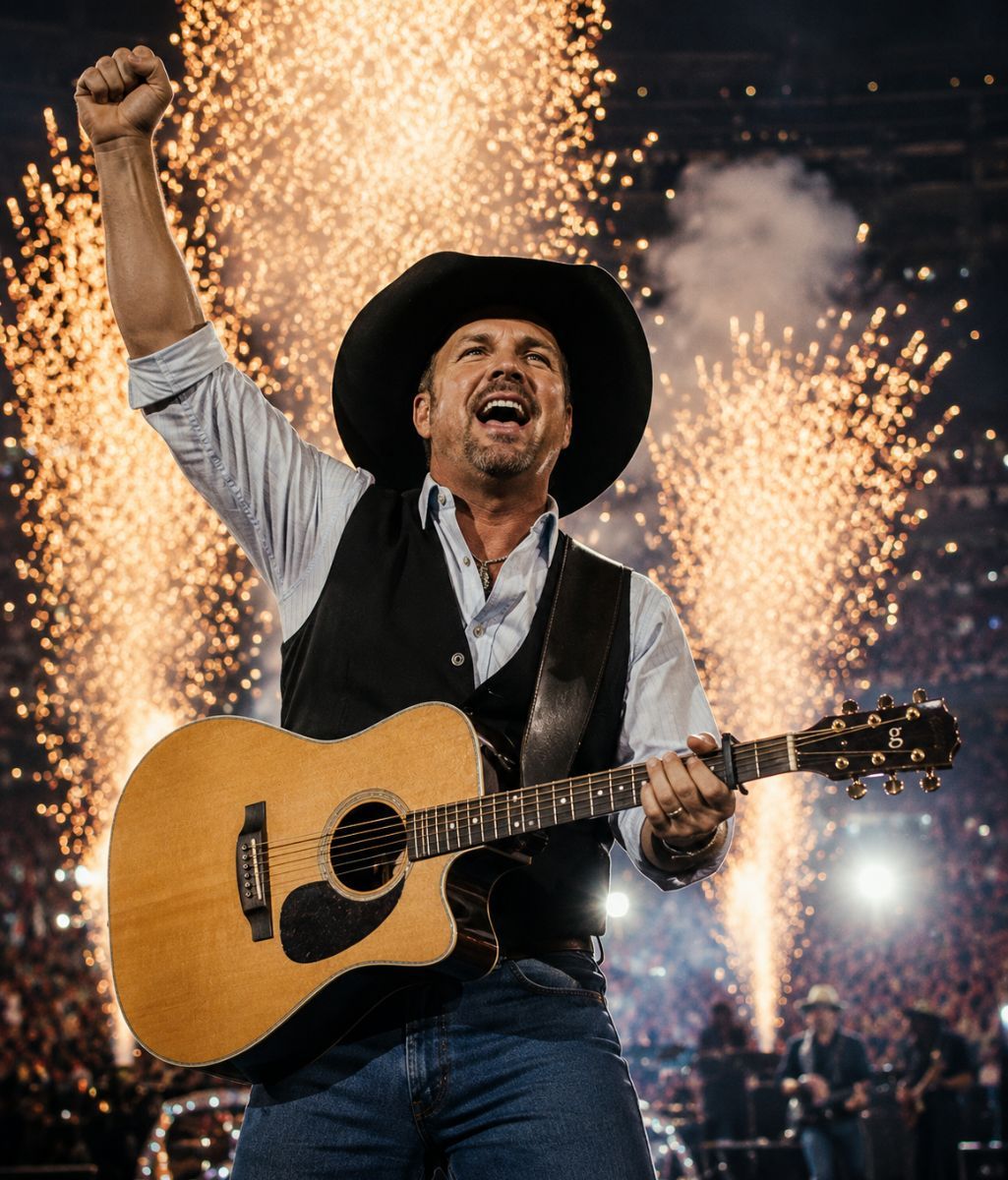
For millions of fans, a Garth Brooks concert was unlike anything they had ever experienced. His relentless sprint across the stage wasn’t carefully choreographed for dramatic effect—it reflected a simple philosophy. Every fan, whether standing in the front row or sitting in the highest seat of the arena, deserved to feel seen, included, and part of the same unforgettable celebration.
The first thing many people remember about a Garth Brooks concert isn’t a particular song.
It’s the movement.
The lights would dim, the crowd would erupt, and almost instantly Brooks would explode onto the stage with an energy that seemed impossible to sustain. Before fans had fully settled into the opening song, he was already racing from one side of the arena to the other, waving, pointing, smiling, and making eye contact with people scattered throughout every section of the venue.
To first-time concertgoers, it almost looked exhausting.
To Garth Brooks, it simply felt natural.
Throughout his career, Brooks believed that buying a concert ticket meant more than hearing songs performed live. Fans weren’t paying to watch someone stand behind a microphone for two hours. They were investing in an experience—one that should leave them feeling connected, energized, and emotionally fulfilled long after the final encore.
That belief shaped everything about the way he performed.
As country music concerts grew larger and moved into massive arenas and football stadiums, Brooks refused to let the size of the venue create distance between himself and the audience. Instead, he embraced 360-degree stages, allowing fans to surround him from every direction. But designing the stage was only part of the equation.
He knew he had to keep moving.
From the moment the show began until the final bow, Garth Brooks treated the entire venue as his stage. He sprinted from corner to corner, making sure every section received attention. Whether someone had purchased a premium seat near the front or an affordable ticket in the upper deck, Brooks wanted them to feel included.
He often said, in different ways, that no one should leave believing they had been too far away to be part of the show.
That commitment became one of the defining characteristics of his concerts.
There was another reason behind his nonstop movement as well.
Brooks never believed country music performances had to follow traditional expectations. Growing up, he admired artists who transformed concerts into full-scale events filled with excitement, spontaneity, and audience participation. Among his influences were legendary rock performers such as KISS, whose theatrical stage productions demonstrated how powerful live entertainment could become.
But perhaps no performer influenced him more deeply than Chris LeDoux.
Before Brooks became a global superstar, he watched Chris LeDoux perform with an authenticity and intensity that left a lasting impression. LeDoux brought the spirit of the rodeo into his concerts, creating performances that felt energetic, genuine, and completely alive. Brooks later acknowledged how much he admired that approach, adopting the idea that audiences deserved not only great music but also unforgettable memories.
Inspired by those performers, Garth Brooks embraced technology that gave him complete freedom on stage. Wireless microphones allowed him to abandon the traditional image of a singer standing in one place. Instead, he could run, jump, kneel beside fans, climb ramps, and interact with every corner of the arena without missing a single lyric.
The movement wasn’t rehearsed choreography designed to impress critics.
It wasn’t a publicity stunt.
It wasn’t even an attempt to appear younger or more athletic.
It was simply an extension of who Garth Brooks was.
Friends and longtime collaborators have often described Brooks as someone whose enthusiasm is genuine both on and off the stage. The excitement audiences witnessed during concerts reflected the same personality that existed behind the scenes. Performing brought him enormous joy, and he believed that joy should be visible in every moment of every show.
He once questioned why artists shouldn’t be enjoying themselves just as much as the audience.
That simple idea changed country music concerts forever.
As his popularity grew throughout the 1990s and beyond, Brooks helped redefine what fans expected from a live country performance. His concerts became immersive experiences where the boundary between performer and audience seemed to disappear. Fans didn’t merely watch a show—they felt like participants in a celebration that belonged to everyone in the building.
Even after decades of performing, that philosophy never changed.
Whether entertaining thousands in an arena or more than 100,000 people in a stadium, Garth Brooks approached every concert with the same determination: to leave no section overlooked and no fan feeling forgotten. The endless running, the constant smiles, the spontaneous interactions, and the seemingly limitless energy all came from one unwavering promise—to give audiences everything he had, every single night.
Looking back today, those unforgettable performances remain one of the defining legacies of Garth Brooks’ remarkable career. His songs made him one of country music’s biggest stars, but his connection with audiences made him something even rarer. He understood that fans remember not only what they hear but also how they feel.
Perhaps that’s why, years later, so many people still describe attending a Garth Brooks concert as one of the greatest live experiences of their lives. They remember the music, of course. But they also remember the artist who never stopped moving—not because he had to, but because he believed every person in the crowd deserved the very best night he could possibly give them.