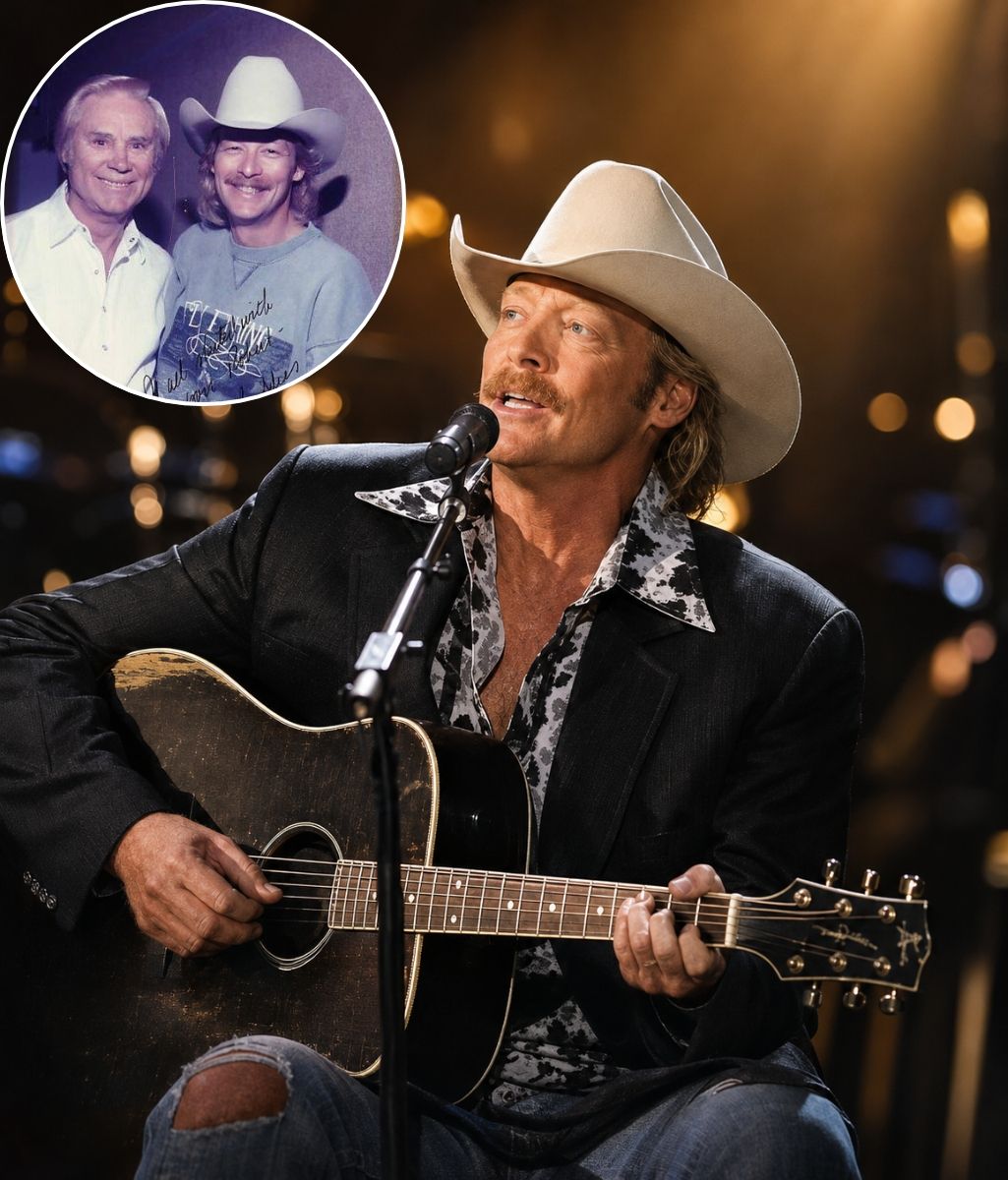
At the 1999 CMA Awards, Alan Jackson was supposed to do exactly what every major artist was expected to do on one of country music’s biggest nights: step onto the stage, perform his current hit and use the national television spotlight to promote his own career.
Instead, he used that moment for someone else.
That someone was George Jones.
Earlier that year, George had nearly died in a serious car accident. After recovering, he released “Choices,” a deeply personal song about mistakes, consequences and the decisions that shape a life. The recording became one of his most meaningful late-career releases and earned a CMA nomination for Single of the Year.
But when producers invited George to perform at the ceremony, there was a condition.
He would not be given enough time to sing the full song.
George was reportedly offered only a shortened slot of roughly a minute, while several younger stars were being given the full three or four minutes needed to perform their songs. To George, after nearly four decades in country music, the request felt disrespectful.
So he declined.
He stayed home with his wife, Nancy Jones, and watched the ceremony on television instead.
Alan Jackson knew what had happened.
He also knew how much George Jones meant to country music.
Alan was scheduled to perform “Pop a Top,” his own current single. He began exactly as expected, singing the song while the cameras rolled and the audience watched.
Then, midway through the performance, everything changed.
Alan stopped.
Instead of continuing “Pop a Top,” he shifted into George Jones’s “Choices.”
There was no long speech.
There was no angry announcement.
There was only the song.
For the people in the room who understood what had happened, the message was unmistakable. Alan had taken the television time reserved for his own hit and used it to give George Jones the moment he had been denied.
The audience began to rise.
By the time Alan finished, the room was on its feet.
He did not stand there soaking in the applause. He simply walked offstage, leaving the gesture to speak for itself.
Back at home, George Jones understood exactly what Alan had done.
George later said the moment meant more to him than he could express. He remembered watching the performance with Nancy and said that when Alan began singing “Choices,” both of them were moved to tears. George also praised Alan for making a statement not only on his behalf, but on behalf of traditional country music.
Alan later explained his reasoning just as simply.
He believed George Jones deserved better.
Speaking after the incident, Alan said it made no sense to treat George like an ordinary new artist when he was already a living legend who had spent decades helping build the music everyone in that room was celebrating.
That is why the 1999 CMA moment still matters.
Alan Jackson could have used the stage to promote himself.
Instead, he gave part of his own spotlight to the man who had influenced him and countless other country singers.
He did not need a speech.
He did not need an argument.
He sang George Jones’s song, walked away and allowed the room to understand the rest.
Years later, fans still remember that night because Alan Jackson did something far more powerful than perform another hit. He reminded an entire industry that the legends who built country music deserved to be honored while they were still here to see it.