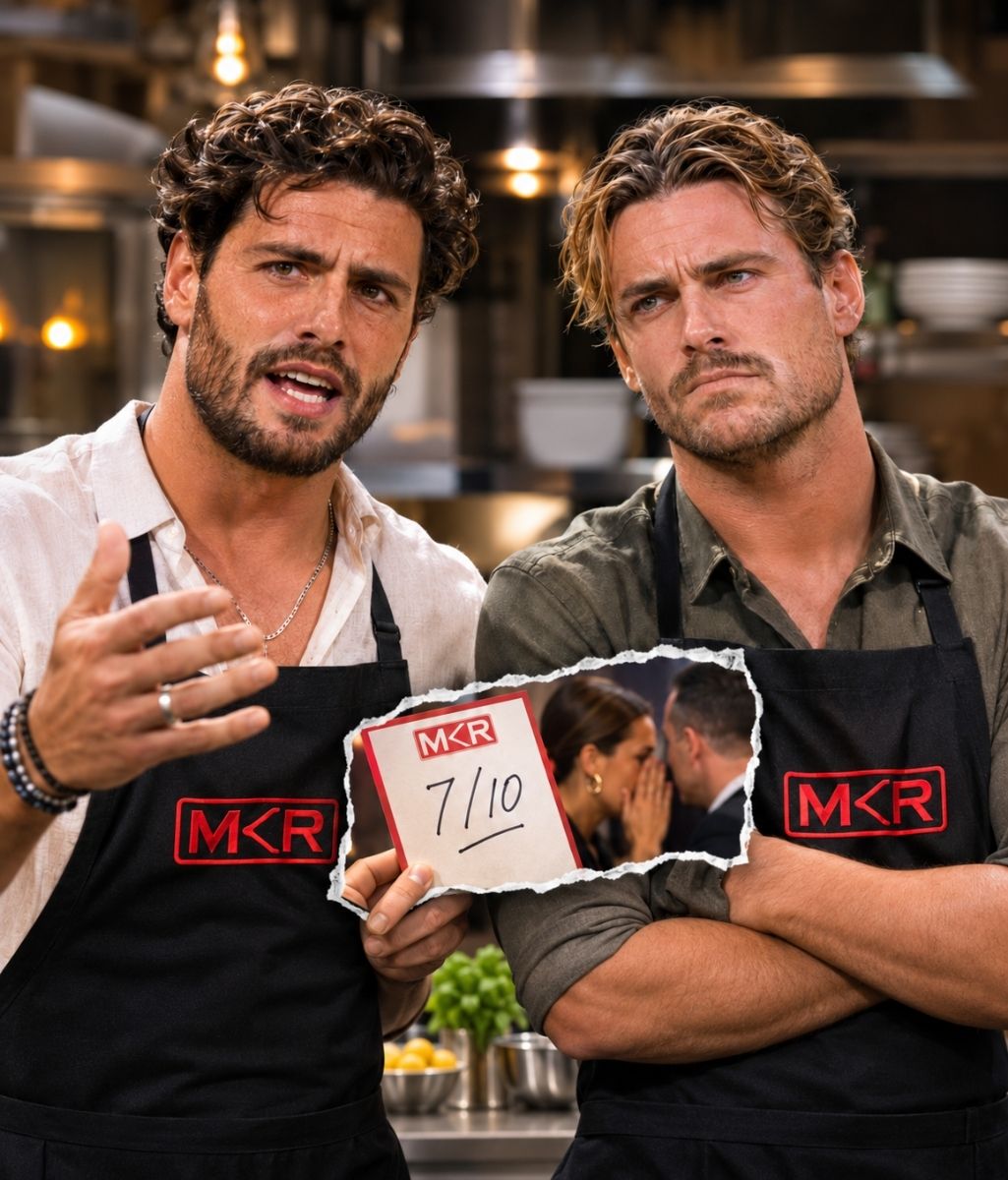
They have won over Australian audiences with their friendship, honesty, and impressive cooking skills. But now, My Kitchen Rules favourites Harrison and Oliver have found themselves caught in a controversy that threatens to overshadow everything happening in the kitchen. As accusations of secret strategies and deliberately manipulated scores continue to divide viewers, the popular NSW duo have finally responded — and their reaction reveals just how complicated the competition has become.
For years, My Kitchen Rules has entertained Australian families with its mixture of extraordinary dishes, fierce rivalry, and unforgettable dinner-table confrontations. Yet the 2026 season has introduced a particularly uncomfortable question: Are contestants still judging the food, or are they using their scores to eliminate their strongest competitors?
The controversy intensified after a dramatic admission from fellow contestants Angus and Simon, whose approach to the competition has attracted increasing scrutiny.
During a dinner party hosted by Ted and Sheridan, Simon openly acknowledged that he had deliberately awarded higher scores to Zoe and Zac to improve their chances of remaining in the competition.
The reasoning was simple but controversial. By keeping a team they considered less threatening, Angus and Simon believed they could improve their own prospects of winning.
Their strategy came at the expense of Tiffany and Giancarlo, who had been regarded as strong cooks.
For many viewers, the revelation changed the way they looked at the entire competition.
If contestants could influence eliminations through tactical scoring rather than culinary judgment, how could anyone be certain that the strongest cooks would survive?
The fallout soon reached Harrison and Oliver, whose friendly personalities and consistent performances had made them popular with audiences.
Some online commentators began questioning whether their approachable manner might conceal a similar strategy.
The suggestion was that the pair could be quietly influencing the competition while maintaining an image of being completely focused on cooking.
But in an interview with 7NEWS, Harrison and Oliver firmly rejected those claims.
Harrison acknowledged that competition inevitably brings out different approaches in people. After all, every team enters the show knowing that victory requires determination, confidence, and the ability to perform under enormous pressure.
He also recognised that Simon’s decision, while controversial, could be understood as a competitive tactic.
However, Harrison made it clear that recognising the strategy was not the same as believing it was fair.
What surprised him most was how openly Simon had admitted what he was doing.
Rather than concealing his intentions, Simon had effectively confirmed that the scores were being influenced by calculations about which contestants would be easier to defeat.
Oliver took a similarly firm position.
For him, the most important responsibility was to produce outstanding food and make sure there was little opportunity for anyone to justify an unfair assessment.
Their approach, they insisted, was to concentrate on the quality of their dishes rather than become distracted by rivalries, personalities, or tactical alliances.
But the controversy became more personal when allegations emerged that Harrison and Oliver themselves might be secret masterminds.
Harrison responded with humour, suggesting that if producing good food counted as a strategy, then perhaps they had been particularly successful at it.
Oliver was more direct, pointing to the way fellow contestants had interacted with them throughout the competition.
He maintained that their personalities on screen reflected who they genuinely were, rather than an elaborate attempt to influence public opinion or manipulate other teams.
The pair also defended the scores they had given throughout the season.
According to Oliver, their assessments had always been accompanied by explanations addressing the strengths and weaknesses of each dish.
They insisted that their scores reflected what appeared on the plate, not a hidden plan to remove particular competitors.
Yet the wider argument remained unresolved.
The contestants were competing for a $100,000 prize, and Harrison acknowledged that the prospect of winning such a substantial amount could encourage people to take extraordinary measures.
His observation captured the uncomfortable reality behind the controversy: “People would do anything to win, you know?”
It was a striking comment from a contestant whose partnership had become associated with good humour and genuine friendship.
But the pressure was not limited to accusations about scoring.
Harrison and Oliver had already faced the challenge of opening the Super Dinner Parties round, placing them under intense scrutiny as they attempted to establish themselves at the top of the leaderboard.
They admitted that cooking first was nerve-racking, particularly because earlier criticism from judges and competitors had made them aware of the improvements they needed to make.
Presentation, technique, and the overall quality of their dishes had all become areas of renewed focus.
Still, the pair believed their greatest advantage was something that could not easily be measured by a scorecard.
Their friendship and ability to support each other under pressure had become the foundation of their success.
Unlike teams with sharply divided kitchen responsibilities, Harrison and Oliver explained that they could move between tasks whenever necessary.
That flexibility helped them respond to unexpected problems without allowing tension to overwhelm their cooking.
As the competition entered another demanding stage, the pair also identified Mary and Golden, whose traditional Filipino cooking had impressed judges and contestants, as serious contenders.
But the strategic-scoring controversy continued to raise difficult questions about fairness and the spirit of the programme.
For viewers, the debate has become about more than a single elimination.
It concerns the fundamental promise of a cooking competition: that talent, preparation, and the quality of the food should ultimately determine who deserves to win.
Harrison and Oliver have made their position clear. They reject the suggestion that their friendly behaviour disguises a calculated plan, and they remain committed to letting their cooking speak for itself.
But with $100,000 at stake, rival teams openly discussing tactical scoring, and viewers questioning who can really be trusted, one uncomfortable question remains: Is My Kitchen Rules still a contest to find Australia’s best home cooks — or has winning the game become more important than the food itself?