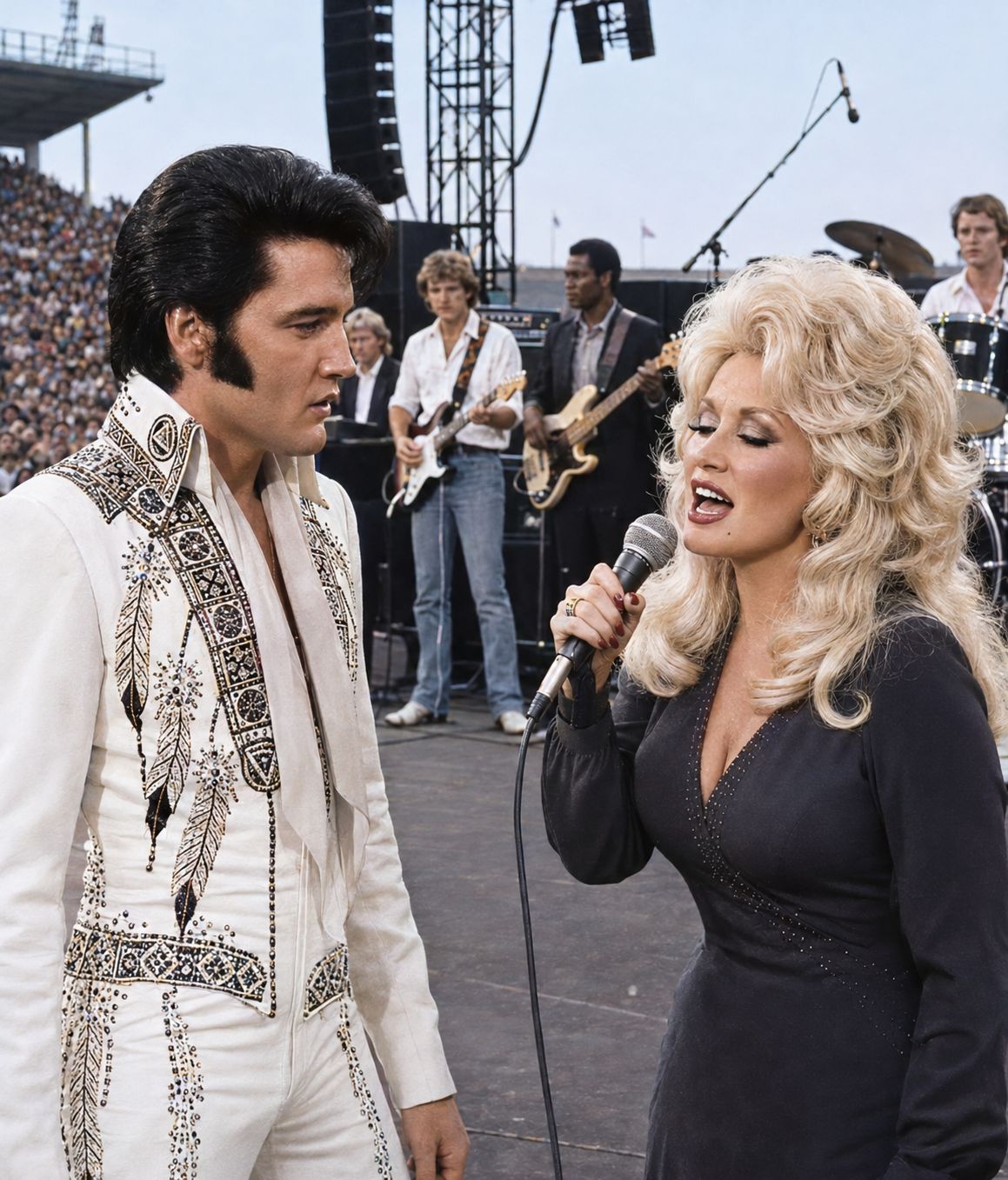
For years, stories about Elvis Presley and Dolly Parton have circulated among fans who love imagining what might have happened if two of the most recognizable voices in American music had ever shared the same stage. One of the most dramatic versions claims that Elvis once challenged Dolly to sing “My Way” live, only to become emotional within seconds of hearing her begin.
It is the kind of story that sounds almost too perfect to resist.
Elvis, already famous for turning “My Way” into one of the most emotional songs of his later career, sits nearby while Dolly begins to sing. Her voice enters softly, the room grows quiet, and within moments the King is supposedly overwhelmed by what he hears.
There is only one problem.
There is no reliable historical record showing that this performance actually happened.
No known television archive, concert record or established Elvis biography documents a moment in which Elvis publicly dared Dolly Parton to sing “My Way” before breaking down in tears. The story appears to belong to the growing category of dramatic celebrity tales that borrow real relationships and recognizable songs, then build a fictional scene around them.
The real connection between Elvis and Dolly, however, is arguably even more fascinating.
In the early 1970s, Elvis wanted to record “I Will Always Love You,” the deeply personal song Dolly had written about ending her professional partnership with Porter Wagoner. For Dolly, the possibility of Elvis Presley singing one of her songs was almost impossible to believe. She later recalled being thrilled by the idea because Elvis was one of the biggest stars in the world.
Then the business side intervened.
According to Dolly, Elvis’s manager Colonel Tom Parker told her that if Elvis recorded the song, they would need a significant portion of the publishing rights. Dolly had built her career partly by protecting ownership of her songwriting, and although turning down Elvis was emotionally painful, she refused to surrender those rights.
She later said she cried all night over the decision.
Years afterward, the story gained another emotional layer when Priscilla Presley told Dolly that Elvis had loved “I Will Always Love You” and had even sung it privately. For Dolly, that knowledge mattered because it confirmed that Elvis had genuinely connected with the song, even though the official recording never happened.
That real story says more about both artists than the viral “My Way” tale ever could.
Dolly admired Elvis enough to be deeply moved by the thought of him recording her work, but she was also strong enough to protect the song that belonged to her. Elvis, meanwhile, apparently recognized the emotional power of a composition that had already come from one of the most personal moments of Dolly’s life.
There is another reason the “My Way” story feels believable to fans.
Elvis himself had turned the song into something deeply personal during the final years of his career. Although Frank Sinatra had made “My Way” famous, Elvis approached it with a heavier sense of vulnerability. By the time he performed it during his later concerts, the lyrics about looking back on a life filled with triumphs, regrets and difficult choices carried an emotional weight that audiences could hear immediately.
Dolly possessed a similar ability to make a familiar lyric sound personal.
It is therefore easy to imagine what might have happened if the two of them had actually shared that song together. Elvis’s dramatic delivery and Dolly’s emotional phrasing could have created one of those moments fans would still be discussing decades later.
But imagination and history are not the same thing.
The documented Elvis-Dolly story is not about a surprise performance of “My Way.” It is about a song Elvis desperately wanted to record, a songwriter who made one of the hardest decisions of her career and a recording that never existed because Dolly refused to give away part of something she had created.
In the end, Elvis never gave the world his version of “I Will Always Love You.”
Yet the fact that he wanted to sing it became part of both artists’ legends.
The viral story says Dolly made Elvis cry with “My Way,” but the truth may be even more powerful: Elvis wanted one of Dolly Parton’s most personal songs badly enough to record it, and Dolly respected her own work enough to tell the King of Rock ’n’ Roll