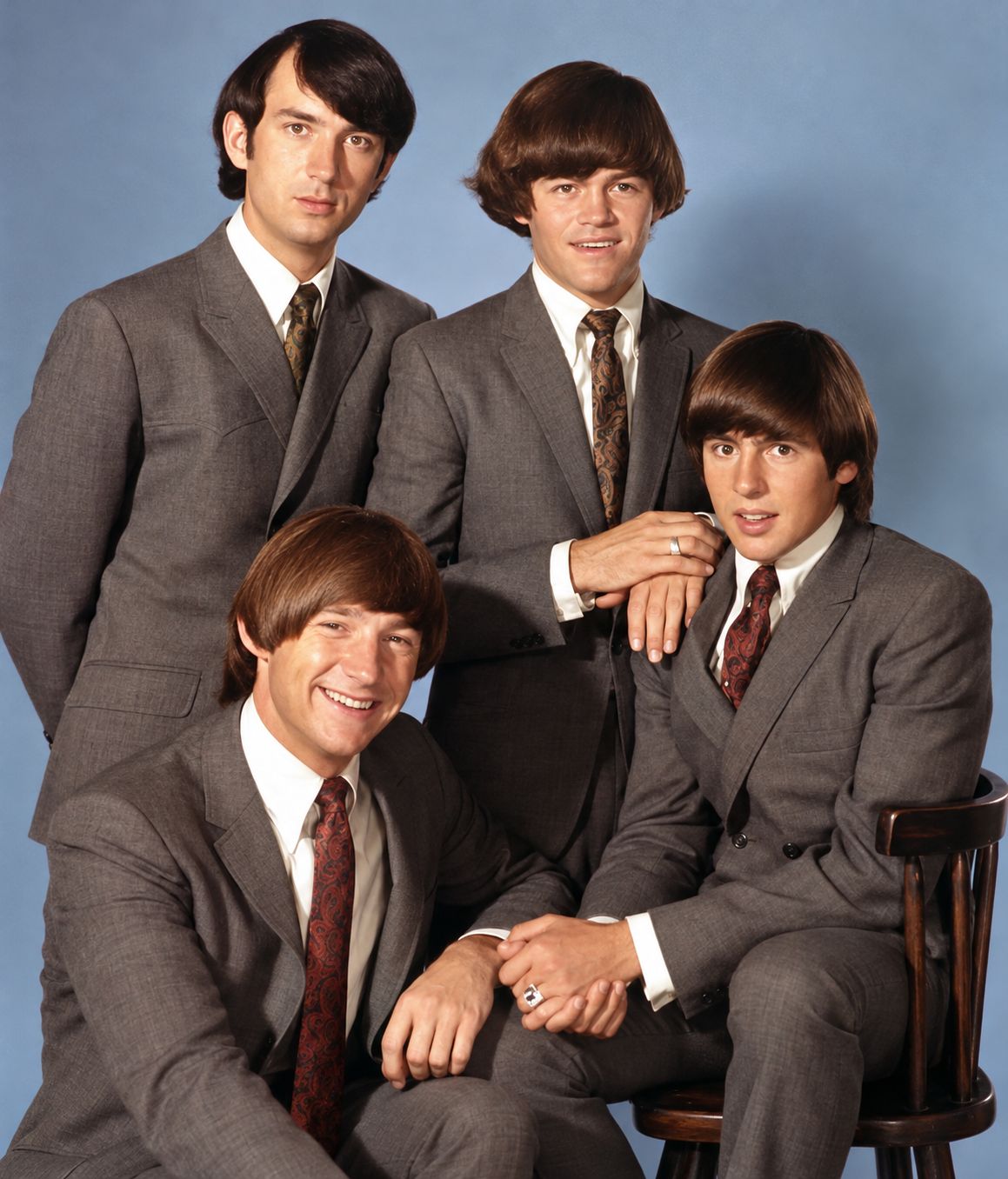
By the end of the 1960s, The Monkees had become one of the biggest pop phenomena in America. Their television show had turned Micky Dolenz, Davy Jones, Michael Nesmith and Peter Tork into familiar faces, while songs such as “Last Train to Clarksville,” “I’m a Believer,” and “Daydream Believer” filled radios across the country. In barely two and a half years, the group sold millions of albums and singles, a level of success most bands could only dream of.
Yet behind that success was a problem that would follow them for decades.
The Monkees had originally been assembled for a television series rather than formed naturally in a garage or local club. During their earliest recording sessions, the four members generally provided the vocals while professional session musicians handled much of the instrumental work. Music supervisor Don Kirshner preferred using experienced studio players and outside songwriters, believing that arrangement would produce reliable hit records quickly.
To many critics, that was enough to dismiss The Monkees as something manufactured rather than a “real” band.
The criticism was especially frustrating because the four men were not simply actors pretending to understand music. Peter Tork was an accomplished multi-instrumentalist, Michael Nesmith was already writing songs, and the group was learning to function together onstage as a genuine live band. By late 1966 they were touring in front of audiences and playing their own concerts, even while their records were still being produced under a system that gave them limited creative control.
Michael Nesmith became one of the loudest voices demanding change. He openly complained that the band was expected to reproduce records in concert that had largely been created by other musicians. Peter Tork shared the frustration, especially after More of the Monkees was released without the group having meaningful control over the finished album. The irony was painful: the record became enormously successful, but the men whose faces were on the cover felt increasingly disconnected from the music carrying their name.
Eventually, they fought back.
The conflict with Kirshner reached a breaking point in early 1967, and after he was removed from the project, The Monkees gained far greater control over their recordings. They began working with producer Chip Douglas and created Headquarters, the album that became their clearest answer to anyone who doubted their musicianship. Micky played drums, Nesmith played guitar, Peter handled several instruments, and Davy contributed percussion, while the group became deeply involved in the arrangements and creative decisions.
The result reached No. 1 on the Billboard album chart.
That achievement mattered because Headquarters was not simply another commercial success. It proved that The Monkees could function as a band when they were finally given the opportunity to make the music themselves. Their next album, Pisces, Aquarius, Capricorn & Jones Ltd., continued that creative evolution and also reached No. 1.
Still, the old accusation never completely disappeared.
For decades, people continued arguing about whether The Monkees were authentic because they had begun as a television creation and relied heavily on outside musicians during their earliest recordings. Yet that argument often overlooks what happened after the cameras started rolling.
Four men who had been hired to play a fictional band gradually became a real working group.
They toured together. They learned each other’s musical strengths. They wrote songs. They fought for control. And eventually, they entered the studio determined to prove that the music belonged to them too.
The Monkees may have been manufactured at the beginning, but what happened afterward was much harder to manufacture: four very different men became a band because they refused to remain only characters on a television show.