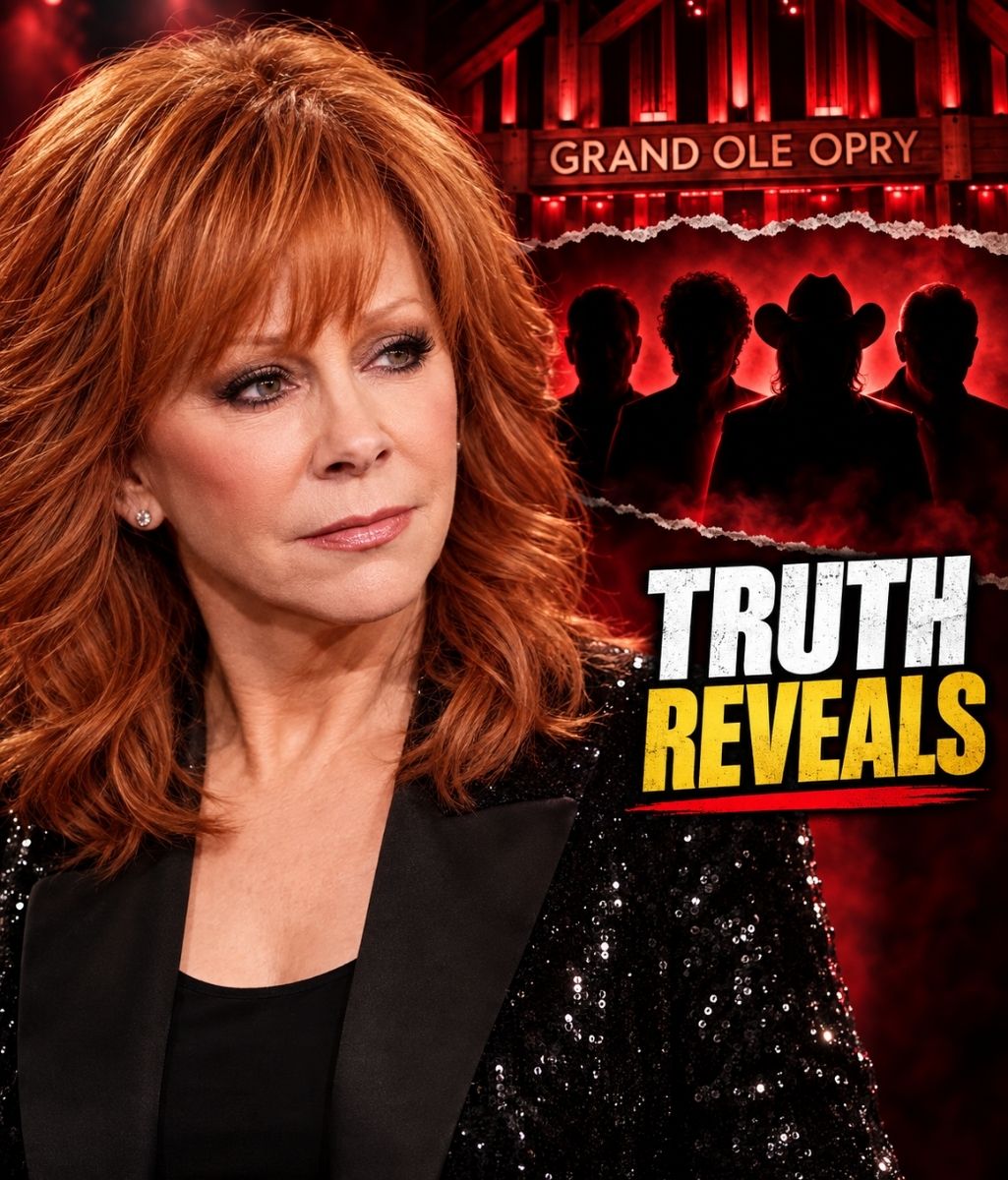
For nearly five decades, Reba McEntire’s story has been closely tied to the Grand Ole Opry. She first stepped onto its stage as a young singer from Oklahoma in 1977, long before “Fancy,” “Is There Life Out There,” or “The Heart Won’t Lie” helped establish her as one of country music’s defining voices. Over the years, she crossed paths with some of the biggest names the Opry has ever known, and many of those encounters became part of the larger story of how she grew from an ambitious newcomer into a country legend herself.
A recent video frames those memories dramatically as five Opry legends Reba could “never forgive,” but there is no reliable evidence that Reba has ever publicly released a literal list of five country stars she refuses to forgive. The documented stories are actually more interesting because they involve professional competition, unexpected interruptions, friendships, loss, and memories that stayed with Reba for decades without necessarily becoming bitter feuds.
One of the names most closely connected to Reba’s Opry history is Vince Gill. Both came from Oklahoma and eventually became major Grand Ole Opry members, with Reba joining in 1986 and Vince in 1991. Their careers crossed repeatedly, but their most memorable connection became musical rather than hostile. In 1993, they recorded “The Heart Won’t Lie,” a duet that reached the top of the country chart and became one of the most recognizable collaborations in Reba’s catalog. The Opry itself has celebrated their decades-long friendship and shared Oklahoma roots, making the idea of a permanent feud difficult to support.
Their relationship also reflects something common in country music. Artists can compete for chart positions, awards, television appearances, radio attention, and major touring opportunities while still maintaining genuine respect for one another. Reba and Vince worked through one of the most competitive periods in modern country music, yet their public history is defined much more by collaboration and mutual admiration than resentment.
Another name often pulled into stories about Reba’s generation is Tanya Tucker. Tanya entered country music at an extraordinarily young age and had already become famous years before Reba reached superstar status. Their careers later occupied many of the same spaces, which naturally led to comparisons between two powerful female artists with strong personalities, distinctive voices, and enormous fan bases.
Country music during those years was especially competitive for female performers, who often had to fight for a limited number of radio slots, award nominations, television appearances, and headline opportunities. Retrospective videos can easily turn that competition into a personal rivalry, but there is little credible evidence that Reba has publicly described Tanya as someone she could “never forgive.” What can be documented is that both women survived an industry that often placed major female artists in direct competition even when the supposed personal drama was much larger in headlines than in reality.
The same caution applies to Travis Tritt, who became part of a younger wave of country stars during the late 1980s and early 1990s and joined the Grand Ole Opry in 1992. His Southern-rock edge and outspoken image made him one of the era’s most recognizable performers, while Reba was already operating at superstar level and becoming one of the most powerful women in country music.
Their careers overlapped during one of the genre’s biggest commercial booms, when artists regularly competed for chart positions, television exposure, awards-show moments, and prime touring opportunities. That overlap can be turned into rivalry very easily, but Travis’s official Opry history presents him as a respected member of the institution rather than part of any documented long-running feud with Reba. The stronger story is not that she never forgave him, but that they worked in an era where competition between major stars was constant and highly visible.
The fourth name carries an entirely different emotional weight: Naomi Judd. If there is one relationship that clearly shows why the phrase “never forgive” should not be taken literally, it is this one. Naomi publicly described Reba as one of her best girlfriends, and in a 1995 interview she spoke casually about spending time with Reba away from the spotlight, including attending a celebration marking Reba’s 20th year in country music.
Their relationship extended far beyond awards shows or industry appearances. They were women navigating the same demanding business, dealing with touring schedules, family responsibilities, changing musical trends, and the personal pressures that came with being famous. When Naomi died in 2022, the story between them was not one of unresolved anger but of losing someone who had been part of Reba’s life beyond the stage and beyond the competition of the country music industry.
No name, however, is more inseparable from Reba’s Grand Ole Opry story than Dolly Parton. Reba made her Opry debut on September 17, 1977, and her parents and older sister Alice had driven roughly 1,400 miles round trip from Oklahoma to witness the moment. Reba was originally scheduled to perform two songs, which made the appearance especially important for a young singer still trying to establish herself in Nashville.
Then Dolly Parton unexpectedly arrived, and Opry management asked Reba to give up one of her songs so Dolly could appear. For a young artist making one of the biggest debuts of her life, losing half of her performance could easily have become a memory filled with resentment. Instead, Reba reacted almost completely differently. According to the Grand Ole Opry, she was “thrilled to death” and performed only “Invitation to the Blues” that night because Dolly’s surprise appearance shortened her set. Reba was far more excited about the possibility of meeting Dolly than upset about losing stage time.
That memory became even more meaningful four decades later. In 2017, Reba returned to the Opry to celebrate the 40th anniversary of her debut, and once again Dolly surprised her. This time the interruption became a deliberate callback to 1977, bringing the story full circle. The young woman who once surrendered half of her first Opry set because Dolly unexpectedly arrived was now herself a country legend being surprised by the same woman 40 years later.
That is why Dolly belongs at the end of this story. Reba could have remembered September 17, 1977 as the night another superstar took away half of an opportunity she had waited years to receive, but instead she remembered it as part of the magic of her first Opry appearance. The incident says something important about how Reba viewed country music itself: she understood that she was entering an institution built by artists who had come before her, and Dolly was already one of those towering figures.
Years later, Reba became exactly that kind of figure for younger singers entering the same circle. Vince Gill became a trusted collaborator, Naomi Judd became a close friend, Tanya Tucker and Travis Tritt became fellow stars whose careers overlapped with hers, and Dolly Parton became part of one of the most memorable stories from Reba’s first night at the Opry.
So did Reba McEntire really reveal five Opry legends she would “never forgive”? The documented history tells a much more interesting story. These were not simply five people she carried grudges against, but five major figures connected to different chapters of her career, from competition and collaboration to friendship and unforgettable Opry memories.
The biggest twist belongs to Dolly. She once took half of Reba’s first Grand Ole Opry set away from her, yet Reba did not spend the next 49 years resenting what happened. She treasured the memory, and that may say more about Reba McEntire than any sensational story about revenge ever could.
Sometimes the moments a person never forgets are far more powerful than the people they supposedly never forgive.