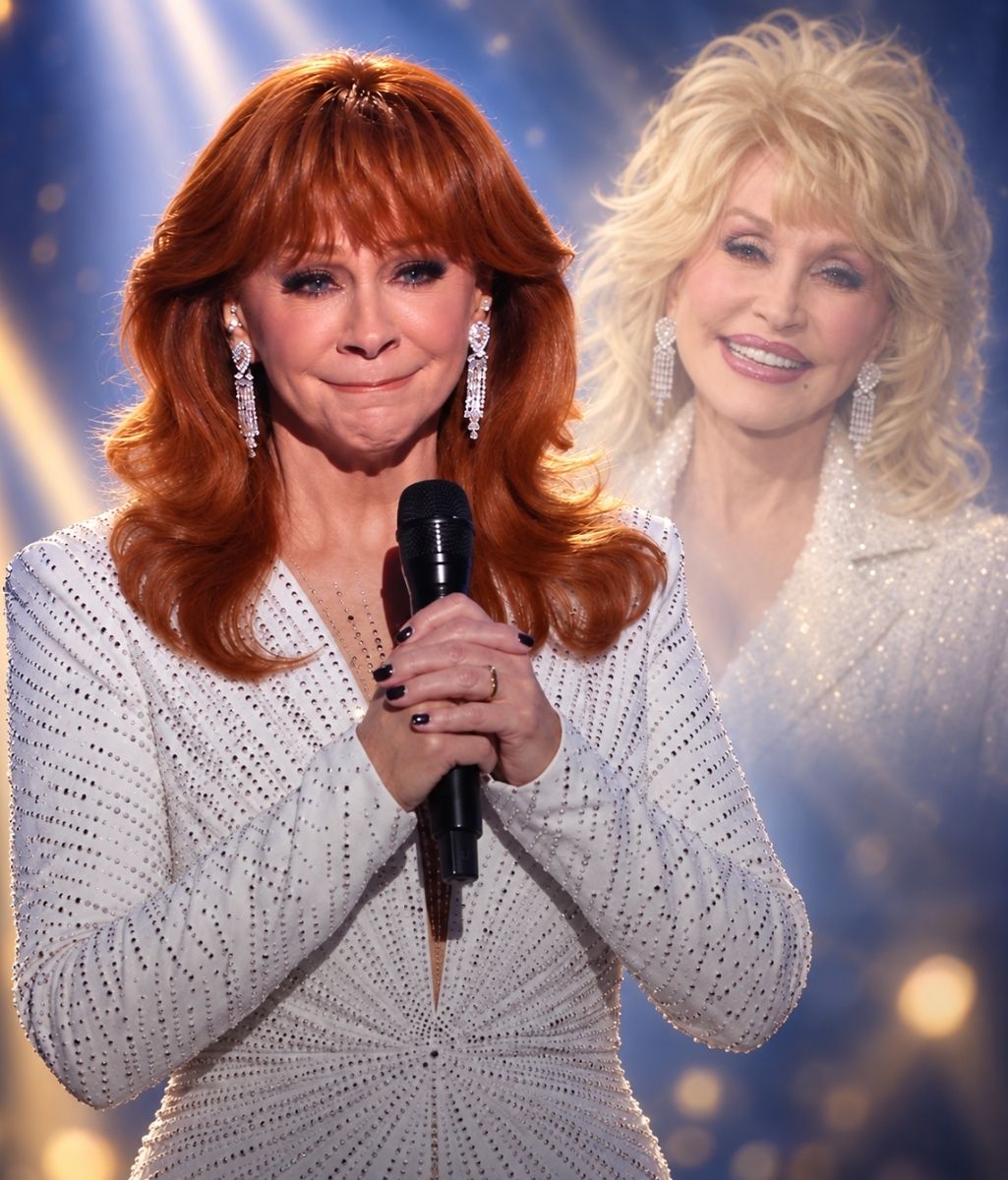
When Reba McEntire walked onto the stage at the 78th Primetime Emmy Awards to honor Dolly Parton, most viewers immediately noticed the song, the sparkling white gown, and the emotion on Reba’s face. She performed Dolly’s 1983 song “Appalachian Memories,” a deeply personal piece tied to Dolly’s East Tennessee roots and the family history she carried with her throughout her life. But hidden inside the tribute was a detail many fans did not notice until after the ceremony, and it made the performance feel far more intimate than it first appeared.
Reba was wearing Dolly Parton’s own jewelry.
Before the Emmy tribute, Reba’s manager, Justin McIntosh, contacted Dolly’s niece Rebecca and asked whether the family would be willing to lend Reba some of Dolly’s personal jewelry for the performance. The family agreed, allowing Reba to choose pieces that could accompany her onto the stage. She selected a pair of rhinestone earrings and a butterfly ring, two details that could hardly have been more closely associated with Dolly’s unmistakable style.
For Reba, the gesture meant far more than simply completing an outfit. She explained that it was an honor to have a small piece of Dolly with her while she sang. The rhinestones immediately recalled Dolly’s lifelong love of sparkle, while the butterfly carried an even deeper connection because butterflies had become one of Dolly’s most recognizable personal symbols over the years. Reba herself summed it up perfectly when she noted that few things represented Dolly more clearly than rhinestones and butterflies.
The earrings carried another layer of history. They were associated with the video for “Does He Love You,” the duet Reba and Dolly revisited together in 2021. That collaboration had given the two longtime friends another chance to work closely, and Reba later remembered how much she enjoyed simply sitting with Dolly and talking between takes. Wearing those earrings during a memorial performance therefore connected the Emmy stage not only to Dolly’s public image, but to an actual memory the two women had shared together.
Even Reba’s white gown had been chosen with Dolly in mind. She deliberately avoided wearing black because she wanted the tribute to feel bright and sparkling, the way Dolly herself approached fashion and performance. The gown also nodded to the white fringed outfit Dolly wore during her Live in London television special in 1983, where she performed “Appalachian Memories.” That meant Reba’s song, clothing, jewelry, and even the color of the tribute were all connected to Dolly in some way.
The song itself made those details even more emotional. “Appalachian Memories” was not simply one of Dolly’s recognizable recordings; it was a song about where she came from, the mountains that shaped her, and the sacrifices made by people who left home in search of work and opportunity. Reba said it had always been one of her favorite Dolly songs because it reflected the family and upbringing Dolly never stopped carrying with her.
By the time Reba stepped onto the Emmy stage, Dolly had been gone only a few weeks. For Reba, the loss was not simply the death of another legendary country singer. Their relationship went back decades, beginning with a memory Reba could still recall down to the exact date. On September 17, 1977, Reba was preparing for her Grand Ole Opry debut when one of her songs was cut because Dolly had arrived unexpectedly. Rather than being upset, Reba remembered being thrilled at the possibility of finally meeting her.
That first meeting became the beginning of a friendship that continued through television appearances, musical collaborations, personal conversations, and difficult moments. When Reba lost members of her band in the devastating 1991 plane crash, Dolly was among the first people to call and even offered her own band to help Reba recover professionally. Reba never forgot that generosity, and years later Dolly’s bandleader helped assemble the new group Reba needed to continue touring.
That history explains why Dolly’s family trusting Reba with those personal pieces carried so much meaning. They were not handing jewelry to a performer selected simply because she was famous. They were allowing a longtime friend to carry part of Dolly’s personal world into one of the first major television tributes following her death.
The gesture also reflected something Dolly herself seemed to understand about objects and memory. Throughout her life, clothing, jewelry, songs, and family possessions often carried stories for her. A coat made from scraps became “Coat of Many Colors.” Butterflies became a recurring image tied to freedom and transformation. Even the rhinestones that defined her stage appearance represented the playful glamour she embraced without apology.
For one night, those same symbols belonged to Reba’s farewell.
Most people watching the Emmys could see the white dress and hear the song, but they could not immediately know that the ring on Reba’s hand had actually belonged to Dolly. They could not know that Dolly’s family had deliberately allowed it to leave the collection so Reba could wear it onstage. Once that story emerged, the performance looked different.
Reba was not merely singing about Dolly.
She was carrying something of Dolly with her.
That may be why the tribute now feels so much more personal than a traditional award-show memorial. Every major element pointed backward toward a shared memory: the 1983 song, Dolly’s white stage outfit, the rhinestones, the butterfly, and jewelry connected to a duet between two friends who had known one another for almost half a century.
At the end of the performance, Reba’s emotion was difficult to miss.
But perhaps the strongest part of the tribute had been visible the entire time, sitting quietly on her hand.
A butterfly ring.
A piece of Dolly’s personal history.
And a family willing to place it in the hands of someone they trusted to carry Dolly’s memory onto the stage one more time.