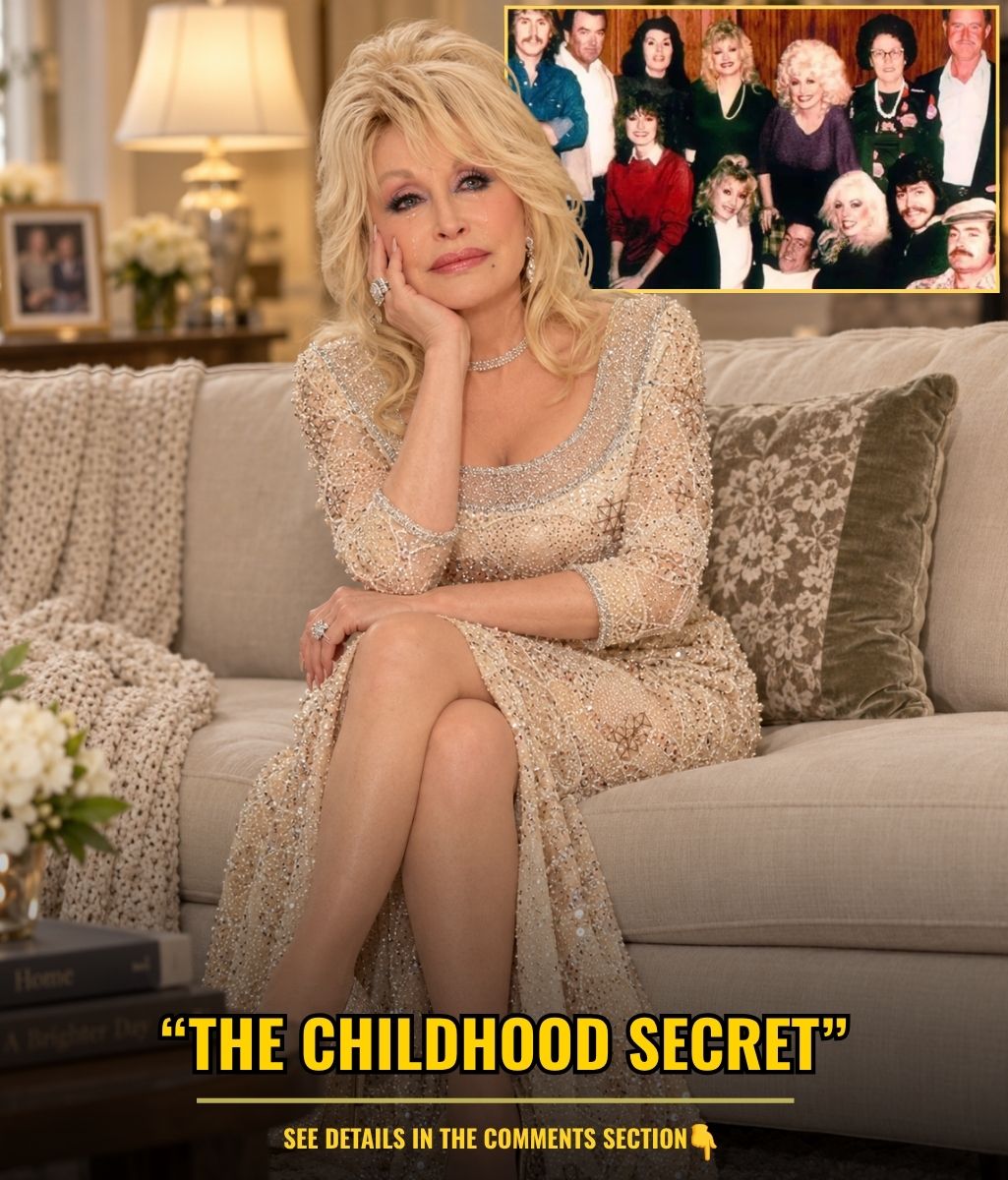
Long before the rhinestones, private jets, hit records, and a business empire worth hundreds of millions of dollars, Dolly Parton was one of 12 children growing up in a tiny home in the mountains of East Tennessee. The family had very little money, space was limited, and winter nights could become brutally cold. Years later, Dolly would describe those conditions with the same humor that eventually became one of her trademarks, but behind the laughter was a childhood reality almost impossible to imagine when looking at the superstar she eventually became.
Dolly grew up with 11 brothers and sisters, and there simply were not enough beds for everyone. She recalled that the children often slept three or four to a bed, bundled together while temperatures inside the house could feel almost as cold as they did outside. It was crowded, uncomfortable, and particularly difficult during Tennessee winters, but for the Parton children it was simply normal life.
Then Dolly revealed one detail from those nights that shocked even the interviewer hearing the story.
Some of the younger children would wet the bed while they slept, often soaking Dolly after she had washed herself before bedtime. When asked whether she immediately got up to clean herself, Dolly laughed and explained that in the freezing winter, the warmth was sometimes almost welcome. She joked that being peed on could feel like “the only warm thing we knew” because the bedroom itself was so cold.
The story sounds almost unbelievable coming from a woman who would later become synonymous with glamour, but Dolly never seemed embarrassed by it. She spoke openly about the poverty of her childhood and often found humor in circumstances other people might have tried to hide. That ability to turn hardship into a story without allowing it to become bitterness would eventually appear throughout her songwriting.
Bathing was another challenge. During warmer months, Dolly remembered the children washing in the river. In winter, the family relied on a simple pan of water, and Dolly joked about washing whatever parts of themselves they could manage while maintaining some privacy inside such a crowded house. Running hot water and a private bathroom were luxuries the Parton children did not grow up taking for granted.
Yet Dolly consistently resisted describing her childhood as miserable. Her family lacked money, but she remembered music, storytelling, faith, humor, and a remarkable closeness among the children. Her father, Lee Parton, worked relentlessly to support the family despite having little formal education, while her mother, Avie Lee, filled the home with songs and stories that would later become part of Dolly’s creative foundation. Dolly would repeatedly credit both parents with giving her qualities she carried for the rest of her life.
Music offered an early glimpse of another world. Dolly began singing publicly as a child, performed in church, and by her teenage years was already pursuing opportunities beyond the mountains. At 13, she appeared at the Grand Ole Opry, and after graduating from high school in 1964 she headed for Nashville with ambitions far larger than the circumstances she had been born into.
What happened next became one of the most extraordinary rags-to-riches stories in American entertainment. Dolly developed into one of country music’s defining songwriters, created classics including “Jolene,” “Coat of Many Colors,” “9 to 5,” and “I Will Always Love You,” and eventually expanded far beyond recording. Her business interests included Dollywood, publishing rights, merchandise, entertainment ventures, books, television, and numerous other projects.
By 2025, Forbes estimated Dolly’s net worth at approximately $450 million, with much of that wealth connected not simply to performing but to the ownership decisions she made throughout her career. Her music catalog alone was estimated to be worth around $120 million, while her stake in Dollywood became another major source of wealth.
The contrast is extraordinary. A little girl who once shared a bed with several siblings because her family could not afford enough space eventually became one of America’s wealthiest self-made entertainers. A child who joked about accepting an uncomfortable source of warmth during freezing winter nights would one day own businesses attracting millions of visitors and control songs worth fortunes.
But Dolly rarely told those childhood stories simply to show how far she had risen. They became part of the reason she remained so connected to ordinary people. She remembered what it was like to live without basic comforts, to wear homemade clothes, to share everything with siblings, and to grow up in a family where creativity often had to substitute for money.
That history eventually shaped some of her most beloved work. “Coat of Many Colors,” for example, turned another memory of childhood poverty into a song about dignity, family love, and refusing to let material wealth determine a person’s worth.
Perhaps that is why the story of those freezing nights feels so revealing today. The distance between Dolly Parton’s childhood home and the enormous fortune she eventually built could hardly have been greater, yet she never tried to erase the uncomfortable details of where she started.
Before Dolly Parton became a superstar worth roughly $450 million, she was simply one child in a family of 12, squeezed three or four to a bed on bitterly cold Tennessee nights. And rather than hiding that past once she became famous, she turned it into part of the story that made millions of people believe they knew exactly where Dolly had come from.