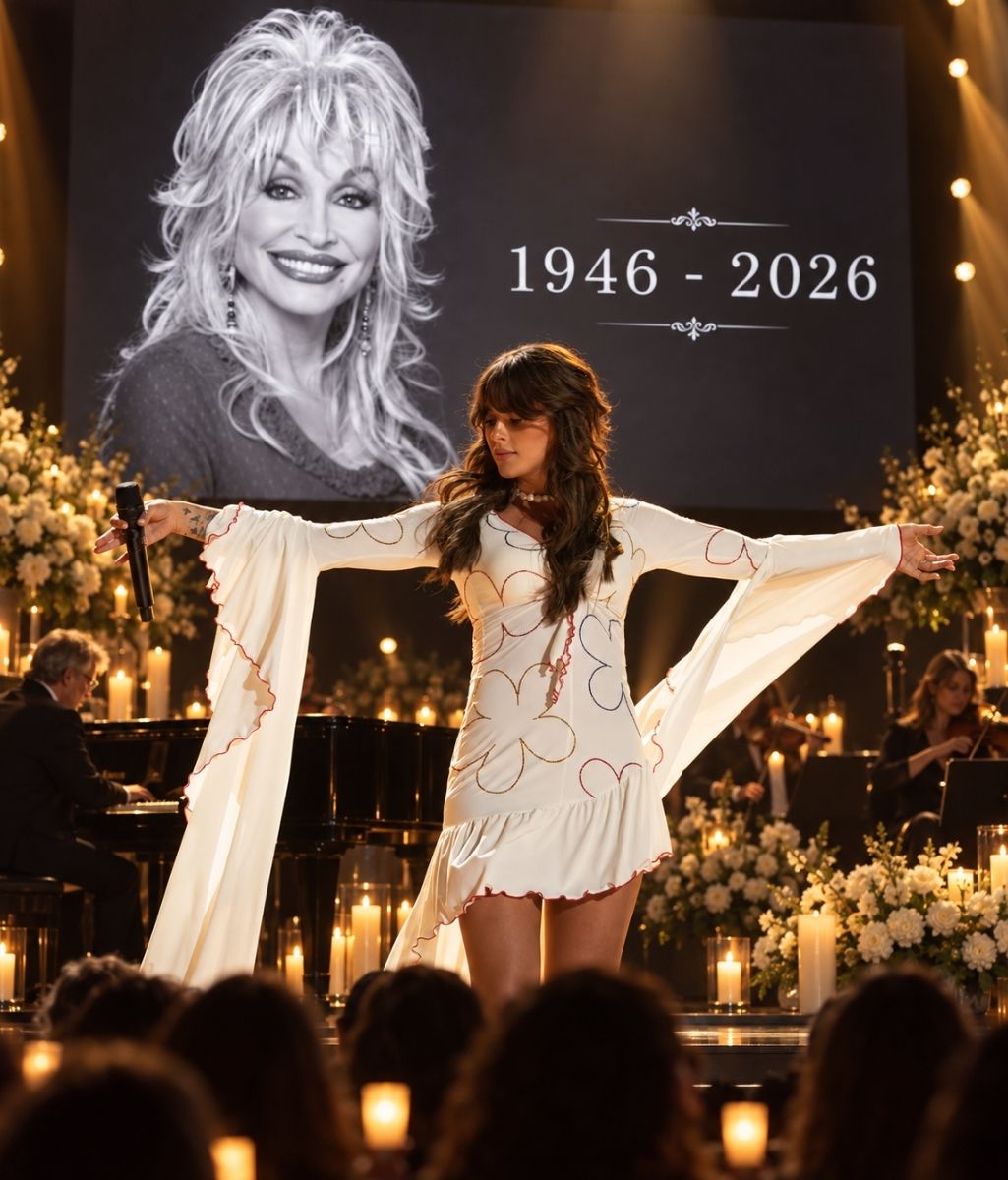
Only days after Dolly Parton’s death at age 80, Ella Langley walked onto a stage in Alabama knowing that one song in her set suddenly carried a very different meaning. Like countless younger women in country music, Ella had grown up in a genre Dolly helped reshape, but her tribute went beyond simply covering one of the legend’s biggest hits. Before singing “Jolene,” Ella told the crowd that the night simply would not have felt right without doing something to honor Dolly.
The performance took place on August 28, 2026, just three days after Dolly’s death, during the first of Ella’s two sold-out concerts at Neville Arena in Auburn, Alabama. As the familiar opening of “Jolene” began, Ella delivered her own forceful interpretation of a song that had survived more than half a century and influenced generations of artists who came after Dolly. What might normally have been an exciting cover suddenly felt like a goodbye.
But one personal detail gave the moment an even deeper meaning: Auburn was not simply another tour stop for Ella Langley. It was a homecoming. Ella attended Auburn University, and after the concerts she described selling out two nights at Neville Arena as a “full circle moment.” She had returned to a place connected to the beginning of her own journey at almost exactly the same moment country music was saying goodbye to one of the women who helped make careers like hers possible.
That connection becomes even clearer when looking at what Ella had written about Dolly only days earlier. In her first public tribute, Ella did not focus solely on hit records or celebrity. She thanked Dolly for standing up for herself as an artist, songwriter, musician, producer, author, creative, and especially as a woman in the music industry. Ella said Dolly had paved the way for others to be brave and praised her for being unafraid to show the world her authentic self.
Those words reveal why choosing “Jolene” mattered. When Dolly released the song in the 1970s, she was already proving that a female country songwriter could build an identity around her own stories, her own voice, and her own instincts. The song was vulnerable without making its narrator weak, simple without being forgettable, and unmistakably Dolly. Decades later, it remains one of the clearest examples of the songwriting independence Ella was praising in her tribute.
For a young artist building her career in a very different era of country music, Dolly’s example still matters. Ella has developed a reputation around her own Southern identity, songwriting, and willingness to follow a sound that feels personal rather than carefully manufactured. The circumstances are different, but the principle behind Dolly’s influence remains remarkably familiar: an artist becomes difficult to replace when she refuses to become interchangeable.
That is why Ella’s social-media message contained one particularly powerful thought. She thanked Dolly for giving so many artists permission to be brave. It was less about copying Dolly’s music than understanding what Dolly’s career represented. She had crossed from country into pop, television, film, business, philanthropy, gospel, and rock without allowing those transformations to erase the woman from East Tennessee who had started writing songs as a child.
Ella’s tribute also reflected the generational nature of Dolly’s legacy. The two women belonged to completely different eras. Dolly entered Nashville when women faced enormous restrictions over what they could record, write, own, and control. Ella came into an industry already transformed by decades of women pushing against those boundaries. When Ella thanked Dolly for standing up for herself, she was acknowledging that some of the freedoms younger performers now possess were built through battles fought long before they arrived.
Then came the Auburn performance.
There was something unusually fitting about Ella honoring Dolly while experiencing a milestone of her own. She was standing inside a sold-out arena connected to her earlier life, looking out at an audience that represented how far her career had traveled. Yet rather than making the night entirely about herself, she paused to remember the woman whose career had helped widen the road ahead.
That gave “Jolene” a meaning beyond nostalgia. Ella was not trying to reproduce Dolly’s original recording or pretend she could replace the voice that made it famous. She was allowing a song from one generation to pass through another, demonstrating exactly how musical influence survives after an artist is gone.
Ella’s first written farewell had ended with an image of Dolly entering heaven as a “beautiful soul.” Days later, instead of adding a long speech, she allowed Dolly’s own music to carry the tribute.
For fans in Auburn, the emotional connection was difficult to miss. A young Alabama artist had returned to the university tied to her own beginnings, sold out the arena, and reached one of those career milestones that once might have seemed impossibly distant. Then she stopped the celebration to honor a woman who spent decades proving that women in country music could dream bigger than the roles originally offered to them.
That may be what gave Ella Langley’s tribute its deepest meaning. On a night that represented how far Ella herself had come, she chose to look backward and thank Dolly Parton for helping create the road that allowed another young woman to move forward. And when “Jolene” filled the arena, it no longer sounded like just a classic country song — it sounded like one generation saying goodbye to the woman who helped make the next one possible.