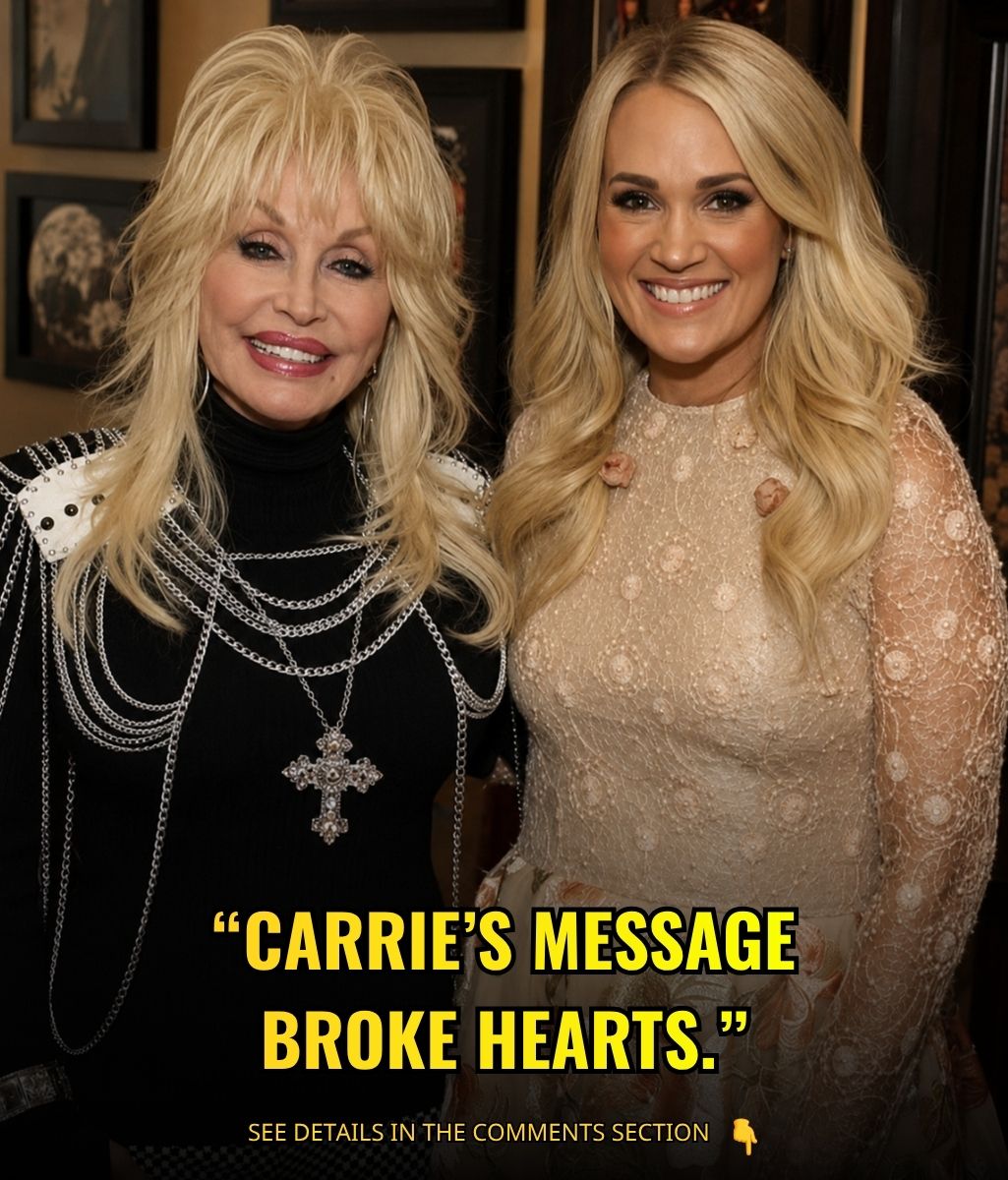
 In the days following Dolly Parton’s death at age 80, countless singers stepped forward to honor the woman who helped shape country music for generations. But when Carrie Underwood spoke about Dolly, her tribute carried a particularly personal weight. Carrie did not begin by talking about record sales, awards, or even Dolly’s extraordinary songwriting career. Instead, she opened with a line rooted in faith: “She’s not gone. I know exactly where she is.”
For Carrie, that belief shaped everything she wanted fans to understand about Dolly. She described her as the “epitome of faith, grace, talent, beauty and humor” and remembered a woman whose humility made people around her feel important. But one observation stood out above the rest. Carrie said Dolly may have been the rare person almost everyone could love and agree on, a remarkable statement in an era when very few public figures seem capable of bringing people together.
That may be the part of Carrie’s tribute that explains Dolly’s legacy better than any list of accomplishments ever could. Dolly had enormous fame, but people rarely spoke about her with the distance normally reserved for celebrities. Fellow artists consistently remembered being treated warmly by her, while fans often felt as though they somehow knew her despite never meeting her. Carrie had experienced that kindness personally, calling Dolly one of the nicest people she had ever met.
Their connection stretched across many years. Carrie had admired Dolly long before becoming a country superstar herself, and eventually found herself sharing some of the same stages with the woman who had helped make careers like hers possible. Carrie participated in the 2006 Kennedy Center Honors tribute to Dolly, and years later the two stood together with Reba McEntire as hosts of the 2019 CMA Awards, a celebration that placed three generations of influential women at the center of country music’s biggest night.
Looking back now, those images carry a different meaning. At the time, seeing Carrie beside Dolly represented continuity: one generation of country music standing alongside another. Dolly had fought for artistic independence and helped widen the possibilities available to women in Nashville, while Carrie later built one of the biggest careers to emerge from modern country music. Neither woman needed the other’s success to diminish her own, and that mutual admiration became visible whenever they appeared together.
Carrie’s grief became even more apparent during a concert at the Tanglewood Music Center in Massachusetts just days after Dolly’s death. Speaking to the audience, she again described Dolly as an enormous influence and one of the kindest people she had encountered. As emotion began to take over, Carrie chose to honor Dolly through her own 2012 song “See You Again.”
The song suddenly carried a meaning it had never possessed when originally released.
Carrie asked the audience to illuminate the venue while she performed, turning the crowd into a field of lights dedicated to Dolly. She told them that although Dolly was no longer physically present, she remained with people through their hearts, memories, and the enormous body of work she left behind. Carrie became visibly emotional as she tried to express what the loss meant.
There was also a striking visual detail that night. Carrie wore a custom jacket honoring Dolly, decorated with her initials, butterflies, and one of Dolly’s most recognizable pieces of advice: “Find out who you are and do it on purpose.” For Carrie, the words seemed especially appropriate because Dolly had spent her entire career demonstrating exactly that principle. She never tried to become whatever Nashville expected her to be. She built an identity so unmistakably her own that decades later, younger artists were still learning from it.
That may be why Carrie’s tribute reaches beyond ordinary mourning.
Dolly’s greatest influence was not simply that other women wanted to sing like her. Few ever could. What she showed artists such as Carrie was that authenticity itself could become a source of strength. A woman could embrace faith, glamour, humor, ambition, songwriting, business, and generosity without choosing only one identity.
Carrie understood that lesson.
Her message also reflected something Dolly herself had spoken about throughout her life: faith. Carrie’s conviction that Dolly was now in heaven was not presented as an attempt to deny grief. Instead, it became the way she made sense of the goodbye. She could mourn the absence while still believing that this was not the end of Dolly’s story.
Country music will continue measuring Dolly Parton through the songs she wrote, the barriers she broke, and the countless artists she inspired. But Carrie Underwood’s tribute points toward another legacy that cannot be measured on a chart.
Dolly made people feel special.
That may sound simple compared with Grammys, Hall of Fame honors, and songs known around the world, but perhaps it explains why so many tributes after her death have felt unusually personal.
Carrie had shared major stages with Dolly. She had watched her influence country music from a position few fans could experience. Yet when the moment came to say goodbye, the thing she wanted people to remember most was not how famous Dolly Parton had become.
It was how kind she remained after becoming that famous.
And as Carrie stood before a crowd struggling through “See You Again,” her message became clear: Dolly may no longer be physically standing beside the artists she inspired, but the way she treated people, the example she set, and the music she left behind ensure that she is still very much with them.