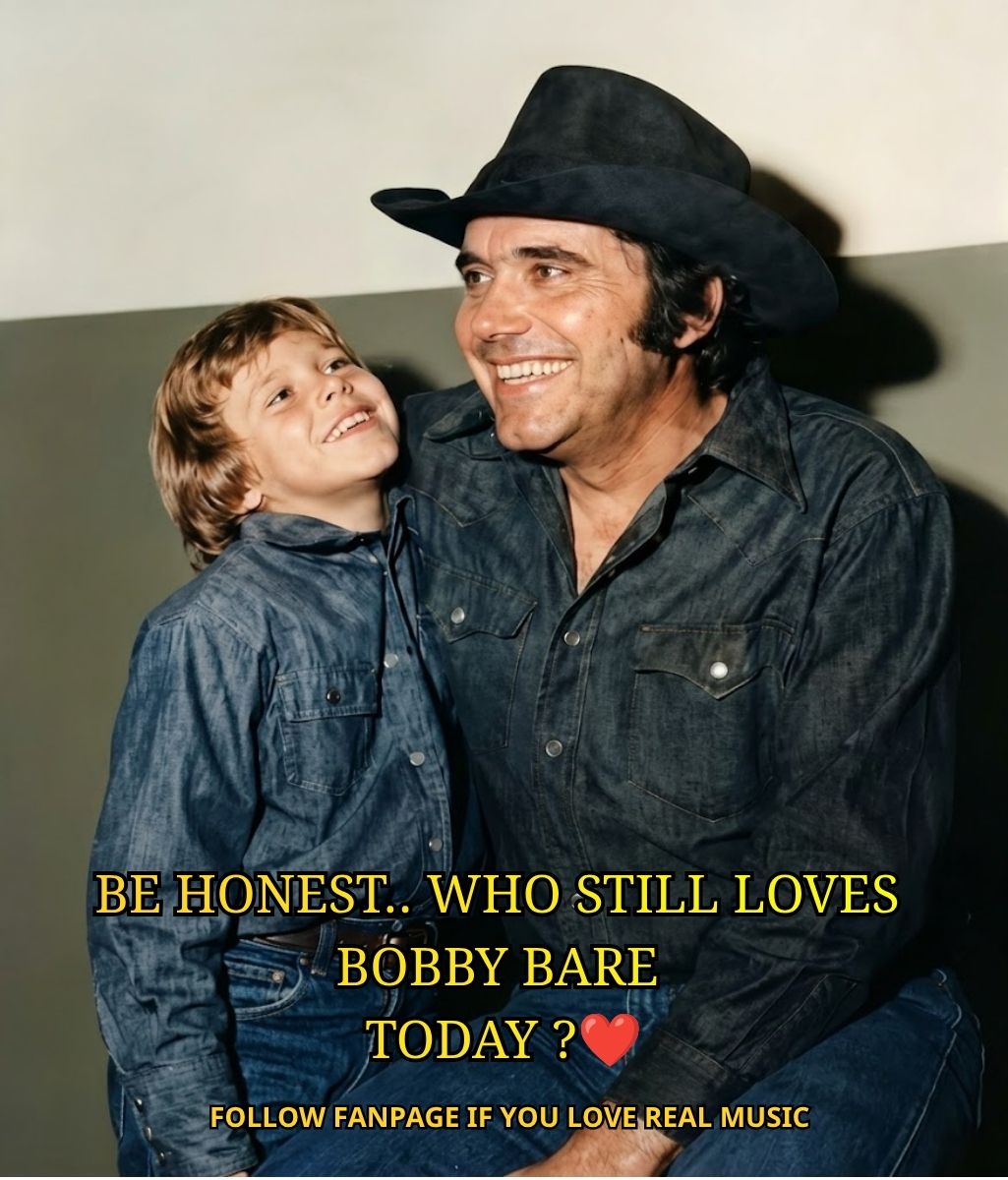
Some recordings become famous because they reach the top of the charts. Others survive because they capture something no studio could ever manufacture. In 1973, Bobby Bare recorded “Daddy What If” with his five-year-old son, Bobby Bare Jr., creating one of those rare country music moments that feels more like a family memory than a performance. More than half a century later, the recording still carries the innocence of a little boy standing beside his father, asking the kind of questions that seem simple until the years make them precious.
The song came from Shel Silverstein, the gifted songwriter, poet, author, and longtime creative collaborator whose unusual imagination found a perfect musical partner in Bobby Bare. Silverstein could take ordinary thoughts and turn them into stories filled with humor, curiosity, tenderness, and humanity. “Daddy What If” was built around something almost every parent recognizes: the endless questions of a curious child trying to understand a world that still feels impossibly large. There was no need for an elaborate storyline or dramatic production. The heart of the song was already there in the conversation between a child and his father.
But when Bobby Bare Jr., only five years old at the time, joined his father on the recording, Silverstein’s words took on another dimension. Bobby Jr. was not simply playing the role of a child for the song. He really was Bobby Bare’s little boy, and that reality gave the recording an authenticity that would have been difficult to reproduce any other way. His young voice asks imaginative questions about the sun, the wind, and all those impossible possibilities children wonder about, while Bobby Bare’s familiar, weathered voice answers him with the calm presence of a father listening to his son.
That contrast is what makes the recording so memorable. Bobby Bare had already developed the relaxed storytelling style that made him one of country’s most distinctive voices. He could deliver a lyric without making it feel overly polished or theatrical. Beside him was a five-year-old child who did not need decades of musical experience to make listeners pay attention. The innocence in Bobby Jr.’s voice was something that could only exist at that exact moment in his life. Together, father and son created a recording that sounded remarkably natural—as though someone had simply opened a door, discovered them talking, and quietly turned on a microphone.
“Daddy What If” became a major country success, but its lasting importance reaches beyond chart positions. The father-and-son performance earned a Grammy nomination, and Bobby Bare Jr. became one of the youngest performers ever associated with such recognition. Yet statistics can only explain part of why the song continues to matter. Awards belong to a particular year. Charts eventually change. Records are replaced. What remains is the sound of a father and his young son sharing a few minutes together before either of them could know what the decades ahead would bring.
And the decades did come.
Bobby Bare Jr. grew up. The five-year-old voice preserved on that recording eventually became the voice of a musician with his own identity, his own career, and his own experiences. He would no longer be simply the little boy standing beside a country star. He became an artist in his own right, carrying music forward while following a path different from his father’s. Bobby Bare, meanwhile, continued building the remarkable career that would eventually establish him as one of the enduring figures of American country music.
But recordings have a strange power that ordinary memories do not.
Put on “Daddy What If” today, and the calendar suddenly becomes meaningless. The grown musician disappears for a few minutes. Bobby Bare Jr. is five years old again. Bobby Bare is beside him again. The questions are still being asked. The answers are still coming. Nothing in those few minutes has aged, even though the people who created them continued living, changing, and moving through the years.
Perhaps that is why the song feels different now than it did in 1973. When it was first released, listeners heard an unusual and charming duet between a famous country singer and his little boy. More than fifty years later, we can hear something else inside it: the extraordinary value of an ordinary moment preserved before anyone realized how quickly it would disappear.
Every parent eventually discovers that childhood does not announce when it is leaving. There is no final morning when a child wakes up and everyone knows that a chapter has ended. The questions slowly change. The voice changes. The little hand becomes larger. Life moves forward so naturally that sometimes we recognize what has vanished only when we look backward.
Bobby Bare happened to capture one of those moments on a record.
That may be the greatest legacy of “Daddy What If.” It is certainly a country song, and it remains an important piece of Bobby Bare’s catalog. But beneath the melody is something even more universal: a father answering his little boy while childhood quietly passes around them. Neither needed to know that generations of listeners would someday hear that conversation. They only needed to be there together.
And today, every time the record begins, 1973 returns for a few precious minutes. A little boy asks his father another question. His father answers. And somewhere inside an old country song, a moment between Bobby Bare and his son remains forever young.