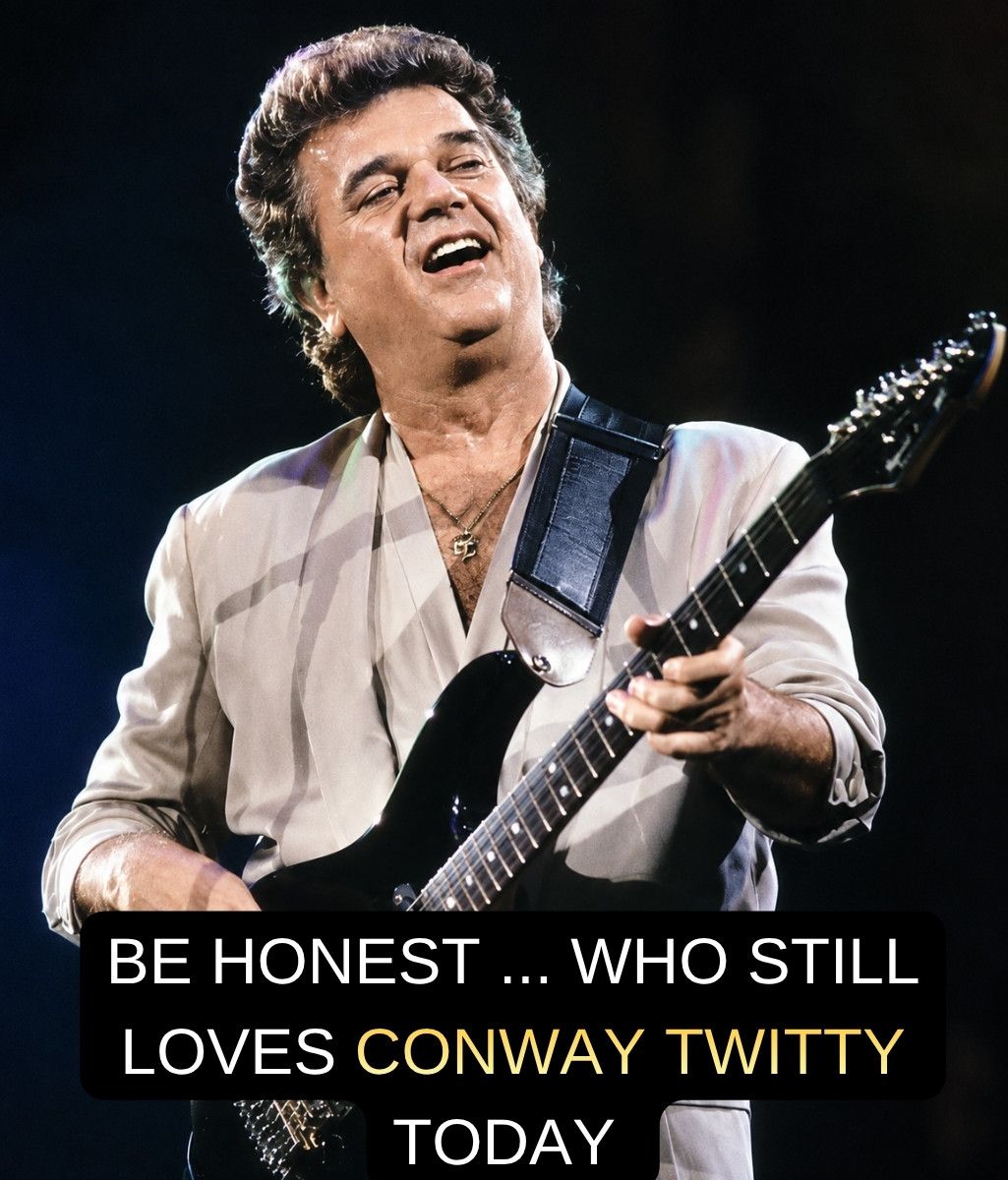
When Conway Twitty and songwriter L. E. White sat down to write “Hello Darlin'”, they weren’t trying to create one of country music’s greatest classics. They simply wanted to capture a painfully familiar moment—the unexpected encounter with someone you once loved, and the impossible task of pretending your heart has already moved on. More than five decades later, those two quiet words still carry the weight of a thousand unspoken emotions.
Some songs become hits because of a catchy melody.
Others become timeless because they tell the truth.
When Conway Twitty recorded “Hello Darlin'” in 1970, there were no grand production tricks or dramatic vocal flourishes designed to impress listeners. Instead, the song opened with something almost unbelievably simple.
“Hello darlin’.”
Two ordinary words.
Yet in Conway Twitty’s unmistakable voice, they became one of the most unforgettable openings in country music history.
The story behind the song is just as remarkable as the recording itself. When Conway Twitty and his longtime collaborator L. E. White began writing, they weren’t chasing chart success or trying to reinvent country music. Their goal was far more personal. They imagined a moment nearly everyone has experienced—or feared experiencing.
You walk into a room.
Across the crowd stands someone you once loved more than anything.
Time has passed. Lives have changed. The relationship is over.
But in that single instant, every memory comes rushing back.
What do you say?
The answer was astonishingly simple.
“Hello darlin’.”
That quiet greeting became the emotional doorway into a story of regret, longing, and love that never completely disappeared.
Perhaps the song’s greatest stroke of genius was Conway Twitty’s spoken introduction. Rather than launching immediately into the melody, he chose to speak the opening words almost as if he were standing face-to-face with the woman who had changed his life. There was no theatrical delivery, no exaggerated emotion. It sounded less like a performance than a private confession that listeners had somehow been invited to overhear.
That authenticity made all the difference.
People didn’t simply listen to “Hello Darlin'”.
They remembered someone.
For some, it was a high school sweetheart they never forgot. For others, it was a marriage that quietly slipped away or a relationship that ended with too many words left unsaid. Every listener seemed to bring their own story into the song, and somehow Conway Twitty made each one feel deeply personal.
The recording quickly became one of the defining moments of his extraordinary career. “Hello Darlin'” reached No. 1 on the country charts and went on to become his signature song, one that audiences eagerly waited to hear at every concert. Night after night, thousands of fans would cheer before he had even finished speaking those famous opening words.
Yet popularity alone does not explain why the song still resonates more than half a century later.
Many chart-topping hits belong to a particular era.
“Hello Darlin'” belongs to human nature.
Its power lies in what it leaves unsaid. There are no dramatic confrontations, no elaborate storylines, no attempts to force emotion. Instead, it captures one brief encounter that reveals everything. The listener fills in the missing chapters from their own life, making the song feel new every time it is heard.
That is the hallmark of truly great songwriting.
Conway Twitty possessed a rare gift for turning ordinary moments into unforgettable music. Whether singing about enduring love, heartbreak, or second chances, he understood that the smallest details often carry the deepest emotions. With “Hello Darlin'”, he proved that sometimes the most powerful stories begin not with a grand declaration, but with two words spoken almost in a whisper.
Looking back today, it is remarkable that a song born from such a modest idea continues to touch generation after generation. Young listeners discover it for the first time, while longtime fans hear echoes of their own past every time the opening greeting returns. The emotions remain as real today as they were in 1970 because love, regret, hope, and memory never go out of style.
Perhaps that is the true legacy of “Hello Darlin'”.
A hit may dominate the charts for a season.
A masterpiece continues speaking to hearts long after the applause has faded.
More than fifty years later, Conway Twitty still greets listeners with those same two quiet words, and somehow they never lose their power. They remind us that the greatest songs are not remembered because they were loud or spectacular. They are remembered because they told the truth—and in doing so, they became part of our own stories forever.